5 Key Takeaways
- Stacking the deck for a top performer is a symptom, not a strategy. It usually means the roles are wrong or there is an enablement gap.
- Territory quality should follow role requirements and comparable market conditions, not a private decision to give a favored performer the easiest path to quota.
- Compare like roles, publish the role definition and Balance Goals (measurable objectives for territory health), separate account facts from performance history, identify enablement gaps, and require an explicit exception rationale for any deliberately stronger book.
- Top performers may deserve complex or strategic work, but that is different from silently removing opportunity from peers; role differentiation is defensible when responsibility, support, quota, and account logic move together.
- Stacking the deck fails because it hides a role, enablement, or talent problem inside account allocation and then treats the resulting attainment gap as proof the original favorite deserved more.
Your territory shapes your accounts, workload, pipeline, customer relationships, quota, earnings, and opportunity to advance. Stacking the deck for a top performer is a symptom, not a strategy. It usually means the roles are wrong or there is an enablement gap. This guide shows what you should check, what evidence to request, and which questions to bring to your manager. You can use them without becoming the territory designer yourself.
BoogieBoard treats role-based access to high-quality territories as part of a governed change process. The model must connect market strategy with account-level evidence, productive capacity, explicit decision rights, and controlled activation. The objective is not to remove judgment. It is to make judgment visible and repeatable.
The central position is: Stacking the deck for a top performer is a symptom, not a strategy. The sections below turn that position into definitions, alternatives, procedures, examples, controls, and an operating decision.
Working Definitions
- Territory Equity: a defensible distribution of opportunity, workload, and obligations across comparable roles.
- stacking the deck: deliberately giving a favored seller a stronger book instead of solving the underlying role or enablement problem.
- Balance Goal: a measurable objective for healthy opportunity, quality, workload, or continuity.
- role definition: the published responsibilities, authority, handoffs, and success measures for a coverage role.
- Book of Business: the accounts, customers, and responsibilities assigned to a role.
BoogieBoard's customer-coverage doctrine also reflects interviews with more than 50 Sales and Operations leaders responsible for customer and account-management motions. It is practitioner evidence, not a controlled prevalence study. For role-based access to high-quality territories, use that observation only for the claim and population it directly supports.
Independent evidence provides a separate check for role-based access to high-quality territories: SMU research on seller reactions to territory design examines the parameters that shape perceptions of fairness and workload.
Common Models and Variations: Role-Based Access To High-Quality Territories
Top performers may deserve complex or strategic work, but that is different from silently removing opportunity from peers; role differentiation is defensible when responsibility, support, quota, and account logic move together. No model removes judgment. Geographic, named-account, segment, industry, customer, and hybrid structures each solve a different constraint. Use the fewest logical layers that express the strategy, then state where a deliberate override is allowed. Complexity should correspond to a real customer or operating need, not inherited convention. In role-based access to high-quality territories, test the choice against stacking the deck, then record any accepted exception in the decision log. You should be able to trace the result from your account roster to the published rule.
The model in this subsection is useful only when its organizing rule matches the selling motion. Compare options by opportunity, workload, continuity, explainability, and maintenance burden. A structure that looks simple at launch can create expensive exceptions when accounts change segment, sellers leave, or related companies need coordinated coverage. The role-based access to high-quality territories review is complete only when Balance Goal and the affected account roster tell the same story. If your territory is an outlier, ask whether the difference is intentional, temporary, or a data error.
Alternative Structures: Role-Based Access To High-Quality Territories
Territory quality should follow role requirements and comparable market conditions, not a private decision to give a favored performer the easiest path to quota. The model in this subsection is useful only when its organizing rule matches the selling motion. Compare options by opportunity, workload, continuity, explainability, and maintenance burden. A structure that looks simple at launch can create expensive exceptions when accounts change segment, sellers leave, or related companies need coordinated coverage. The role-based access to high-quality territories review is complete only when Balance Goal and the affected account roster tell the same story. If your territory is an outlier, ask whether the difference is intentional, temporary, or a data error.
No model removes judgment. Geographic, named-account, segment, industry, customer, and hybrid structures each solve a different constraint. Use the fewest logical layers that express the strategy, then state where a deliberate override is allowed. Complexity should correspond to a real customer or operating need, not inherited convention. Use one current-state baseline to keep every role-based access to high-quality territories scenario comparable. Your manager should be able to explain the tradeoff without relying on a private spreadsheet.
Source-System Responsibility
Stacking the deck fails because it hides a role, enablement, or talent problem inside account allocation and then treats the resulting attainment gap as proof the original favorite deserved more. Evaluate the operating burden as carefully as the feature list. Ask who maintains the data and logic, how managers review changes, what sellers receive, and how a correction reaches the live system. The system should make tradeoffs easier to inspect without pretending software can make the business judgment. Use one current-state baseline to keep every role-based access to high-quality territories scenario comparable. Your manager should be able to explain the tradeoff without relying on a private spreadsheet.
The Decision Rule
For The Decision Rule, make the implicit policy inspectable at account level. Use Book of Business to test whether the customer obligation, accountable role, future book, and handoff remain clear; keep the account-level evidence visible. You should be able to see how the rule changes your accounts, role, workload, or customer responsibility.
The Evidence Standard
For The Evidence Standard, make the implicit policy inspectable at account level. Use Territory Equity to test whether the customer obligation, accountable role, future book, and handoff remain clear; keep the account-level evidence visible. You should be able to see how the rule changes your accounts, role, workload, or customer responsibility.
The Population Test
For The Population Test, make the implicit policy inspectable at account level. Use stacking the deck to test whether the customer obligation, accountable role, future book, and handoff remain clear; keep the account-level evidence visible. You should be able to see how the rule changes your accounts, role, workload, or customer responsibility.
The Account-Level Test
For The Account-Level Test, make the implicit policy inspectable at account level. Use Balance Goal to test whether the customer obligation, accountable role, future book, and handoff remain clear; keep the account-level evidence visible. You should be able to see how the rule changes your accounts, role, workload, or customer responsibility.
See Role Assignments in the Planning Workflow
The relevant product workflow is Map BDRs to AE Territories. BoogieBoard Scenario Planning keeps the account-level assumptions, tradeoffs, and proposed assignments visible while the team completes that work.
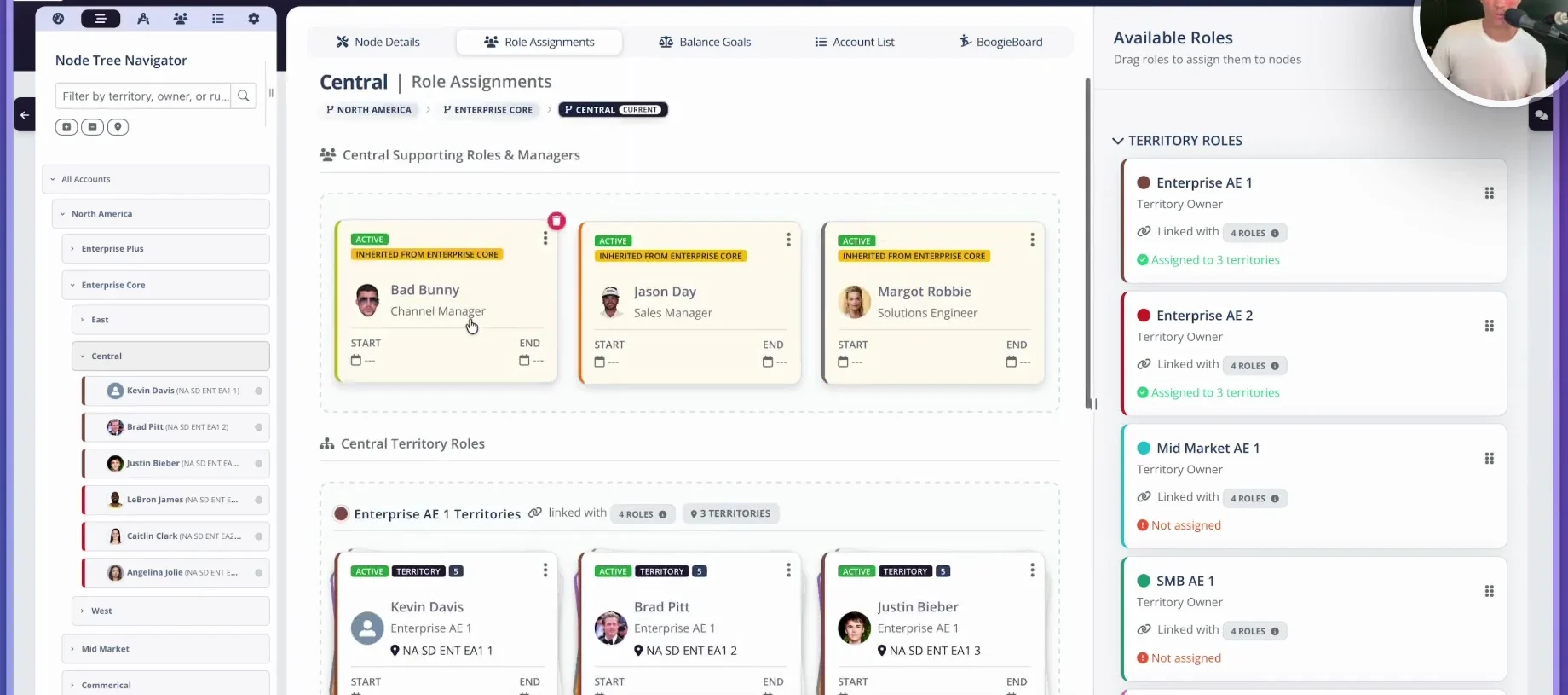
Role Assignments show territory owners, supporting roles, and available roles in the same operating model.
The Role Test
For The Role Test, make the implicit policy inspectable at account level. Use role definition to test whether the customer obligation, accountable role, future book, and handoff remain clear; keep the account-level evidence visible. You should be able to see how the rule changes your accounts, role, workload, or customer responsibility.
Advanced Considerations: Role-Based Access To High-Quality Territories
A practical test is to pick one surprising account and trace it end to end. Explain why it is in the segment, why it belongs in the territory, whether it is locked, which goals it affects, and what happens when the seller changes. If the answer requires several private spreadsheets, the model is not yet governed. In role-based access to high-quality territories, test the choice against stacking the deck, then record any accepted exception in the decision log. You should be able to trace the result from your account roster to the published rule.
Use this module to make the hidden decision explicit. State the role, population, evidence, rule, exception path, and operating consequence. The objective is not a perfectly clean model; it is a model whose compromises are visible enough to approve, communicate, and improve. The role-based access to high-quality territories review is complete only when Balance Goal and the affected account roster tell the same story. If your territory is an outlier, ask whether the difference is intentional, temporary, or a data error.
The Coverage Objective
Compare like roles, publish the role definition and Balance Goals, separate account facts from performance history, identify enablement gaps, and require an explicit exception rationale for any deliberately stronger book. The strategic question is what the company believes creates a healthy path to market. Translate that belief into measurable Balance Goals, then test it through scenarios. The model is a hypothesis: it should be specific enough to guide a decision and humble enough to be revised when evidence changes. The role-based access to high-quality territories review is complete only when Balance Goal and the affected account roster tell the same story. If your territory is an outlier, ask whether the difference is intentional, temporary, or a data error.
The Continuity Test
For The Continuity Test, make the implicit policy inspectable at account level. Use stacking the deck to test whether the customer obligation, accountable role, future book, and handoff remain clear; keep the account-level evidence visible. You should be able to see how the rule changes your accounts, role, workload, or customer responsibility.
The Approval Test
For The Approval Test, make the implicit policy inspectable at account level. Use Balance Goal to test whether the customer obligation, accountable role, future book, and handoff remain clear; keep the account-level evidence visible. You should be able to see how the rule changes your accounts, role, workload, or customer responsibility.
The Activation Test
For The Activation Test, make the implicit policy inspectable at account level. Use role definition to test whether the customer obligation, accountable role, future book, and handoff remain clear; keep the account-level evidence visible. You should be able to see how the rule changes your accounts, role, workload, or customer responsibility.
Practical Implications
Giving the top AE every strategic logo may improve one forecast while making peer results uninterpretable; a specialist overlay or clearer role can preserve expertise without transferring the entire opportunity base.
Decision Worksheet
| Decision | Evidence to inspect | Control |
|---|---|---|
| Define responsibility | Territory Equity and comparable customer roles | Accountable and collaborating roles |
| Measure the book | stacking the deck and Balance Goal | Source date and customer roster |
| Protect obligations | Renewals, health, relationships, and active work | Movement and handoff rule |
| Approve the future book | Workload, potential, continuity, and role capacity | Decision owner and effective date |
What This Means for You
You do not need to rebuild the model to evaluate role-based access to high-quality territories. Check whether your accounts match the published population, whether your workload and opportunity are measured with understandable inputs, whether locked accounts remain in the final comparison, and whether your quota reflects material territory differences. Bring account IDs and evidence when you find an error.
Questions to Ask Your Manager
- Which role is accountable for each customer and which roles collaborate?
- Which renewal, health, workload, and potential measures shaped my book?
- Which customer obligations were protected and why?
- What changes for the customer, and how will the handoff be communicated?
- How does my workload and quota reflect the customer work in this book?
- Where do I submit a data correction, policy question, or exception request?
Accountable Role Definition
Name the role accountable for the customer outcome and distinguish it from specialists, executives, service teams, and opportunity collaborators. For role-based access to high-quality territories, use Territory Equity to record the evidence, decision owner, affected account population, and condition that closes this review.
Frequently Asked Questions
Should top reps get better territories?
Territory quality should follow role requirements and comparable market conditions, not a private decision to give a favored performer the easiest path to quota. Top performers may deserve complex or strategic work, but that is different from silently removing opportunity from peers; role differentiation is defensible when responsibility, support, quota, and account logic move together. Use the published definitions and complete-territory result instead of relying on one universal benchmark. Ask your manager to show how that standard applies to your book.
How do you handle a rep who always gets the best accounts?
Compare like roles, publish the role definition and Balance Goals, separate account facts from performance history, identify enablement gaps, and require an explicit exception rationale for any deliberately stronger book. Giving the top AE every strategic logo may improve one forecast while making peer results uninterpretable; a specialist overlay or clearer role can preserve expertise without transferring the entire opportunity base. Publish the assumptions so another reviewer can reproduce the answer. You should be able to reproduce the answer from your roster and the stated inputs.
What customer data is required for role-based access to high-quality territories?
For role-based access to high-quality territories, assemble governed account data, current assignments, role capacity, and decision evidence for Territory Equity, stacking the deck, and Balance Goal. Date the sources and publish the definitions so another reviewer can reproduce the result and separate a factual correction from a policy exception. Request the source date when the underlying account facts look stale.
How often should role-based access to high-quality territories be reviewed?
Review role-based access to high-quality territories on the formal planning cadence and whenever the inputs behind Territory Equity, stacking the deck, and Balance Goal change materially. Keep customer and pipeline ownership stable between reviews; reopen the model when strategy or new evidence changes the decision, not merely because a manager prefers a different assignment. Ask when your territory will next receive a formal review.
Which customer accounts should be protected from movement?
Customer ownership under role-based access to high-quality territories should be protected only when renewal timing, health risk, implementation work, executive relationships, or active commitments make movement unusually costly. Apply the published lock rule after goals are defined and keep every protected account in the final territory-health result. Check that your locked accounts remain in the final health calculation.
How should customer handoffs be managed?
For role-based access to high-quality territories, each customer handoff needs named current and future owners, transferred commitments and relationship context, a communication plan, an effective date, and follow-up on renewal health and unresolved work. Temporary coverage should expire rather than becoming an undocumented permanent assignment. You need a system when manual reconciliation makes the rule impossible to inspect.
About the author: George James is Co-Founder & CPO of BoogieBoard.
In Summary
Stacking the deck for a top performer is a symptom, not a strategy. It usually means the roles are wrong or there is an enablement gap. Use the sequence above to keep the decision governed, evidence-based, and inspectable at both the account and territory levels.
See Territory Planning in Practice
Watch practical territory-design workflows on the BoogieBoard YouTube channel.