
5 Key Takeaways
- Start by defining and communicating clear territory design principles: business alignment, territory equity, disruption control, and operating rules. Sellers need to understand the why before the what.
- Execute a three-phase rollout: Preparation (baseline understanding, audience segmentation, manager training, and territory views), Announcement (leadership briefing, team meeting, policies, and one-on-ones), and Reinforcement (office hours, feedback channels, measurement, and onboarding).
- Prioritize manager enablement with deep-dive training, a manager-only FAQ, conversation guidance, territory-level context, and a clear escalation path because managers are the primary channel for individual questions.
- Use transparent, direct, jargon-free messaging and practical tools such as rep territory views, Scenario comparisons, CRM assignments, and dashboards to make the impact tangible and data-driven.
- Measure and iterate by tracking data corrections, policy questions, exception requests, manager feedback, and seller understanding, then update the Rules of Engagement and onboarding materials for consistency.
How do you announce a fundamental change to where sellers focus without creating confusion and distrust? A new territory plan changes account access, customer relationships, pipeline ownership, reporting, and each seller's perception of opportunity. Get it wrong, and every assignment can become a negotiation.
Get it right, and sellers can see where to focus, why the model changed, and what they should do next.
A sound design is not enough. The company must explain the logic, show each seller the practical impact, and make the systems match the message. This guide shows how to prepare, announce, and reinforce a new territory plan.
The Foundation: Building a Transparent Territory Design Philosophy
You cannot communicate territories clearly if the work behind them is sloppy. Before you explain a new territory plan, make the design principles explicit: why the company allocates accounts, markets, and seller capacity the way it does, and how those principles shaped the final model.
A transparent territory design philosophy has four pillars:
- Business Alignment: How the territory model reflects the company's market, product, ICP, segment, capacity, and customer-coverage strategy.
- Territory Equity: How the company defines a healthy territory and which Balance Goals it uses to evaluate opportunity, workload, and viability. Learn more about territory equity.
- Disruption Control: How account locks, opportunity holdovers, customer continuity, and approved exceptions limit unnecessary movement.
- Operating Rules: How ownership, decision rights, effective dates, issue types, and escalation paths are documented in the Rules of Engagement. See the Rules of Engagement guide.
What the philosophy should explain: How role and capacity, Ideal Customer Profile, account hierarchy, market potential, customer relationships, geography, data quality, and strategic priorities contributed to the final territory model.
Explain these principles before showing the account list. Sellers can then evaluate the new structure against a visible method instead of filling gaps in the story with politics.
Territory-specific research reinforces this point. Two studies found that managerial actions during implementation can influence seller motivation and performance, with justice-based actions especially important when a seller's territory potential decreases. Read Managing Salesperson Motivation in a Territory Realignment.
Crafting Your Communication Strategy: A Step-by-Step Plan
A successful rollout requires careful planning across three distinct phases: preparation, announcement, and reinforcement. Rushing any stage can undermine the initiative.
Phase 1: Preparation - Before the Announcement
This is the most critical phase. The work completed here determines whether managers and sellers receive stable answers or another working draft.
- Gauge Current Understanding: Survey managers and a representative group of sellers. Do they understand Territory Logic, Balance Goals, account locks, holdovers, and the difference between a data issue and an exception? Use the baseline to tailor the explanation.
- Define Key Messages and Segment Audiences: Keep the central story consistent while tailoring the depth. Executives need the strategic rationale and approved tradeoffs. Managers need the mechanics and individual impact. Sellers need the why, what changes for them, effective dates, and support path.
- Appoint Your Communicators: Decide who owns the company announcement, manager training, one-on-one conversations, policy decisions, data corrections, and exception reviews. Managers are the critical channel for personal questions, but they should not be forced to invent policy.
- Prepare Your Toolkit: Complete the materials and operating outputs before launch: a master FAQ, manager training and conversation guidance, individual territory views, approved policies, the final Scenario, CRM activation timing, and named support channels.
- Master FAQ: Answer why the model changed, who is affected, how individual assignments were built, how fairness was assessed, and how disputes are handled.
- Manager training and talking points: Give managers a deeper explanation of methodology, tradeoffs, policies, and difficult conversations.
- Individual territory views: Show each seller what changed, what stayed, what to prioritize, and the data behind the territory.
- Scenario and system readiness: Approve the final Scenario and coordinate CRM, routing, dashboards, reporting, and the source of truth.
Phase 2: The Announcement - Rolling Out the Plan
The goal during the announcement is to tell one consistent story, clearly and directly.
A typical rollout cadence might look like this:
| Timeline | Action | Channel | Key objective |
|---|---|---|---|
| Week 1 | Executive and senior leadership briefing | Leadership meeting | Align on the business reason, design logic, tradeoffs, and sponsorship. |
| Week 2 | Manager training session | Mandatory workshop | Equip managers with territory context, policies, tools, and escalation paths. |
| Week 3 | All-hands sales meeting | Town hall or webinar | Announce the change and explain the territory philosophy and high-level model. |
| Week 3 | Release of digital resources | CRM, ROE, and territory portal | Publish territory views, policies, FAQs, dates, and support channels. |
| Weeks 3-4 | One-on-one manager and rep meetings | In person or video call | Discuss individual impact using the rep's territory view. |
When communicating, do not begin with the account list. Explain what changed in the business, what work was completed, what the model means for sellers, and what happens next. Use plain language. Tell sellers when the new territories will appear in CRM, which system is authoritative, and where they should take data issues, policy questions, and exception requests. The Guide to Territory Management in Salesforce explains how live assignments and governance should work after launch.
Lead With the Truth, Always
Territory changes are personal because they affect customer relationships, pipeline, focus, and a seller's perceived chance of success. Acknowledge that directly. Do not claim every territory is equal. Explain the company's definition of equity, the Balance Goals it used, and where customer continuity or limited disruption outweighed a mathematically cleaner rebalance.
Phase 3: Post-Announcement - Reinforcement and Feedback
The conversation does not end after the announcement. Consistent follow-up is essential to embed the new model and correct legitimate issues.
- Open Feedback Channels: Create visible paths for data corrections, policy questions, and exception requests. Give each path an owner and response time.
- Host Office Hours: Schedule open sessions where RevOps, sales leadership, and systems owners can answer recurring questions.
- Monitor and Measure: Track issue volume, resolution time, recurring data defects, policy confusion, exception patterns, and manager feedback.
- Integrate Into the Sales Operating Rhythm: Add the territory philosophy, policies, and current model to onboarding, manager enablement, quarterly reviews, and the next planning cycle.
A quasi-experimental study also found that participatory change communication strengthened procedural-fairness perceptions more than programmatic communication, and those perceptions helped explain commitment to change. Read Top Management's Communication and Employees' Commitment to Change.
Separate Corrections, Questions, and Exceptions
One support queue should not treat every response as the same problem. A seller who finds a duplicate account is reporting a data defect. A manager asking how a holdover works needs policy clarification. A leader asking to preserve a strategic relationship is requesting an exception. Give each type a separate path, owner, response standard, and decision record.
| Issue type | Example | Owner | Required response |
|---|---|---|---|
| Data correction | Wrong segment, hierarchy, or customer status | Data or RevOps | Verify source, correct record, rerun affected logic |
| Policy question | Whether an opportunity qualifies for a holdover | Policy owner | Apply the published rule and cite it |
| Exception request | Keep an account despite the standard rule | Named approver | Record rationale, duration, and design impact |
This separation protects trust in two ways. Legitimate errors can be fixed quickly without reopening the whole model, while exceptions remain visible as business decisions instead of being disguised as corrections. Publish a service level for each path and report recurring causes after launch.
Measure Whether the Rollout Worked
Do not judge communication only by attendance or message delivery. Measure whether people can operate the new model. Useful indicators include the percentage of managers completing enablement, seller understanding of the design principles, issue volume by type, median resolution time, repeated questions, CRM assignment defects, and exception requests approved outside policy.
Review the measures at 48 hours, two weeks, and the end of the first operating period. Early review catches system and comprehension problems. Later review shows whether the territory plan has entered normal operating rhythms or remains dependent on the launch team.
Equipping Managers: Your Most Critical Communication Channel
Leadership sets the direction, but managers translate the territory plan into individual reality. Their ability to explain assignments, tradeoffs, policies, and next steps with confidence will make or break the rollout. An unprepared manager can erode trust quickly; an equipped manager can reinforce it.
Why Managers Are Key to Success
Sellers take personal questions to their direct manager first. If that manager appears uncertain, defensive, or surprised, the seller will assume the plan is unstable. When managers understand both the common design logic and the individual territory context, they can make the new model concrete without creating their own rules.
The Cost of Unprepared Managers
Underinvesting in manager preparation is a common mistake. A manager may give incorrect guidance about an account move, promise an exception they cannot approve, or explain fairness differently from another manager. Every conflicting answer weakens the source of truth and turns a governed rollout into local negotiation.
Essential Training and Tools for Managers
Your manager-enablement program should be practical. Provide:
- Deep-Dive Training: Go beyond the all-hands presentation. Let managers ask pointed questions about methodology, individual territory changes, holdovers, locks, exceptions, and system timing.
- A Detailed Manager-Only FAQ: Answer sensitive questions such as why an account moved, why another territory appears stronger, what the manager can decide, and when an issue must be escalated.
- Conversation Guidance and Talking Points: Give managers a consistent sequence for one-on-one conversations without asking them to read a script mechanically.
- A Clear Escalation Path: Define how managers route questions they cannot answer. It is better to name the owner and response time than to guess and reverse the answer later.
- Opening: The goal today is to walk through the new territory plan and what it means for you personally.
- Explaining the why: The company changed the model because our market and coverage strategy changed. Here is the problem the new design addresses.
- Presenting the territory: Here is what changed, what stayed, how the territory was built, and where we want you to focus.
- Handling questions: Let us identify whether this is a data issue, policy question, or exception request and route it through the published process.
For territory changes, BoogieBoard Scenario Planning can make these conversations concrete. The Scenario Results view lets managers inspect future-state assignments by rep across customer and prospect mix, prospect grade, quarterly ARR, account locks, and rep capacity before the plan is activated. Watch Manage Territory Scenarios in BoogieBoard to see the workflow.
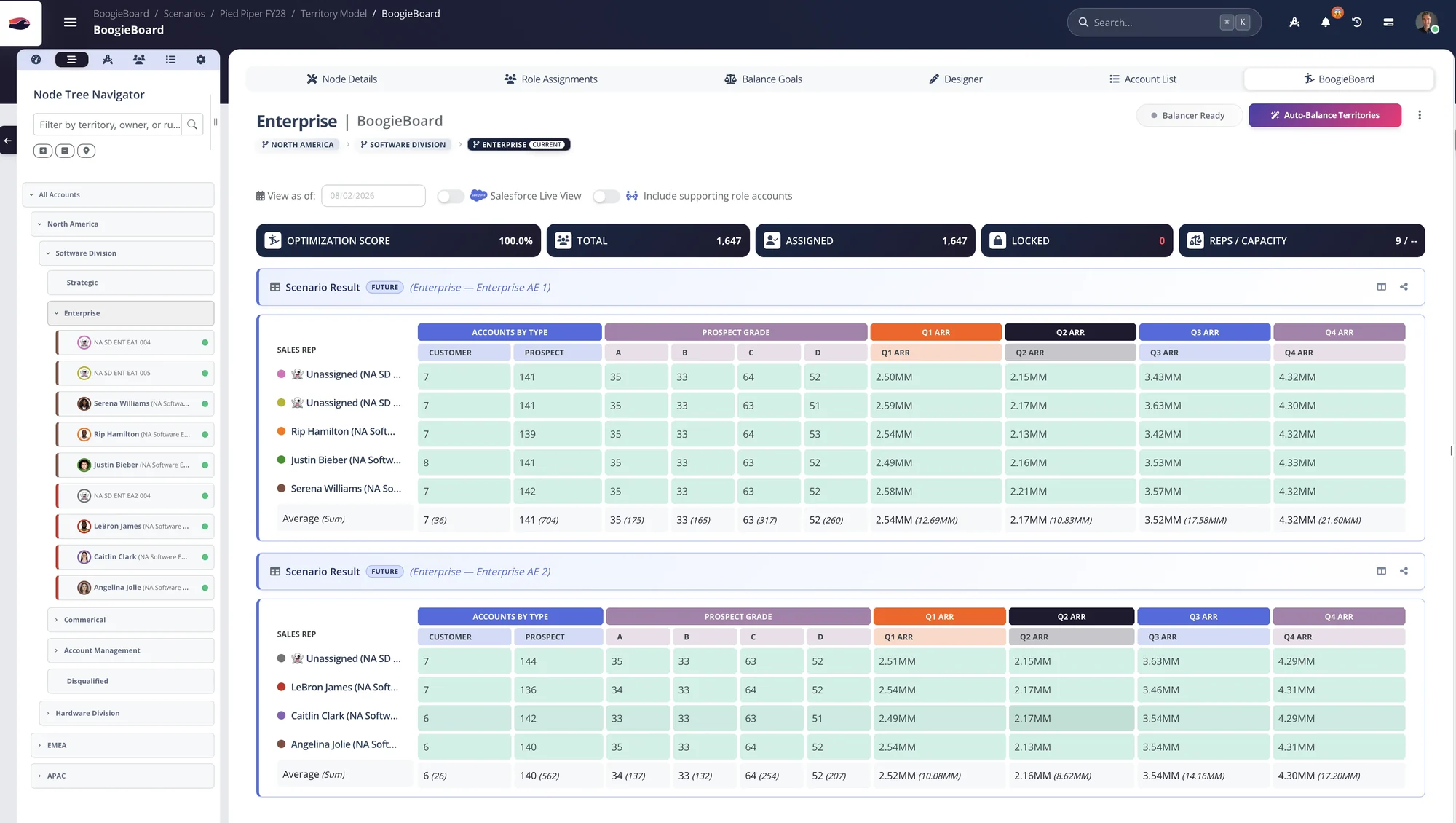
Scenario Results show customer and prospect mix, prospect grade, quarterly ARR, account locks, and rep capacity in one review surface.
A successful territory rollout is a change-management discipline. It requires a clear territory philosophy, a carefully sequenced communication strategy, and prepared managers who can translate the model into individual action. When the design logic, policies, support paths, and operating systems are ready, the company can turn a disruptive change into a credible direction for the sales team.
TERRITORY CHANGE COMMUNICATION TEMPLATE
Use the existing BoogieBoard template to turn the article's process into a company-specific announcement.
Frequently Asked Questions
Why is the territory plan changing?
Companies change territory plans when their market, product, ICP, capacity, customer coverage, or growth strategy makes the current model insufficient. The communication should state the specific business reason, connect it to the company's go-to-market direction, and explain the planning work completed in response. Avoid generic language about optimization. Sellers should understand the actual problem the company is solving.
Who is affected by these changes?
Specify exactly which teams, roles, segments, regions, overlays, or customer motions are affected. Also identify what is not changing. Managers, customer-facing partners, finance, and systems teams may need different levels of detail even when they do not own a territory. Clear audience boundaries prevent rumors and help each group focus on the decisions that apply to them.
How will my personal territory be impacted?
Deliver the individual answer privately through the seller's manager and a rep-level territory view. Show the before and after, meaningful account movements, effective date, applicable holdovers or locks, expected focus, and the path for questions. BoogieBoard automatically generates Account-Level and Summary views, while Scenario Planning keeps draft designs separate from the active model until the reviewed changes are ready for production.
How do you ensure the new territories are fair?
Territory fairness comes from a structured definition of equity. Explain which Balance Goals were used, what data informed them, how territory health was evaluated, and which tradeoffs were made to preserve customers or limit disruption. Do not promise identical territories. Show that the company applied a documented method consistently and provides a governed process for correcting data and reviewing exceptions. Read the RevOps Guide to Territory Equity.
BY KEVIN DAVIS Co-Founder & CEO
Summary
- Define the territory design principles before explaining the assignments.
- Prepare managers and systems before the sales-team announcement.
- Reinforce the change through governed feedback, measurement, and onboarding.
WATCH BOOGIEBOARD ON YOUTUBE
See practical territory-planning workflows, operator guidance, and product demonstrations on the BoogieBoard YouTube channel.
Look at Our Other Articles
- REVENUE OPS: RevOps Guide to Territory Equity - Define and measure healthy, equitable territories.
- SALES OPS: Rules of Engagement for Your Sales Organization - Document ownership, holdover, and exception policies.
- REVENUE OPS: Guide to Territory Management in Salesforce - Operationalize assignments, reporting, and governance.