
5 Key Takeaways
- An annual territory-planning cycle is the governed process for moving from strategy and current-state data to approved coverage at a defined go-live date.
- Start backward from go-live. BoogieBoard's observed cycles range from roughly one to six months depending on company size and complexity.
- The five essential stages are stakeholder preparation, Territory Health definition, timeline and design work, scenario approval, and controlled activation.
- Annual redesign, strategic restructuring, and in-year maintenance are different motions. Treating every account change as a redesign creates unnecessary disruption.
- The most common failure is starting late and compressing socialization. Communication is downstream of design, but it still needs protected time.
When should annual territory planning start? Most teams answer with a month: October, November, or December. The better answer is a calculation that starts at go-live and works backward through manager review, seller communication, CRM activation, scenario approval, data preparation, and stakeholder decisions.
BoogieBoard's observed planning-cycle ranges widen with organization size: roughly one to three months for teams with 25+ reps, two to four months at 100+, three to five months at 250+, and four to six months at 1,000+ reps. Those ranges are not targets. They show how much operating complexity the calendar must absorb.
Run the cycle backward. Otherwise the deadline stays fixed while review and communication are quietly removed.
What Is an Annual Territory-Planning Cycle?
An annual territory-planning cycle is the structured process used to define, design, approve, communicate, and activate the next coverage model. It connects company strategy to a durable hierarchy of territories, account assignments, role coverage, Balance Goals, Account Locks, and Rules of Engagement.
The cycle usually ends near the start of a fiscal year, but the work begins months earlier. Its purpose is not merely to redistribute accounts. It is to answer:
- What changed in the business?
- Which market and customer motions require coverage?
- What makes a territory viable and healthy?
- Which accounts should not move?
- Which future-state scenario best balances opportunity and disruption?
- Who approves the design and who activates it?
An effective cycle communicates priorities. The Balance Goals and Territory Logic tell the organization which outcomes matter and what tradeoffs leadership accepted.
Annual Redesign vs. In-Year Maintenance
Annual planning and ordinary territory management should not be confused.
| Criteria | Annual territory cycle | In-year maintenance |
|---|---|---|
| Purpose | Align coverage with next-period strategy | Preserve accountable coverage as conditions change |
| Typical triggers | New segments, capacity plan, market entry, major redesign | Rep departure, promotion, vacancy, account-status change |
| Scope | Whole model or major portion | Bounded accounts, roles, or territories |
| Governance | Cross-functional project and executive approval | Rules of Engagement and delegated approval |
| Communication | Coordinated rollout | Targeted change notice |
Major strategic restructuring may happen outside the annual cycle after an acquisition, product change, or market shock. That is still a project, not ordinary maintenance. Name the motion before choosing the process.
Why a Structured Annual Cycle Matters
- It aligns strategy and capacity. The model reflects the headcount, ramp, roles, and market the company intends to run.
- It makes equity measurable. Comparable territories are evaluated against a published Territory Health definition.
- It protects customer continuity. Account Locks and movement rules are set before optimization.
- It creates accountability. A Project Hub records decisions, owners, deadlines, and approvals.
- It preserves communication time. Managers and sellers receive a clear narrative rather than unexplained assignments.
The annual cycle is where the organization earns or loses confidence in the territory process.
Designing the Annual Territory Cycle: A 5-Step Guide
Step 1: Define Participants and Decision Rights
Identify the accountable leader, working team, approvers, reviewers, and informed audiences. Typical stakeholders include RevOps, Sales leadership, Finance, Marketing, Business Systems, and executive leadership.
Use a DACI or similar decision model. Sales should have real input because territory quality affects seller income and customer relationships. Sales should not operate an ungoverned side process. Letting Sales run everything and removing Sales entirely both fail.
Atlassian's published DACI decision framework is a useful independent reference for separating the Driver, Approver, Contributors, and Informed participants. The labels matter less than naming one accountable approver before scenario requests begin.
Step 2: Define Success Measures
Set the Territory Health definition before anyone sees assignments. Choose the few Balance Goals that represent the motion: account potential, customer ARR, prospect grade, renewal timing, hierarchy, workload, time zone, or another defensible attribute.
Expert Tip: Measure Decisions and Readiness
Do not measure the project's health by meetings held or spreadsheets produced. Measure whether required decisions are made, data is fit for the chosen logic, scenarios are reviewable, and activation criteria are satisfied.
Step 3: Establish the Timeline and Phase Gates
Each phase should have an exit condition:
| Phase | Threshold | Target | Maximum acceptable risk |
|---|---|---|---|
| Prepare | Decision owners named | Objectives and calendar approved | No unresolved go-live ownership |
| Data and definitions | Critical fields assessed | ICP, segments, hierarchy, and health approved | No silent assumption treated as fact |
| Design | Current state preserved | Viable scenarios compared | No direct editing of production assignments |
| Socialize | Managers trained | Feedback and exceptions resolved | No surprise rollout |
| Activate | Pre-flight approved | CRM and reporting validated | No unbounded write |
Step 4: Build, Compare, and Approve Scenarios
Start from a Current State Scenario. Apply the approved Territory Logic, locks, roster assumptions, and Balance Goals to several future states. Compare balance, disruption, vacancy coverage, customer continuity, and operational complexity.
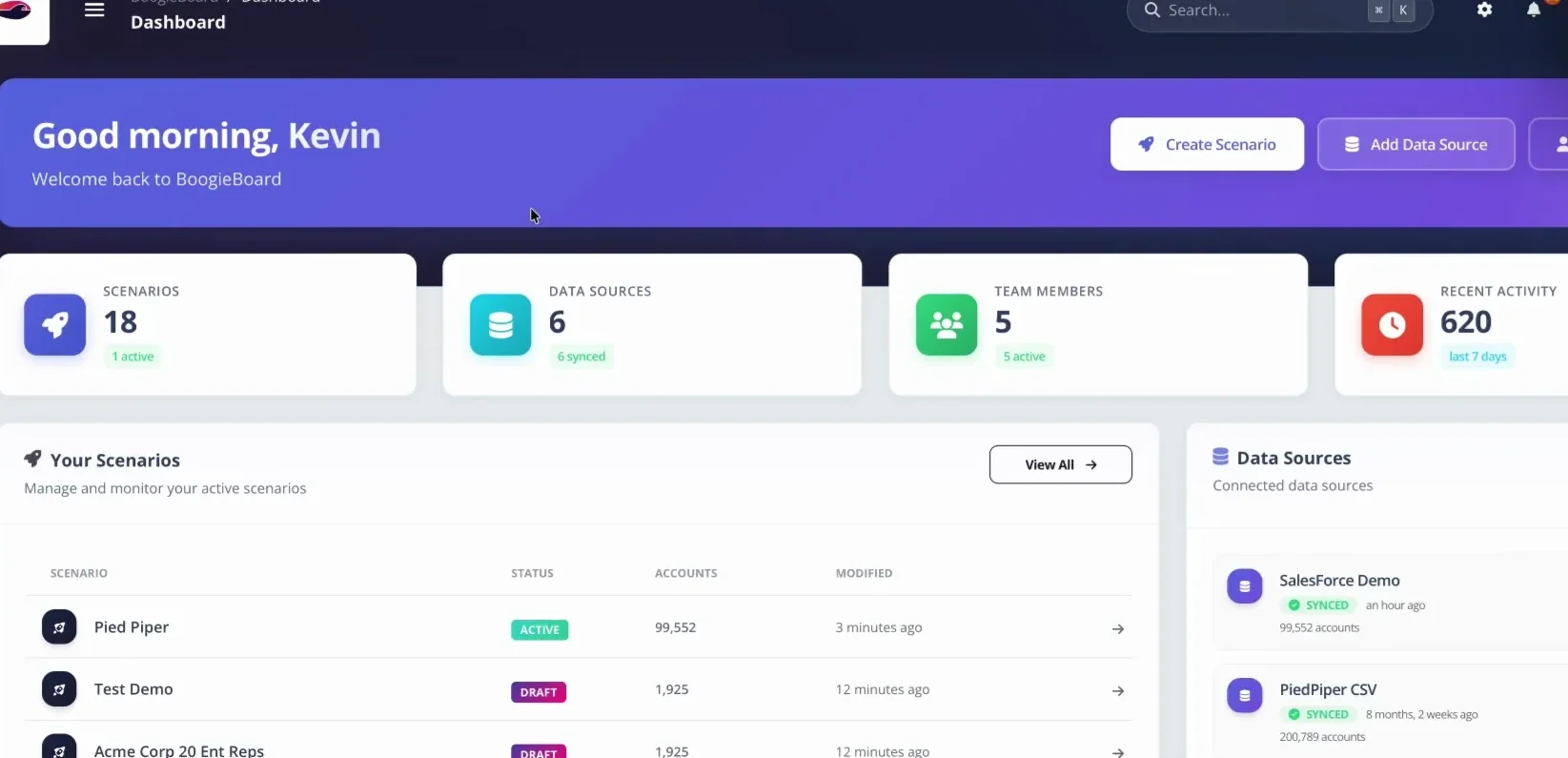
BoogieBoard keeps current and future territory scenarios separate so teams can model changes before activation.
BoogieBoard keeps scenarios separate from the active model and lets stakeholders review account-level and summary evidence. The approval is therefore a choice among visible tradeoffs, not a vote on one mysterious workbook.
Step 5: Finalize Activation and Communication
Prepare the pre-flight change set, validate Salesforce fields and role mappings, train managers, communicate the decision narrative, activate the approved model, and reconcile the result.
The rollout should explain what changed in the business, what work was completed, what the design means for each seller, and what happens next. Publish the escalation path for data defects and policy exceptions.
Worked Example: Planning Backward from January 1
Assume a 100-rep sales organization with a January 1 go-live and a three-month planning window.
| Timing | Work | Exit condition |
|---|---|---|
| October 1-15 | Objectives, stakeholders, capacity inputs, current-state reconciliation | Project charter and source data approved |
| October 16-31 | ICP, segment, hierarchy, Balance Goals, locks, Territory Logic | Design policy approved |
| November 1-20 | Build and compare scenarios | Preferred scenario selected |
| November 21-December 5 | Leadership review and governed exceptions | Final design approved |
| December 6-15 | Manager enablement and seller communication preparation | Managers ready to explain the model |
| December 16-22 | Pre-flight, Salesforce preparation, reporting validation | Activation authorization |
| January 1 | Activate and reconcile | Live assignments match approval |
The weighting is intentional: defining and reviewing the design receives more time than the CRM write. If data work runs late, do not automatically steal time from socialization. Adjust scope, staffing, or go-live with the consequences visible.
Watershed shows that a fast cycle can still produce confidence. The company completed territories in three weeks and described equity as the "shining light" because reps could see they had a credible chance to hit quota (Watershed customer proof). Speed was valuable because the decisions and standard were clear.
Annual Planning in Practice: Three Operating Motions
| Motion | Time horizon | Primary job | Typical output |
|---|---|---|---|
| Annual cycle | Next fiscal period | Align complete coverage model | Approved future-state territories |
| Strategic redesign | Event-driven | Respond to material business change | Revised hierarchy or segment model |
| Continuous maintenance | Ongoing | Keep coverage accountable | Bounded role or account changes |
Avoiding Common Planning-Cycle Pitfalls
- Starting too late: strategy and capacity decisions are still unsettled when account design begins.
- Unclear Territory Health: stakeholders argue from different definitions of fairness.
- Stale current state: late pipeline, customer, and roster changes never reach the model.
- Compressed socialization: managers first see the design when sellers do.
Warning: The Danger of Spreadsheet Coordination
The annual cycle produces more than calculations. It requires scenarios, comments, locks, approvals, account-level review, and controlled activation. A spreadsheet can calculate, but it becomes fragile when it must also serve as the Project Hub, policy record, collaboration layer, and deployment authority.
A 12-Week Territory-Planning Calendar
The exact duration depends on scale and change, but a backward plan protects the jobs that compressed cycles usually sacrifice.
| Weeks | Primary work | Exit condition |
|---|---|---|
| 12-11 | Objectives, scope, decision rights, timeline | Approver, Driver, goals, and in-scope decisions confirmed |
| 10-9 | Current-state reconstruction and data profiling | Account, roster, hierarchy, customer, and pipeline defects quantified |
| 8 | ICP, segment, and capacity assumptions | Market and role assumptions approved |
| 7 | Balance Goals and Account Locking Criteria | Measures, variance, sources, and continuity rules locked |
| 6-5 | Territory Logic and initial Scenarios | Reviewable alternatives with account-level outputs |
| 4 | Leadership and manager review | Tradeoffs, exceptions, and selected Scenario documented |
| 3 | Systems mapping and pre-flight | Exact CRM changes, permissions, and failure paths validated |
| 2 | Manager enablement and seller materials | Territory views, FAQ, ROE, and escalation paths complete |
| 1 | Final reconciliation and activation approval | Live state reconciled; go/no-go decision recorded |
| Go-live | Controlled deployment and communication | Approved values active and seller access verified |
Do not interpret this calendar as a reason to wait until week twelve to begin data work. Continuous account-data governance should reduce the planning-season burden. The calendar identifies the point at which planning decisions need reliable inputs.
Decision Gates and Required Evidence
Every phase should end with a decision, not merely a meeting.
Scope Gate
Leadership confirms what may change: hierarchy, segments, regions, account rules, roles, customer books, quotas, or only assignments. It also states what must remain stable and how much disruption is acceptable.
Data Gate
Operations reports missing and conflicting fields, hierarchy quality, duplicate exposure, roster readiness, and current-state reconciliation. The gate does not require perfect data. It requires knowing which defects can change the design and how they will be handled.
Design Gate
Approvers receive Scenario comparisons, account movement, Territory Health, locks, exceptions, vacant capacity, and account-level samples. The selected Scenario includes the rejected alternatives and rationale.
Activation Gate
Systems and Operations verify users, territories, fields, roles, permissions, effective dates, write scope, rollback, and reconciliation. Managers confirm they can explain the individual impact. Leadership records the go/no-go decision.
The Locking and Balance Sequence Inside the Cycle
The annual calendar should enforce one canonical sequence. Set the high-level structure, define Balance Goals, define Account Locking Criteria, apply qualifying locks, model the movable book, and evaluate the complete proposed territories.
This ordering matters because locks and goals answer different questions. Balance Goals define what healthy opportunity and workload look like. Locks protect assignments whose movement cost is unusually high. A lock may leave one territory outside the accepted range; the cycle should surface that residual rather than break the lock or hide the imbalance.
The First 30 Days After Go-Live
Planning is not complete when CRM writes finish. Use a stabilization period:
- Reconcile approved and live assignments immediately after deployment.
- Triage data corrections separately from policy questions and exception requests.
- Hold manager office hours and publish repeated answers.
- Track unassigned accounts, routing conflicts, access failures, and missing roles.
- Review customer handoffs, holdovers, and temporary coverage.
- Measure the complete Territory Health after corrections.
- Record lessons, unresolved assumptions, and next-review triggers.
Avoid redesigning the whole model around the first complaint. Fix objective defects quickly, apply published policy consistently, and collect patterns before changing the underlying design hypothesis.
Resource Planning for the Cycle
Territory planning competes with quarter-end, annual planning, compensation design, systems releases, and leadership travel. The project plan should reserve time by role instead of assuming stakeholders will join when asked.
RevOps needs sustained design and coordination capacity. Sales leaders need shorter but decision-heavy working sessions. Managers need territory-level review and enablement time. Finance must validate capacity and quota dependencies. Systems owners need time for field mapping, permissions, testing, deployment, and reconciliation. Customer teams need focused review of relationships whose movement cost is high.
Publish the required commitment with the calendar. If an approver misses a gate, use the escalation rule or move the launch date; do not ask the working team to absorb the delay through overnight modeling.
Control Scenario Volume
Every stakeholder request can create another Scenario. Establish entry criteria: the proposal must change a documented assumption, resolve a visible health issue, reduce disruption, or test a meaningful strategic alternative. Cosmetic variants and account-level favors should enter the exception process instead.
Use a consistent comparison sheet showing the same Balance Goals, movement, customer impact, capacity, quota implications, and high-risk accounts. Limit the final decision to a small number of genuinely different options. Preserving rejected Scenarios is valuable; producing endless versions is not.
Close the Cycle Formally
At the end of stabilization, publish the final model version, unresolved exceptions, data work carried forward, lessons, and next review dates. Confirm who owns continuous Territory Health, vacancies, account locks, and CRM drift. A formal close prevents the annual project team from remaining the default owner of every in-year question.
The closeout should also compare the original objective with the delivered model. Record which assumptions changed, which decisions arrived late, and which constraints created residual imbalance. That evidence improves the next calendar more than a generic retrospective about communication.
Frequently Asked Questions
When should annual territory planning start?
Work backward from go-live through activation, communication, approval, design, data, and stakeholder preparation. Observed cycles range from one to six months depending on scale.
How long does a territory-planning cycle take?
BoogieBoard's observed ranges are one to three months at 25+ reps, two to four at 100+, three to five at 250+, and four to six at 1,000+.
Who should participate in annual territory planning?
RevOps usually operates the process, with Sales leadership, Finance, Marketing, Business Systems, and executives contributing defined decisions and approvals.
Should every in-year territory change wait for annual planning?
No. Use Rules of Engagement for departures, promotions, vacancies, and account-status changes. Reserve full redesign for strategic changes that invalidate the current model.
About the author: George James is Co-Founder & CPO of BoogieBoard.
In summary: A strong annual cycle runs backward from go-live, protects definition and socialization time, compares scenarios, and separates redesign from ordinary maintenance.
Watch territory planning in action
See scenario, collaboration, and activation workflows on BoogieBoard's YouTube channel.
Customer proof: Watershed completed territories in three weeks while preserving a clear equity standard sellers could trust (see the customer story).