
5 Key Takeaways
- A Balance Goal is a measurable objective for what comparable territories should contain; together, the goals express the company's hypothesis about what drives success in a market.
- Choose goals after the high-level hierarchy and segment structure are set, and use only measures with a defensible business reason and a reliable data source.
- Define Account Locking Criteria after Balance Goals, apply qualifying locks, optimize the remaining movable book, and then evaluate the complete territories against Territory Health.
- Perfect balance is impossible and often undesirable. The purpose is to make priorities, acceptable variance, and tradeoffs explicit enough for leaders and sellers to inspect.
- Territory design becomes a learning system when teams compare Scenarios, publish the chosen logic, monitor outcomes, and revise weak hypotheses in the next planning cycle.
"Fair territory" is one of the most consequential undefined phrases in sales. Sellers use it to describe their chance to earn. Leaders use it to describe a distribution they can defend. Operations may use equal account counts because those are easy to calculate. Finance may focus on revenue potential. All four groups can believe they are discussing the same objective while measuring different things.
Balance Goals replace that ambiguity with a published design hypothesis. They do not guarantee identical outcomes or eliminate judgment. They define what the company will try to distribute, why those measures matter, how close the territories should be, and which tradeoffs leadership has accepted.
The framework comes from BoogieBoard's work and interviews with more than 300 companies. It also aligns with independent sales-management research: Piercy, Cravens, and Morgan found territory design to be an important influence on sales-organization effectiveness, directly and through salesforce behavior. Read the field investigation of sales territory design.
What Is a Balance Goal?
A Balance Goal is a measurable objective used to design and compare territories. It usually counts, sums, or distributes accounts with a specific characteristic. Examples include similar counts of high-fit prospects, comparable renewable ARR, an even distribution of near-term renewals, or a controlled concentration of strategic accounts.
Balance Goals are not generic performance metrics. Pipeline and attainment may help test a territory hypothesis later, but they are not necessarily attributes Operations can distribute during design. A usable goal needs:
- A business rationale: why this characteristic should influence seller or customer outcomes.
- A measurable attribute: the account-level field or derived value used in design.
- A population: the roles, segments, regions, or territory types to which the goal applies.
- A direction: equalize, minimize, maximize, cap, preserve, or distribute.
- An acceptable variance: the range leadership is willing to tolerate.
- A data source and owner: where the value comes from and who resolves quality issues.
Together, the selected goals define Territory Health, meaning the measured condition of a territory against the standards chosen for that role and market.
Core Components of a Balance-Goal System
Strategic Design Architecture
High-level structure comes first. Decide the broad hierarchy, regions, segments, coverage motions, and role types before optimizing individual books. A global enterprise model may require theaters and language coverage. A digital SMB model may not. Balance Goals work inside those strategic constraints; they should not silently decide the strategy.
Measurable Account Data
Every goal must connect to an account characteristic the team can measure with enough consistency to use. The source might be CRM data, billing, product usage, a corporate-linkage provider, first-party research, or a governed enrichment field.
Do not select a goal because the field is convenient. Do not select a goal whose data cannot be explained. A weak but visible signal can remain a diagnostic without becoming an optimization target.
Stakeholder Alignment
Operations owns the design process, but leadership must approve the business hypothesis. Sellers and frontline managers can identify missing variables and implausible outcomes. Finance and capacity planning clarify the relationship between potential, quota, and headcount. Systems owners confirm whether the required fields and rules can operate after launch.
Alignment does not mean consensus on every account. It means decision rights, evidence, and acceptable tradeoffs are explicit before account-level lobbying begins.
Why Traditional Territory Balancing Fails at Scale
The Equal-Count Trap
Two territories with 100 accounts can be completely different. One may contain many high-fit companies, active opportunities, and reachable buyers. The other may contain subsidiaries, stale records, weak-fit accounts, and a larger service burden. Equal count is a valid goal only when count corresponds to comparable work or opportunity.
The Single-Score Trap
A composite account score can hide the variables that matter. Summing fit, intent, size, and engagement into one number makes allocation easier while making the hypothesis harder to inspect. Deconstruct the score into the components that change seller action or territory health.
Spreadsheet and Version Failure
Manual designs often spread logic across formulas, tabs, exports, and manager copies. Each request creates another version. Leaders compare results that were produced from different assumptions. Even when the formulas are correct, the decision history is difficult to reconstruct.
Political Exceptions
Without published goals and lock criteria, a request from a senior stakeholder can outweigh the design standard. The problem is not that exceptions exist. Some are strategically necessary. The problem is that they arrive as private influence, carry no recorded cost, and make the final model impossible to explain consistently.
False Precision
A clean optimization score can imply certainty the inputs do not deserve. Balance Goals are hypotheses, not natural laws. Data can be stale and causal relationships uncertain. Report the assumptions and use performance to test them.
The Business Impact of Poor Territory Equity
Territory equity affects more than seller sentiment.
- Quota setting: materially different opportunity may require quota relativity or an explicit explanation of why quotas remain equal.
- Performance evaluation: leaders cannot easily separate seller execution from territory quality when starting conditions are invisible.
- Capacity planning: there is no standard unit for deciding how many viable territories the market supports.
- Seller retention: the territory shapes pipeline, income, recognition, and promotion opportunity in a variable-pay role.
- Customer continuity: poorly governed rebalancing can move relationships repeatedly in pursuit of a cleaner distribution.
The goal is not to promise fairness as a feeling. It is to make the company's allocation standard measurable and contestable.
The Balance Goals Bank
BoogieBoard's corpus contains roughly 35 named goals across 14 categories. The practical choice depends on the motion.
| Category | Example Balance Goals | When they matter |
|---|---|---|
| Account sizing and potential | employee bands, revenue bands, serviceable potential | Capacity and opportunity differ by company size |
| Industry and product | priority industries, product fit, use cases | Sellers or products require specialization |
| Persona and department | target persona present, department size | Buying-center access drives success |
| Technology | installed technology, integration compatibility | Product value depends on the stack |
| Intent and signals | recent research, engagement, buying events | Timing changes near-term focus |
| Strategic accounts | named targets, executive priorities | A limited set requires deliberate distribution |
| Revenue and customer | ARR, renewable ARR, margin | Customer and commercial exposure must be managed |
| Lifecycle and health | renewal timing, churn risk, implementation stage | Post-sale workload and continuity vary |
| Product usage and expansion | adoption, whitespace, product penetration | Customer growth potential differs |
| Geography and coverage | time zone, language, travel radius | Service constraints are physically meaningful |
| Account hierarchy | parent families, subsidiaries, buying centers | Coverage must coordinate related entities |
| Territory structure | account count, workload, role coverage | The book must remain executable |
Use the bank to generate candidates, not to optimize everything. Most models need a small defended set of primary goals and several diagnostics.
How to Build and Apply Balance Goals
1. Set the High-Level Structure
Define hierarchy, region, segment, territory type, and role architecture. State which decisions are already fixed and which remain open.
2. Translate Strategy Into Candidate Goals
Start with the market and role. Ask what makes an account valuable, difficult, time-sensitive, or strategically important. Convert each answer into a measurable account attribute.
3. Test the Data
Profile completeness, freshness, distribution, duplicates, hierarchy, and outliers. A goal based on a field populated for 40% of accounts is usually not ready to govern the model. Decide whether to improve the source, narrow the population, or keep the measure diagnostic.
4. Select Priorities and Acceptable Variance
Choose which goals matter most. Define the target and range. For example, leadership may seek comparable high-fit prospect counts within 10% while accepting wider total-account variation. Record weighting only when the weighting has a business rationale.
5. Define Account Locking Criteria
After the goals are known, define which assignments cannot enter the optimization pool because movement cost is unusually high. Common locks include live opportunities, imminent renewals, complex implementations, strategic relationships, and accounts moved recently.
The sequence is deliberate: Balance Goals define healthy opportunity and workload; Account Locking Criteria define continuity constraints. Apply the qualifying locks and remove those accounts from the movable book.
6. Model the Movable Book
Create Scenarios that distribute the remaining accounts against the goals. Compare several defensible choices rather than perfecting one design in isolation. Measure the cost in account movement and stakeholder impact.
BoogieBoard Scenario Planning lets teams define Balance Goals, apply locks, compare future assignments, and inspect account-level results before activation.
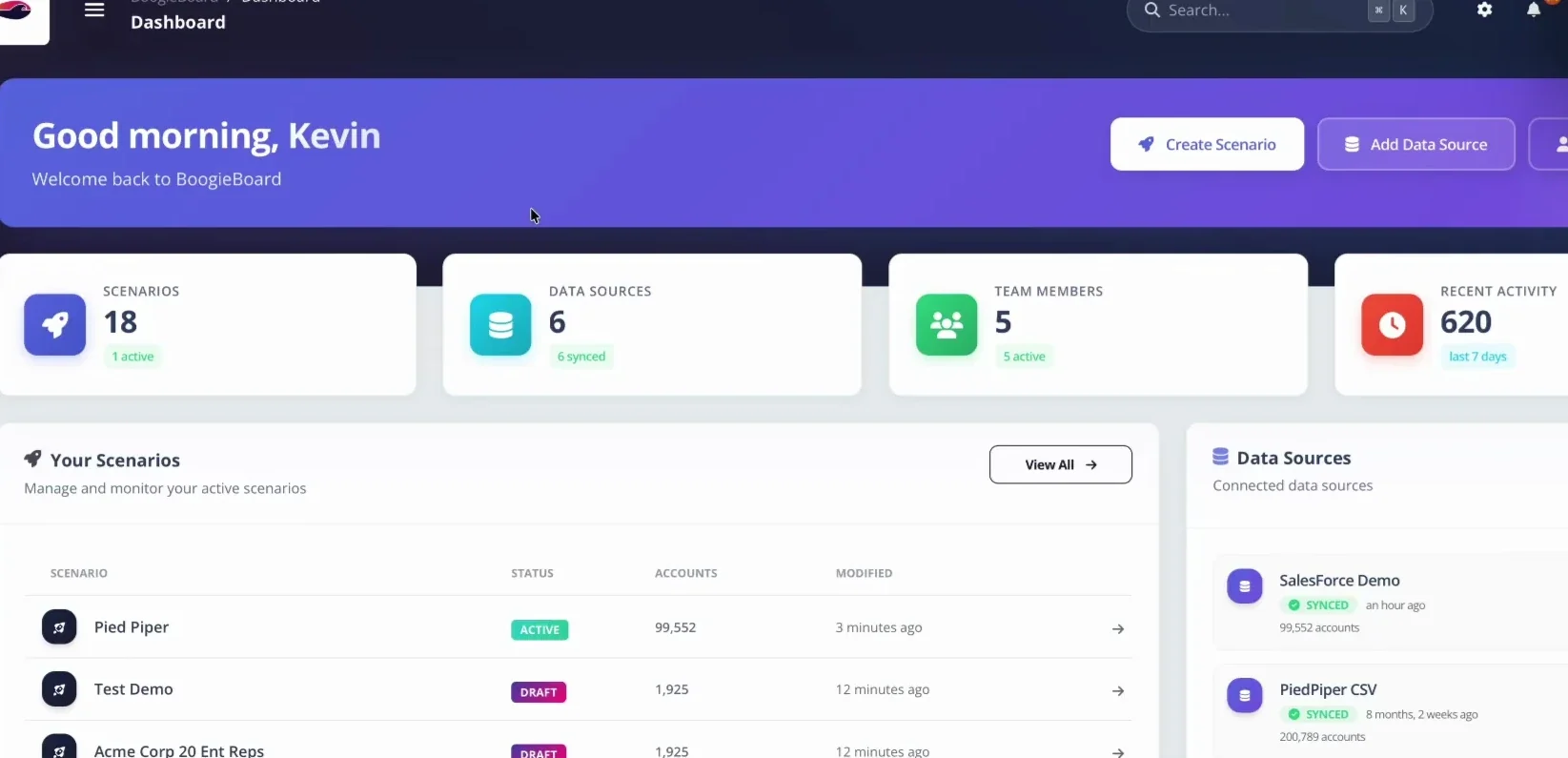
BoogieBoard keeps current and future territory scenarios separate so teams can model changes before activation.
7. Evaluate Complete Territory Health
Put the locked and newly allocated accounts back together and measure the complete proposed territories. A lock may make a Balance Goal impossible to achieve. Keep the qualifying lock, disclose the residual imbalance, and ask leaders whether to accept it, adjust capacity or quota, revise future lock criteria, or choose another Scenario.
Do not claim perfect balance after excluding the hardest accounts from the measurement.
8. Socialize, Approve, and Publish
Show summary results and high-risk account changes. Capture the rationale for the selected Scenario. Give managers territory-level context and publish the goals, definitions, effective dates, exception process, and source of truth to sellers.
9. Monitor and Learn
Track Territory Health, changes in input data, seller feedback, capacity events, and performance. Review whether the selected goals predicted useful outcomes. Revise the hypothesis between cycles rather than rewriting rules through in-year exceptions.
Choosing Good Goals: A Practical Test
For every candidate, ask:
- Does this measure reflect strategy or merely available data?
- Can we explain it to the roles affected?
- Is the source complete and current enough?
- Does it duplicate another goal?
- What undesirable behavior could optimizing it create?
- What variance is acceptable?
- How will we know whether the hypothesis worked?
If the answer to the last question is "attainment," add nuance. Attainment is affected by quota, execution, timing, and territory. Use a portfolio of outcome and leading measures, and resist declaring causality from one cycle.
Worked Example: From Strategy to Territory Health
Assume a software company is dividing 1,200 commercial prospects among eight AEs. Leadership believes success depends on fit, access to the buying department, and a small set of active timing signals. Operations proposes four primary goals: high-fit account count, accounts with the target department above a defined size, accounts showing a qualified signal in the last 90 days, and estimated workload.
The team first fixes the regional and segment structure. It then verifies that the fields are sufficiently complete, defines a target range for each goal, and publishes lock criteria for active late-stage opportunities and accounts moved in the prior quarter. Forty-six accounts qualify for locks and leave the movable pool.
Three Scenarios follow. Scenario A produces the lowest overall variance but moves many parent and child entities apart. Scenario B preserves families but concentrates timing signals. Scenario C accepts slightly wider high-fit variance, preserves hierarchy, and avoids the signal concentration. Leadership chooses Scenario C and records that customer and account-family coherence outweighed the cleanest optimization score.
After locked accounts return, one territory remains above the workload range. The team does not remove the locked opportunity or call the design perfectly balanced. It reports the residual, adjusts temporary support, and flags the book for a 60-day review. That is the framework working as intended: strategy, data, constraints, choices, and follow-up remain visible.
Governance Controls to Keep the Model Honest
- Version the goal definitions, sources, targets, and weights with each Scenario.
- Require an approver for changes to primary goals or acceptable variance.
- Preserve account-level exceptions with rationale and review date.
- Separate data corrections from policy exceptions.
- Compare proposed and current assignments before activation.
- Publish Territory Health using the complete book, not only movable accounts.
- Review whether outcomes support the hypothesis before carrying goals into the next cycle.
These controls prevent a familiar failure: changing the metric, weight, or exception rule until a preferred assignment appears objective. The purpose of measurement is to improve judgment and accountability, not to decorate a political decision.
Balance Goals transform territory planning from account shuffling into hypothesis testing. The company states what it believes creates a healthy patch, designs against that belief, makes constraints visible, and learns from the result. That is a much higher standard than equal counts, and a more honest standard than promising every seller an identical opportunity.
Frequently Asked Questions
How many Balance Goals should a territory model use?
Use the smallest set that captures the strategy and material workload. Three to seven primary goals is often more manageable than a large weighted model, but the right number depends on the motion and data. Keep secondary measures as diagnostics.
Are Balance Goals only about fairness?
No. They encode strategic hypotheses about market potential, specialization, timing, customer coverage, and workload. Equity is one important consequence of making those hypotheses explicit.
Should senior reps receive larger or stronger accounts?
Only through a defined role or strategy. If senior coverage has a different market, capacity, or responsibility, create a separate standard. Quietly stacking the deck makes performance and succession harder to evaluate.
How do locks interact with Balance Goals?
Define goals first, then lock qualifying accounts, optimize the movable book, and evaluate the complete territory. Locks are constraints. Goals are optimization objectives. Report any residual conflict.
How often should Balance Goals change?
Review them when strategy, product, market, role design, or evidence changes. Avoid changing goals simply to justify a preferred assignment. Use the planning cadence to evaluate whether the prior hypothesis worked.
See Balance in Practice
Watch territory scenarios and balance workflows on the BoogieBoard YouTube channel.
About the author: Kevin Davis is Co-Founder & CEO of BoogieBoard.
Related Content
- Designing Books of Business: Complete Guide
- How to Communicate a New Territory Plan Effectively
- Salesforce Territory Tracking: Complete 2026 Guide