5 Key Takeaways
- Territory quality is second only to unfair quota as a source of seller complaints, and reps who leave over it are behaving rationally.
- Territory inequity is a material, unexplained difference in opportunity, workload, quality, or continuity among comparable roles.
- Define comparable populations, publish Balance Goals and ranges, measure complete books, investigate outliers, and separate valid role differences from accidental or political variance.
- Correcting inequity can disrupt relationships and pipeline.
- Dismissing seller complaints as entitlement ignores that territory quality affects income, recognition, promotion, and retention.
Territory quality is second only to unfair quota as a source of seller complaints, and reps who leave over it are behaving rationally. That position is useful only when the planning team can translate it into inputs, decisions, controls, and a result the field can understand.
BoogieBoard treats territory inequity as part of a governed change process. The model must connect market strategy with account-level evidence, productive capacity, explicit decision rights, and controlled activation. The objective is not to remove judgment. It is to make judgment visible and repeatable.
The central position is: Reps are right to complain about bad territories. The sections below turn that position into definitions, alternatives, procedures, examples, controls, and an operating decision.
Working Definitions
- Territory Equity: a defined input used when evaluating territory inequity.
- Balance Attribute: an account characteristic used to measure or distribute a territory.
- Territory Health: the measured condition of a complete territory against its published goals.
- Rep View Report: a defined input used when evaluating territory inequity.
- disruption: a defined input used when evaluating territory inequity.
In BoogieBoard's observed planning data, the share of a book turned over ranges from 10% to 50% at 25-rep companies and from 20% to 75% at organizations with more than 1,000 reps. The range describes total disruption; no locked-versus-unlocked split is claimed. For territory inequity, use that observation only for the claim and population it directly supports.
Independent evidence provides a separate check for territory inequity: SMU research on seller reactions to territory design examines the parameters that shape perceptions of fairness and workload.
A Practical Decision Lens: Territory Inequity
Dismissing seller complaints as entitlement ignores that territory quality affects income, recognition, promotion, and retention. A practical test is to pick one surprising account and trace it end to end. Explain why it is in the segment, why it belongs in the territory, whether it is locked, which goals it affects, and what happens when the seller changes. If the answer requires several private spreadsheets, the model is not yet governed. In territory inequity, test the choice against Balance Attribute, then record any accepted exception in the decision log.
Use this module to make the hidden decision explicit. State the role, population, evidence, rule, exception path, and operating consequence. The objective is not a perfectly clean model; it is a model whose compromises are visible enough to approve, communicate, and improve. The territory inequity review is complete only when Territory Health and the affected account roster tell the same story.
Territory Equity: The Decision Test
Correcting inequity can disrupt relationships and pipeline. Compare the ongoing cost of the imbalance with the movement required to improve it. The model in this subsection is useful only when its organizing rule matches the selling motion. Compare options by opportunity, workload, continuity, explainability, and maintenance burden. A structure that looks simple at launch can create expensive exceptions when accounts change segment, sellers leave, or related companies need coordinated coverage. The territory inequity review is complete only when Territory Health and the affected account roster tell the same story.
Inputs and Assumptions: Territory Inequity
A practical test is to pick one surprising account and trace it end to end. Explain why it is in the segment, why it belongs in the territory, whether it is locked, which goals it affects, and what happens when the seller changes. If the answer requires several private spreadsheets, the model is not yet governed. Use one current-state baseline to keep every territory inequity scenario comparable.
Use this module to make the hidden decision explicit. State the role, population, evidence, rule, exception path, and operating consequence. The objective is not a perfectly clean model; it is a model whose compromises are visible enough to approve, communicate, and improve. For territory inequity, name the approver, the permitted evidence, and the condition that would justify a departure from the rule.
Territory Health: The Decision Test
Use this module to make the hidden decision explicit. State the role, population, evidence, rule, exception path, and operating consequence. The objective is not a perfectly clean model; it is a model whose compromises are visible enough to approve, communicate, and improve. For territory inequity, name the approver, the permitted evidence, and the condition that would justify a departure from the rule.
Rep View Report: The Decision Test
A practical test is to pick one surprising account and trace it end to end. Explain why it is in the segment, why it belongs in the territory, whether it is locked, which goals it affects, and what happens when the seller changes. If the answer requires several private spreadsheets, the model is not yet governed. Keep account-level results beside the territory inequity summary so Balance Attribute remains inspectable after approval.
disruption: The Decision Test
Use this module to make the hidden decision explicit. State the role, population, evidence, rule, exception path, and operating consequence. The objective is not a perfectly clean model; it is a model whose compromises are visible enough to approve, communicate, and improve. Give the territory inequity decision a source date, an owner, and a condition that would trigger revision.
Territory Equity: The Decision Test: Review 7
A second failure is letting exceptions define the model. Define Balance Goals first, then Account Locking Criteria. Apply qualifying locks, model the remaining book, and evaluate the complete result. If the constraints make a goal unattainable, disclose the residual imbalance instead of changing the rule in private. Before activating territory inequity, show managers the effect on Territory Health and every downstream rule that depends on it.
Decision Note: Territory Equity 2
Use this module to make the hidden decision explicit. State the role, population, evidence, rule, exception path, and operating consequence. The objective is not a perfectly clean model; it is a model whose compromises are visible enough to approve, communicate, and improve. For territory inequity, document the effect on Territory Equity before the model advances.
Why the Decision Matters: Territory Inequity
The business consequence is clearest when a company cannot separate execution from starting conditions. If opportunity and workload are invisible, attainment becomes an ambiguous signal. A measured territory does not explain every result, but it gives leadership a defensible denominator for capacity, quota, and performance conversations. In territory inequity, test the choice against Balance Attribute, then record any accepted exception in the decision log.
This decision affects more than visual symmetry. It changes market coverage, seller focus, quota credibility, customer continuity, performance interpretation, and the amount of manual administration required during the year. Poor design transfers work to managers and sellers, who then create informal rules to keep operating. The territory inequity review is complete only when Territory Health and the affected account roster tell the same story.
Balance Attribute: The Decision Test 2
Use this module to make the hidden decision explicit. State the role, population, evidence, rule, exception path, and operating consequence. The objective is not a perfectly clean model; it is a model whose compromises are visible enough to approve, communicate, and improve. The territory inequity review is complete only when Territory Health and the affected account roster tell the same story.
Balance Attribute: The Decision Test
A second failure is letting exceptions define the model. Define Balance Goals first, then Account Locking Criteria. Apply qualifying locks, model the remaining book, and evaluate the complete result. If the constraints make a goal unattainable, disclose the residual imbalance instead of changing the rule in private. Use one current-state baseline to keep every territory inequity scenario comparable.
Territory Health: The Decision Test 2
Use this module to make the hidden decision explicit. State the role, population, evidence, rule, exception path, and operating consequence. The objective is not a perfectly clean model; it is a model whose compromises are visible enough to approve, communicate, and improve. For territory inequity, name the approver, the permitted evidence, and the condition that would justify a departure from the rule.
See Balance in the Planning Workflow
The relevant product workflow is Even Out Quotas and Workload. BoogieBoard Scenario Planning keeps the account-level assumptions, tradeoffs, and proposed assignments visible while the team completes that work.
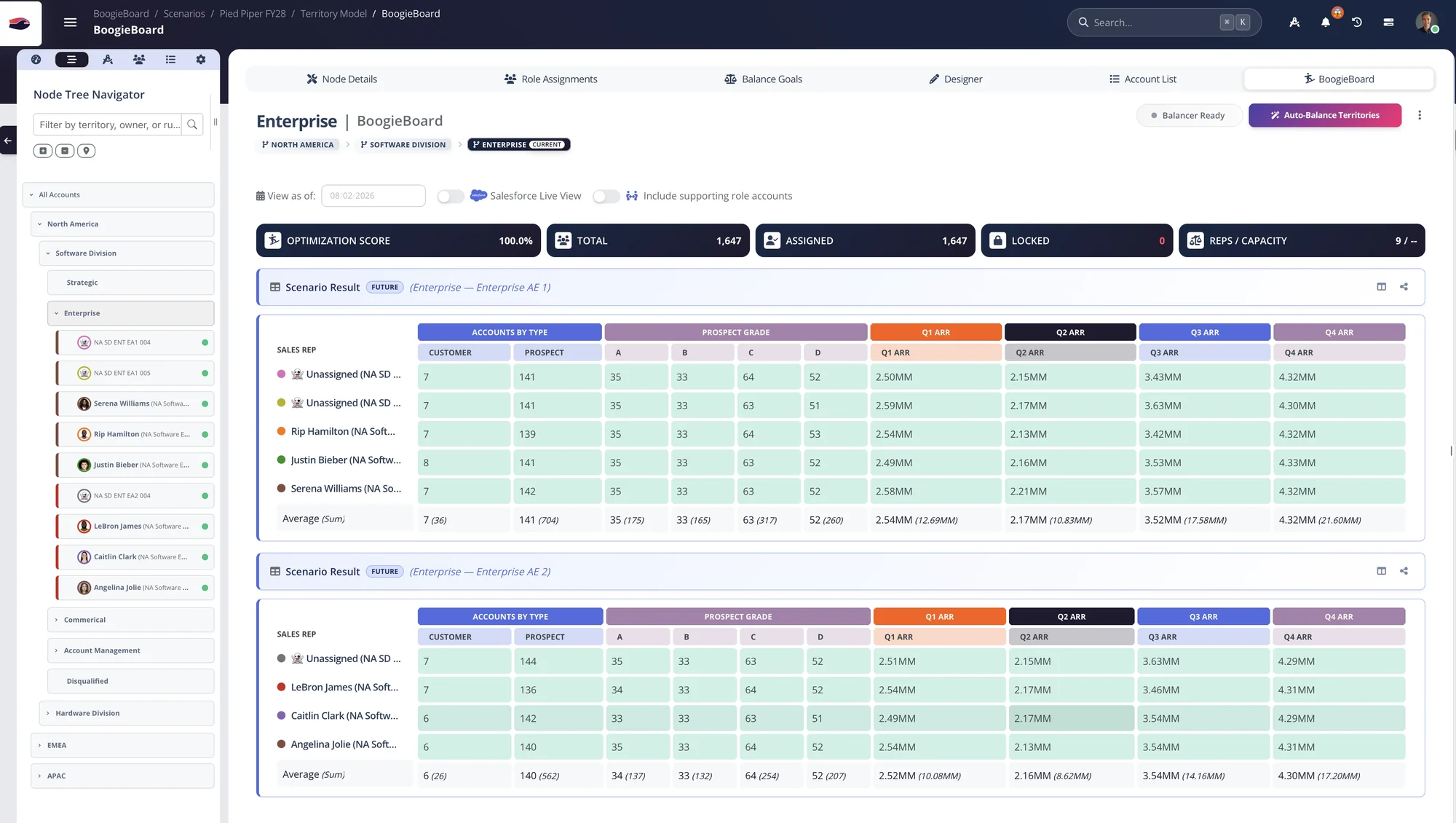
Scenario Results show customer and prospect mix, prospect grade, quarterly ARR, account locks, and rep capacity in one review surface.
How to Put Territory Inequity Into Practice
Define comparable populations, publish Balance Goals and ranges, measure complete books, investigate outliers, and separate valid role differences from accidental or political variance. The control at this stage is a decision log. Separate factual corrections from policy exceptions, preserve rejected alternatives, and attach an effective date. For the planning team, the practical test is whether another informed person could reproduce the result from the same data and rules without relying on private context. Keep account-level results beside the territory inequity summary so Balance Attribute remains inspectable after approval.
How to Put Territory Inequity Into Practice means producing one inspectable decision before advancing. Name the input, owner, output, and approval. Keep the current state as a baseline, and record assumptions that could change the result. This dependency order prevents a late preference from rewriting earlier definitions without anyone seeing the cost. Give the territory inequity decision a source date, an owner, and a condition that would trigger revision.
Define Roles and Comparable Populations
Two enterprise AEs each own 40 accounts, but one book contains three times the serviceable potential and half the active-customer workload. Define Roles and Comparable Populations means producing one inspectable decision before advancing. Name the input, owner, output, and approval. Keep the current state as a baseline, and record assumptions that could change the result. This dependency order prevents a late preference from rewriting earlier definitions without anyone seeing the cost. Give the territory inequity decision a source date, an owner, and a condition that would trigger revision.
Balance Attribute: The Decision Test: Review 15
Territory inequity is a material, unexplained difference in opportunity, workload, quality, or continuity among comparable roles. Difference alone is not inequity; the absence of a defensible standard is. No model removes judgment. Geographic, named-account, segment, industry, customer, and hybrid structures each solve a different constraint. Use the fewest logical layers that express the strategy, then state where a deliberate override is allowed. Complexity should correspond to a real customer or operating need, not inherited convention. Before activating territory inequity, show managers the effect on Territory Health and every downstream rule that depends on it.
Validate Account and Capacity Data
Validate Account and Capacity Data means producing one inspectable decision before advancing. Name the input, owner, output, and approval. Keep the current state as a baseline, and record assumptions that could change the result. This dependency order prevents a late preference from rewriting earlier definitions without anyone seeing the cost. For territory inequity, document the effect on Territory Equity before the model advances.
Decision Note: Rep View Report 2
A practical test is to pick one surprising account and trace it end to end. Explain why it is in the segment, why it belongs in the territory, whether it is locked, which goals it affects, and what happens when the seller changes. If the answer requires several private spreadsheets, the model is not yet governed. In territory inequity, test the choice against Balance Attribute, then record any accepted exception in the decision log.
Set Balance Goals and Acceptable Variance
Set Balance Goals and Acceptable Variance means producing one inspectable decision before advancing. Name the input, owner, output, and approval. Keep the current state as a baseline, and record assumptions that could change the result. This dependency order prevents a late preference from rewriting earlier definitions without anyone seeing the cost. The territory inequity review is complete only when Territory Health and the affected account roster tell the same story.
Policy and Governance 2: Territory Inequity
A practical test is to pick one surprising account and trace it end to end. Explain why it is in the segment, why it belongs in the territory, whether it is locked, which goals it affects, and what happens when the seller changes. If the answer requires several private spreadsheets, the model is not yet governed. Use one current-state baseline to keep every territory inequity scenario comparable.
Territory Equity: The Decision Test 3
Use this module to make the hidden decision explicit. State the role, population, evidence, rule, exception path, and operating consequence. The objective is not a perfectly clean model; it is a model whose compromises are visible enough to approve, communicate, and improve. For territory inequity, name the approver, the permitted evidence, and the condition that would justify a departure from the rule.
Balance Attribute: The Decision Test 3
A practical test is to pick one surprising account and trace it end to end. Explain why it is in the segment, why it belongs in the territory, whether it is locked, which goals it affects, and what happens when the seller changes. If the answer requires several private spreadsheets, the model is not yet governed. Keep account-level results beside the territory inequity summary so Balance Attribute remains inspectable after approval.
Territory Equity: The Decision Test: Review 22
Technology should preserve the model, not only the final owner field. Test version control, current-to-future comparison, account-level inspection, locks, scenario assumptions, approvals, effective dates, CRM deployment, and audit history. A faster spreadsheet export is not the same as a governed planning system. Give the territory inequity decision a source date, an owner, and a condition that would trigger revision.
Decision Worksheet
| Decision | Evidence to inspect | Control |
|---|---|---|
| Define the population | Territory Equity and comparable roles | Named data owner |
| Measure the current state | Balance Attribute and Territory Health | Source date and baseline |
| Choose the tradeoff | Scenario comparison and complete Territory Health | Recorded approver |
| Activate the result | Account roster, changes, quota, and transition rules | Effective date and correction path |
Frequently Asked Questions
Why do reps complain about their territory?
Territory inequity is a material, unexplained difference in opportunity, workload, quality, or continuity among comparable roles. Difference alone is not inequity; the absence of a defensible standard is. Correcting inequity can disrupt relationships and pipeline. Compare the ongoing cost of the imbalance with the movement required to improve it. Use the published definitions and complete-territory result instead of relying on one universal benchmark.
How do you measure territory equity?
Define comparable populations, publish Balance Goals and ranges, measure complete books, investigate outliers, and separate valid role differences from accidental or political variance. Two enterprise AEs each own 40 accounts, but one book contains three times the serviceable potential and half the active-customer workload. Publish the assumptions so another reviewer can reproduce the answer.
What data is required for territory inequity?
For territory inequity, assemble governed account data, current assignments, role capacity, and decision evidence for Territory Equity, Balance Attribute, and Territory Health. Date the sources and publish the definitions so another reviewer can reproduce the result and separate a factual correction from a policy exception.
How often should territory inequity be reviewed?
Review territory inequity on the formal planning cadence and whenever the inputs behind Territory Equity, Balance Attribute, and Territory Health change materially. Keep customer and pipeline ownership stable between reviews; reopen the model when strategy or new evidence changes the decision, not merely because a manager prefers a different assignment.
How should Balance Goals and account locks work together?
For territory inequity, define Balance Goals tied to Territory Equity, Balance Attribute, and Territory Health before applying locks. Then publish Account Locking Criteria, lock only qualifying accounts, optimize the movable book, and score the complete territory so locked burden and residual imbalance remain visible.
When should a spreadsheet be replaced with a planning system?
For territory inequity, a spreadsheet remains adequate while one owner can preserve Territory Equity, Balance Attribute, and Territory Health, plus versions, account detail, approvals, and deployment without manual reconciliation obscuring the rule. Move to a planning system when scenario volume, collaboration, or audit work overwhelms the decision itself.
About the author: Kevin Davis is Co-Founder & CEO of BoogieBoard.
In Summary
Territory quality is second only to unfair quota as a source of seller complaints, and reps who leave over it are behaving rationally. Use the sequence above to keep the decision governed, evidence-based, and inspectable at both the account and territory levels.
See Territory Planning in Practice
Watch practical territory-design workflows on the BoogieBoard YouTube channel.