
5 Key Takeaways
- Frontline managers give workload feedback; they do not own the model. Confusing the two produces the horse-trading you are trying to avoid.
- A territory manager contributes field evidence, validates workload and customer conditions, communicates the approved model, and manages routine exceptions without owning the underlying enterprise territory logic.
- Separate responsibilities with decision rights: RevOps drives data, scenarios, controls, and activation; leadership approves strategy; managers validate local evidence, coach sellers, and escalate documented exceptions.
- Manager proximity reveals customer and seller context that central teams cannot see, while local control can produce inconsistent standards; the model needs contribution without private ownership.
- The role fails when managers are treated as passive messengers or unchecked territory owners, because either field evidence disappears or every region operates a different allocation policy.
Frontline managers give workload feedback; they do not own the model. Confusing the two produces the horse-trading you are trying to avoid. That position is useful only when the planning team can translate it into inputs, decisions, controls, and a result the field can understand.
BoogieBoard treats the territory manager role as part of a governed change process. The model must connect market strategy with account-level evidence, productive capacity, explicit decision rights, and controlled activation. The objective is not to remove judgment. It is to make judgment visible and repeatable.
The central position is: Stacking the deck for a top performer is a symptom, not a strategy. The sections below turn that position into definitions, alternatives, procedures, examples, controls, and an operating decision.
Working Definitions
- manager discretion: documented local judgment exercised within published authority and evidence rules.
- horse trading: private negotiation that swaps accounts without applying one shared standard.
- Rep View Report: the seller-facing account roster and explanation of changes, measures, and next actions.
- escalation path: the named sequence and decision authority for resolving an unresolved territory question.
- Balance Goal: a measurable objective for healthy opportunity, quality, workload, or continuity.
BoogieBoard's customer-coverage doctrine also reflects interviews with more than 50 Sales and Operations leaders responsible for customer and account-management motions. It is practitioner evidence, not a controlled prevalence study. For the territory manager role, use that observation only for the claim and population it directly supports.
Independent evidence provides a separate check for the territory manager role: Monash University's research record summarizes evidence linking territory-design satisfaction with salesperson motivation, attitudes, and work outcomes.
What Is The Territory Manager Role?
A territory manager contributes field evidence, validates workload and customer conditions, communicates the approved model, and manages routine exceptions without owning the underlying enterprise territory logic. Customer books differ from prospect territories because the company knows more and owes more. Product usage, revenue, journey, relationships, renewals, and open work make the territory manager role a service and retention design problem. In the territory manager role, test the choice against horse trading, then record any accepted exception in the decision log.
Operating and Governing the Model: The Territory Manager Role
Separate responsibilities with decision rights: RevOps drives data, scenarios, controls, and activation; leadership approves strategy; managers validate local evidence, coach sellers, and escalate documented exceptions. Publish accountable and collaborative roles, coverage triggers, handoffs, vacancy behavior, customer communication, and escalation. Managers contribute context without privately trading accounts. The the territory manager role review is complete only when Rep View Report and the affected account roster tell the same story.
The Complete Result
A manager can flag that a strategic parent is misclassified and provide evidence, but should not trade it for another account with a peer before the shared model is updated. Use both current-state and future-state views. Report account movement, locked accounts, unassigned records, family splits, vacancies, and quota differences beside Territory Health. Monitor outcomes later, but avoid claiming that attainment alone proves the design was correct; product, market, timing, execution, and quota also affect performance. Use one current-state baseline to keep every the territory manager role scenario comparable.
The Decision Rule
The role fails when managers are treated as passive messengers or unchecked territory owners, because either field evidence disappears or every region operates a different allocation policy. Use this module to make the hidden decision explicit. State the role, population, evidence, rule, exception path, and operating consequence. The objective is not a perfectly clean model; it is a model whose compromises are visible enough to approve, communicate, and improve. For the territory manager role, name the approver, the permitted evidence, and the condition that would justify a departure from the rule.
The Evidence Standard
Manager proximity reveals customer and seller context that central teams cannot see, while local control can produce inconsistent standards; the model needs contribution without private ownership. A practical test is to pick one surprising account and trace it end to end. Explain why it is in the segment, why it belongs in the territory, whether it is locked, which goals it affects, and what happens when the seller changes. If the answer requires several private spreadsheets, the model is not yet governed. Keep account-level results beside the the territory manager role summary so horse trading remains inspectable after approval.
Stakeholder Consequences: The Territory Manager Role
Use this module to make the hidden decision explicit. State the role, population, evidence, rule, exception path, and operating consequence. The objective is not a perfectly clean model; it is a model whose compromises are visible enough to approve, communicate, and improve. Give the the territory manager role decision a source date, an owner, and a condition that would trigger revision.
Policy and Governance: The Territory Manager Role
A practical test is to pick one surprising account and trace it end to end. Explain why it is in the segment, why it belongs in the territory, whether it is locked, which goals it affects, and what happens when the seller changes. If the answer requires several private spreadsheets, the model is not yet governed. Before activating the territory manager role, show managers the effect on Rep View Report and every downstream rule that depends on it.
The Role Test
For The Role Test, make the implicit policy inspectable at account level. Use escalation path to test whether the customer obligation, accountable role, future book, and handoff remain clear; keep the account-level evidence visible.
The Workload Test
For The Workload Test, make the implicit policy inspectable at account level. Use Balance Goal to test whether the customer obligation, accountable role, future book, and handoff remain clear; keep the account-level evidence visible.
See Territory Management in the Planning Workflow
The relevant product workflow is Sales Manager Territory Review. BoogieBoard Scenario Planning keeps the account-level assumptions, tradeoffs, and proposed assignments visible while the team completes that work.
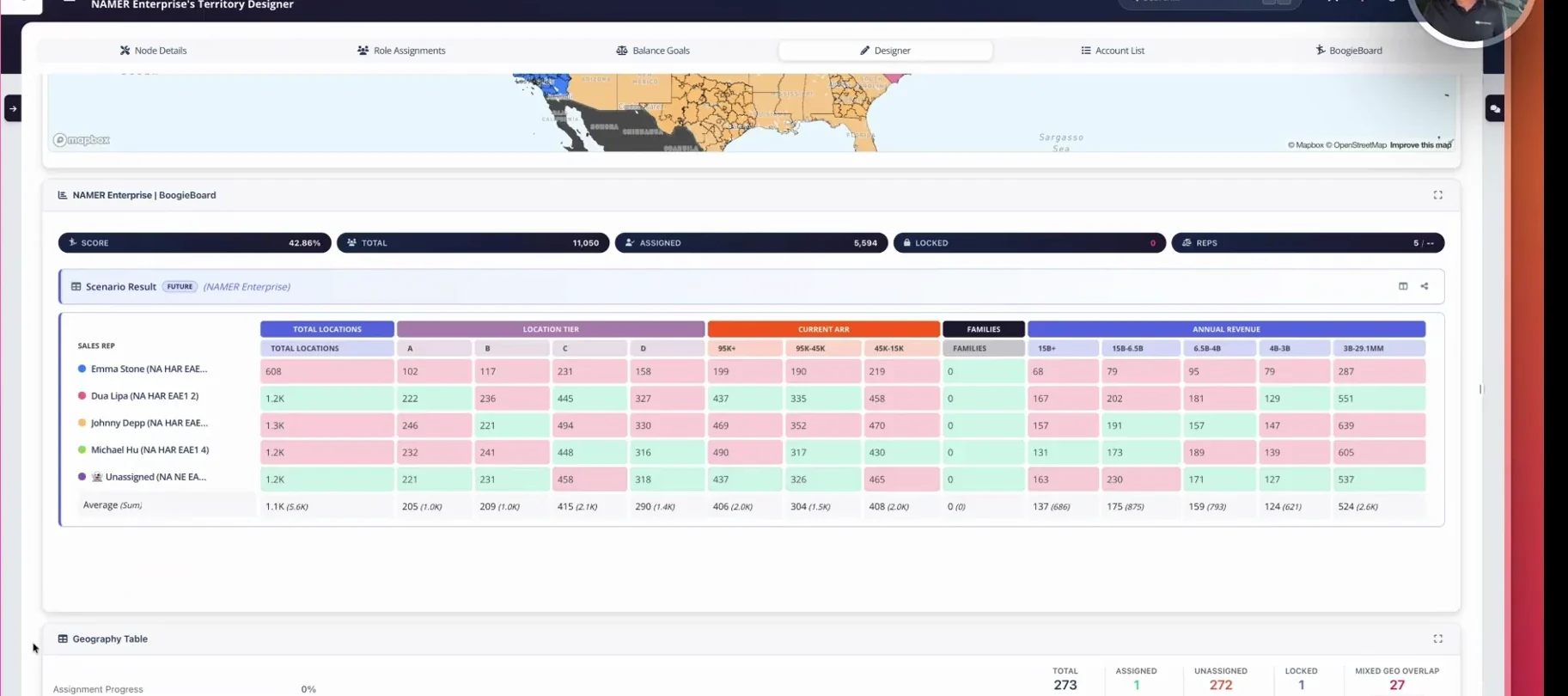
A manager can review mapped coverage and territory measures before requesting or approving changes.
Seller Impact
For Seller Impact, connect the choice to seller, customer, and operating consequences. Use manager discretion to test whether the customer obligation, accountable role, future book, and handoff remain clear; keep the account-level evidence visible.
Approval and Decision Rights: The Territory Manager Role
A practical test is to pick one surprising account and trace it end to end. Explain why it is in the segment, why it belongs in the territory, whether it is locked, which goals it affects, and what happens when the seller changes. If the answer requires several private spreadsheets, the model is not yet governed. Use one current-state baseline to keep every the territory manager role scenario comparable.
The Approval Test
For The Approval Test, make the implicit policy inspectable at account level. Use Rep View Report to test whether the customer obligation, accountable role, future book, and handoff remain clear; keep the account-level evidence visible.
The Activation Test
For The Activation Test, make the implicit policy inspectable at account level. Use escalation path to test whether the customer obligation, accountable role, future book, and handoff remain clear; keep the account-level evidence visible.
The Exception Test
For The Exception Test, make the implicit policy inspectable at account level. Use Balance Goal to test whether the customer obligation, accountable role, future book, and handoff remain clear; keep the account-level evidence visible.
Where the Model Changes Decisions: The Territory Manager Role
Start with coverage before fairness. Define which market the company intends to serve, which roles cover it, and how much productive capacity exists. Only then can the team judge whether the resulting territories distribute opportunity and workload in a defensible way. Before activating the territory manager role, show managers the effect on Rep View Report and every downstream rule that depends on it.
The Correction Test
For The Correction Test, make the implicit policy inspectable at account level. Use horse trading to test whether the customer obligation, accountable role, future book, and handoff remain clear; keep the account-level evidence visible.
Decision Worksheet
| Decision | Evidence to inspect | Control |
|---|---|---|
| Define responsibility | manager discretion and comparable customer roles | Accountable and collaborating roles |
| Measure the book | horse trading and Rep View Report | Source date and customer roster |
| Protect obligations | Renewals, health, relationships, and active work | Movement and handoff rule |
| Approve the future book | Workload, potential, continuity, and role capacity | Decision owner and effective date |
Accountable Role Definition
Name the role accountable for the customer outcome and distinguish it from specialists, executives, service teams, and opportunity collaborators. For the territory manager role, use manager discretion to record the evidence, decision owner, affected account population, and condition that closes this review.
Customer Population Review
Define the customer roster from governed status and contract facts, then reconcile it with finance, CRM, and customer-success systems. For the territory manager role, use horse trading to record the evidence, decision owner, affected account population, and condition that closes this review.
Renewal Calendar
Plot renewable value and renewal dates by month or quarter so equal annual books do not hide concentrated delivery and retention work. For the territory manager role, use Rep View Report to record the evidence, decision owner, affected account population, and condition that closes this review.
Customer Health Evidence
Combine health with its source date, component signals, and open risks; a color without evidence should not determine whether an account moves. For the territory manager role, use escalation path to record the evidence, decision owner, affected account population, and condition that closes this review.
Active Work Inventory
Record implementations, escalations, executive commitments, commercial negotiations, and other open obligations before changing customer responsibility. For the territory manager role, use Balance Goal to record the evidence, decision owner, affected account population, and condition that closes this review.
Relationship Continuity
Identify critical customer and internal relationships, their current owners, and the context the receiving role must inherit. For the territory manager role, use manager discretion to record the evidence, decision owner, affected account population, and condition that closes this review.
Workload Estimate
Measure service demand, complexity, cadence, and travel or coordination burden beside customer count and recurring revenue. For the territory manager role, use horse trading to record the evidence, decision owner, affected account population, and condition that closes this review.
Expansion Potential
Separate renewable revenue from evidence-weighted whitespace so a book's retention burden and growth opportunity remain visible. For the territory manager role, use Rep View Report to record the evidence, decision owner, affected account population, and condition that closes this review.
Comparable Book Test
Compare only roles with the same mandate, service model, segment, and capacity; publish the distributions rather than one universal target. For the territory manager role, use escalation path to record the evidence, decision owner, affected account population, and condition that closes this review.
Protection Criteria
Define which renewal, health, implementation, relationship, or commitment conditions justify temporary protection after Balance Goals are set. For the territory manager role, use Balance Goal to record the evidence, decision owner, affected account population, and condition that closes this review.
Receiving Book Capacity
Test the complete future book, including protected customers, before approving movement; a sensible handoff can still overload the recipient. For the territory manager role, use manager discretion to record the evidence, decision owner, affected account population, and condition that closes this review.
Customer Communication Plan
Name who tells the customer, what changes, what remains stable, and when the new accountable role becomes effective. For the territory manager role, use horse trading to record the evidence, decision owner, affected account population, and condition that closes this review.
Handoff Package
Transfer commitments, relationship history, risks, next steps, success measures, and commercial context rather than only changing the owner field. For the territory manager role, use Rep View Report to record the evidence, decision owner, affected account population, and condition that closes this review.
Vacancy Coverage
Define temporary accountable and collaborating roles when a customer territory is vacant, including authority, duration, and escalation. For the territory manager role, use escalation path to record the evidence, decision owner, affected account population, and condition that closes this review.
Role Conflict Review
Find customers with missing accountability or incompatible role assignments and resolve the rule before activating the future book. For the territory manager role, use Balance Goal to record the evidence, decision owner, affected account population, and condition that closes this review.
Frequently Asked Questions
What does a territory manager do?
A territory manager contributes field evidence, validates workload and customer conditions, communicates the approved model, and manages routine exceptions without owning the underlying enterprise territory logic. Manager proximity reveals customer and seller context that central teams cannot see, while local control can produce inconsistent standards; the model needs contribution without private ownership. Use the published definitions and complete-territory result instead of relying on one universal benchmark.
Should managers pick their team's accounts?
Separate responsibilities with decision rights: RevOps drives data, scenarios, controls, and activation; leadership approves strategy; managers validate local evidence, coach sellers, and escalate documented exceptions. A manager can flag that a strategic parent is misclassified and provide evidence, but should not trade it for another account with a peer before the shared model is updated. Publish the assumptions so another reviewer can reproduce the answer.
What customer data is required for the territory manager role?
For the territory manager role, assemble governed account data, current assignments, role capacity, and decision evidence for manager discretion, horse trading, and Rep View Report. Date the sources and publish the definitions so another reviewer can reproduce the result and separate a factual correction from a policy exception.
How often should the territory manager role be reviewed?
Review the territory manager role on the formal planning cadence and whenever the inputs behind manager discretion, horse trading, and Rep View Report change materially. Keep customer and pipeline ownership stable between reviews; reopen the model when strategy or new evidence changes the decision, not merely because a manager prefers a different assignment.
Which customer accounts should be protected from movement?
Customer ownership under the territory manager role should be protected only when renewal timing, health risk, implementation work, executive relationships, or active commitments make movement unusually costly. Apply the published lock rule after goals are defined and keep every protected account in the final territory-health result.
How should customer handoffs be managed?
For the territory manager role, each customer handoff needs named current and future owners, transferred commitments and relationship context, a communication plan, an effective date, and follow-up on renewal health and unresolved work. Temporary coverage should expire rather than becoming an undocumented permanent assignment.
About the author: Tyler Thompson is Co-Founder & CTO of BoogieBoard.
In Summary
Frontline managers give workload feedback; they do not own the model. Confusing the two produces the horse-trading you are trying to avoid. Use the sequence above to keep the decision governed, evidence-based, and inspectable at both the account and territory levels.
See Territory Planning in Practice
Watch practical territory-design workflows on the BoogieBoard YouTube channel.