5 Key Takeaways
- Your BDR assignment should tell you who supports your territory, which accounts they cover, what work they own, and how the two of you hand opportunities off.
- One-to-one, pod, and pooled coverage can all work. The right model depends on account quality, workload, research depth, inbound volume, specialization, and sales cycle.
- A clean 3:1 AE-to-BDR ratio does not prove the work is balanced. Compare the combined Target Account Lists and expected activity inside the pod.
- BDR coverage should follow durable territories or teams, so an account movement, vacancy, or promotion does not require a hidden spreadsheet rebuild.
- You should know how BDR performance is measured, how priority conflicts are resolved, and what happens when either the AE or BDR seat changes.
When BDR coverage works, it feels like leverage. You and your BDR know which accounts matter, divide the research and outreach clearly, share context, and hand opportunities over without making the customer repeat the first conversation.
When it does not work, the ratio is usually the only part anyone can explain. One BDR supports three AEs, but one AE has twice the qualified accounts. Every seller believes their priorities come first. The BDR gets measured on meetings, the AEs get measured on pipeline, and nobody owns the conflict between them.
That is not a motivation problem. It is a coverage-design problem.
You do not need to administer the territory system to evaluate whether the model supports your work. You should be able to see the role, the account set, the capacity assumption, the handoff, and the change policy behind your assignment.
The BDR Role: More Than Setting Meetings
A Business Development Representative, or BDR, usually creates or qualifies pipeline before an Account Executive owns the complete commercial process. The title can describe several different jobs:
- qualifying and routing inbound demand;
- prospecting into a defined Target Account List;
- researching contacts and account conditions;
- developing strategic or named accounts;
- following up on campaigns, events, or partner activity;
- opening a new segment, region, or industry;
- supporting several AE territories as part of a pod.
Those jobs do not have the same capacity. A BDR researching ten complex global account families cannot be compared with a BDR qualifying a high volume of inbound forms by looking only at meeting count.
The first question is therefore not “What is our ratio?” It is “What work does the BDR own, for which accounts, and at what expected depth?”
The Measures That Affect Your Coverage
You should understand at least five parts of the model:
- Coverage ratio: how many AEs, territories, or account lists each BDR supports.
- Target Account List quality: the number and mix of accounts by fit, prospect grade, pain signal, or strategic tier.
- Workload: research depth, contacts per account, outreach cadence, inbound volume, and segment complexity.
- Handoff quality: what qualifies as accepted, which context travels with the opportunity, and how rejected opportunities return to the BDR.
- Role clarity: whether your BDR is dedicated, shared, inherited from a larger team, temporary, or part of a pool.
If the model gives you only a name and a ratio, it leaves the most important operating decisions to negotiation.
The Core Components of Your BDR Coverage
Your Primary Territory
Your territory is the durable collection of accounts or market coverage assigned to your role. It should exist independently of your name, so the company can cover a vacancy, promotion, or leave without redefining the market.
The BDR is usually a supporting role on that territory. You remain the primary AE owner; the BDR receives the access and account context needed to develop the same market.
That distinction matters. If your territory changes, BDR coverage can follow the approved account set. If the BDR owns a separate spreadsheet of accounts, every change creates a reconciliation problem and a new chance for duplicate outreach.
The Supporting BDR Assignment
The model should identify one of four states:
- a BDR dedicated to your territory;
- a BDR shared across a named pod of territories;
- a BDR team serving a segment, region, or industry;
- a governed pool or queue receiving work according to routing rules.
You should know which state applies and whether the assignment is permanent, inherited from a larger team, or temporary.
Capacity and the Coverage Ratio
A ratio is a planning assumption about how much work one BDR can support. It is not a universal benchmark.
BoogieBoard's observed models show that multi-role territory coverage becomes more common as sales organizations grow: approximately 10-50% among organizations with 25+ sellers, 40-60% at 100+, 60-80% at 250+, and 80-100% at 1,000+. Typical territory teams include AEs, BDRs, CSMs, partner managers, sales managers, and solutions consultants.
Those ranges describe whether organizations model several roles, not whether your company should use a 1:1, 2:1, or 3:1 AE-to-BDR ratio. Your ratio has to survive the actual account set and job definition.
Account Access and CRM Visibility
You and your BDR should see the same authoritative coverage relationship in the systems where you work. The company may represent that relationship through territory roles, account teams, a BDR field, or another governed method.
The implementation choice belongs to Operations, but the outcome affects you directly: the right accounts appear, permissions work, reporting credits the right activity, and customer outreach does not collide.
Salesforce supports multiple users and defined roles within a territory. It also lets one user hold different roles in different territories. In plain language, the system can represent an AE owner and a supporting BDR without pretending both people independently own the account (Salesforce territory-role documentation).
The Change Policy
Coverage changes when someone leaves, joins, gets promoted, changes pods, or goes on leave. You should know:
- who provides temporary coverage;
- whether the account set or only the supporting person changes;
- how active sequences and open opportunities transfer;
- which seller retains credit or context;
- when the permanent assignment becomes effective;
- where to report a missing or incorrect BDR assignment.
A durable model makes those changes visible. A roster spreadsheet turns them into cleanup.
How to Evaluate Your BDR Coverage in 5 Steps
Step 1: Confirm the Job You and the BDR Are Sharing
Start with the business outcome. Is the BDR expected to produce qualified enterprise pipeline, respond to inbound demand, research strategic accounts, penetrate a defined list, or open a new market?
Then make the division of work explicit. For example:
- BDR researches the account and contacts; AE shapes the account plan.
- BDR owns first outreach and early qualification; AE joins after a defined condition.
- AE and BDR coordinate multithreaded outreach on strategic accounts.
- BDR works a segment queue; AE ownership begins only after acceptance.
If both people believe the other owns a step, the account is uncovered. If both believe they own it, the customer receives duplicate contact.
Step 2: Identify the Unit the BDR Supports
Ask whether your BDR is assigned to you personally, your territory, your pod, a regional or segment team, or a queue.
Territory- or team-based assignments are generally more durable than person-to-person pairings. They let coverage follow the approved market when the roster changes. A dedicated pairing can still make sense for strategic or complex work, but the company should state how it survives a vacancy.
Step 3: Test the Ratio Against the Accounts
Do not stop at the number of AEs. Compare the combined work.
| Coverage model | What it can give you | What to inspect |
|---|---|---|
| One BDR to one AE | Deep focus and a stable working relationship | Whether the territory has enough work to justify dedicated capacity |
| One BDR to several AEs | Efficient pod coverage across comparable territories | Qualified-account mix, research depth, priority rules, and combined workload |
| Pooled BDR team | Flexible response to changing volume | Routing, specialization, service levels, continuity, and accountability |
If one territory contains 150 well-scored prospects and another contains 60, a 3:1 pod is not three equal shares. If one AE expects personalized research while another expects high-volume sequences, the BDR is serving two different motions.
Ask to see accounts by grade or priority, expected contacts per account, inbound volume, sequence requirements, and historical conversion. The ratio should reflect the work, not merely make the org chart fit the headcount plan.
Step 4: Agree on Priority and Handoff Rules
Shared BDRs need a way to resolve competing requests. “Work whatever the AEs say is important” guarantees that urgency, seniority, or the loudest message wins.
Useful rules can include:
- a shared ranked Target Account List;
- capacity reserved by territory or segment;
- campaign and inbound service levels;
- criteria for an AE-priority override;
- a weekly pod review of conflicts and results;
- a definition of a qualified handoff;
- a reason code when the AE rejects an opportunity.
The handoff should include the account reason, people engaged, problem discussed, timing, objections, and agreed next step. A calendar invite without context pushes discovery work back onto the customer.
Step 5: Check That the Assignment Is Visible and Maintainable
The model should show the BDR attached to your territory or pod, the dates of the assignment, and any inherited or temporary coverage.
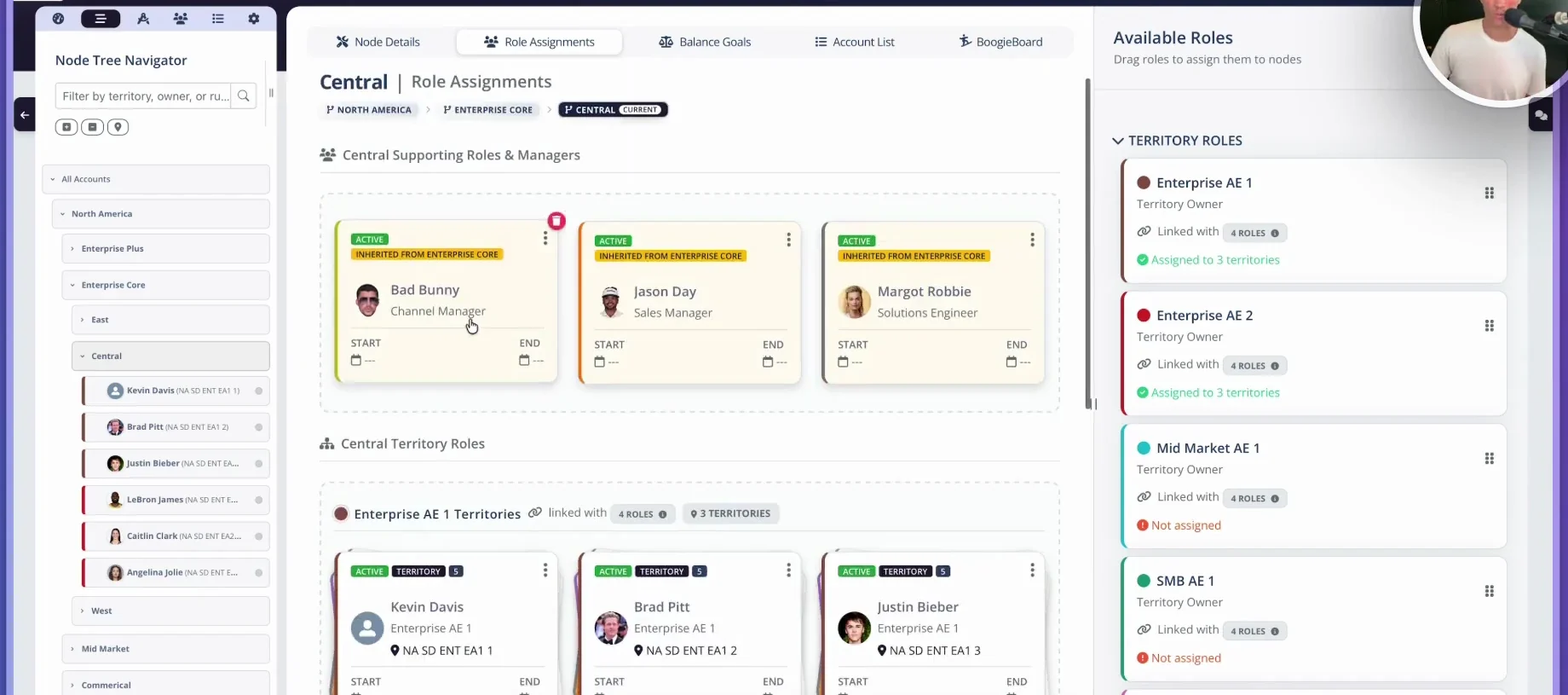
Role Assignments show territory owners, supporting roles, and available roles in the same operating model.
In BoogieBoard, one BDR can be assigned as a supporting role to three AE territories. The AEs remain the primary account owners, while the BDR relationship follows all three approved account books into Salesforce. The assignment can appear through a BDR field, a territory team, or another governed CRM representation.
Salesforce Account Teams provide another collaboration mechanism. Team members can receive defined roles and access without becoming the account owner. The important seller outcome is one visible coverage relationship rather than several disconnected lists (Salesforce Account Teams documentation).
Common BDR Coverage Models
1. Dedicated One-to-One Coverage
Best for: high-complexity, strategic, or high-volume territories where the BDR and AE need continuous coordination.
You gain focus and a shared account rhythm. The risk is fragility. If either person changes roles, the company needs a transition plan. The model can also waste capacity when the dedicated territory does not contain enough qualified work.
2. Pod or Ratio-Based Coverage
Best for: several comparable AE territories that share a segment, specialization, sales cycle, and operating cadence.
You gain a clear team and more flexible use of BDR capacity. The risk is hidden imbalance among the account lists and constant competition for priority. A pod needs shared rules, not just a shared BDR.
Warning: Equal AE Counts Do Not Mean Equal BDR Work
A ratio can look mathematically clean while the account work is lopsided. Compare the actual Target Account Lists, research requirements, active campaigns, inbound demand, and conversion expectations before calling the pod balanced.
3. Pooled or Segment Coverage
Best for: inbound demand, campaign follow-up, transactional motions, or markets where volume changes quickly.
You gain flexibility and can distribute work as it arrives. The risk is weak continuity. Without routing, service levels, and ownership, a pool becomes a place where accounts wait and context disappears.
What This Means for You
Your BDR model affects your pipeline before it affects a dashboard. It determines which accounts receive attention, how much research arrives before your first conversation, whether priority conflicts are resolved, and whether customer context survives the handoff.
Before accepting “this is our ratio” as the complete answer, ask:
- Which exact territory, pod, or account list does my BDR support?
- What work does the BDR own, and what remains mine?
- How many qualified accounts and contacts sit across the full pod?
- How do we decide whose priority wins when capacity is full?
- What qualifies an opportunity for handoff?
- How does feedback on poor-fit accounts return to the target list?
- What happens when my BDR or another AE leaves the pod?
- Where can I see the current assignment in Salesforce?
Those questions are not resistance to the model. They are the minimum information required to operate it well.
Bring the answers into a simple weekly working rhythm with your BDR. Review the highest-priority accounts, the accounts that changed, active outreach, accepted and rejected handoffs, and places where the shared list no longer reflects field reality. The purpose is not another activity meeting. It is to make sure the coverage model continues to match the work. If the same capacity conflict appears every week, take the evidence to your manager: account volumes, research requirements, response times, and opportunities delayed. That gives leadership a reason to adjust the pod, the list, or the ratio instead of asking both of you to work harder inside an impossible design.
Frequently Asked Questions
How should a BDR be assigned to my territory?
The assignment should attach to the most durable unit that matches the work: your AE territory, a named pod, a segment or regional team, a governed pool, or a specific Target Account List. You should be able to see the assignment and responsibilities in the systems you use.
Should every AE have a dedicated BDR?
No. Dedicated coverage fits complex or high-volume territories. Pod and pooled models can use capacity better when the account sets and motions are comparable. The decision should follow workload and specialization, not status.
How can I tell whether a 3:1 AE-to-BDR ratio is fair?
Compare the combined qualified accounts, research requirements, contacts, inbound volume, outreach cadence, and sales cycle. Three AE names are not three equal units of work. Ask how priority conflicts and overrides are handled.
What happens to BDR coverage when someone leaves?
The territory or pod should remain intact while a temporary or replacement person is assigned. Active sequences, account context, access, and open opportunities need a dated transition rule. The company should not have to recreate the account list from a separate spreadsheet.
About the author: George James is Co-Founder & CPO of BoogieBoard.
In summary: BDR coverage should give you clear accounts, responsibilities, capacity, priority rules, handoffs, and change treatment. Evaluate the work behind the ratio before judging the ratio itself.
Watch BDR podding in action
See one BDR mapped across three AE territories in BoogieBoard's BDR territory demo on YouTube.
Related framework: The Territory Management in Salesforce hub explains how ownership, territory roles, and Account Teams fit together without turning every supporting role into another owner.