
5 Key Takeaways
- Every temporary arrangement needs an expiry. Without one the transition is technically done but not actually done.
- A territory transition period is the dated interval between approval of a future model and completion of temporary coverage, holdovers, customer handoffs, account reassignment, and normal operating ownership.
- Define the start, end, protected work, temporary roles, old and new responsibilities, decision owner, communication, CRM states, extension rule, and reconciliation checkpoint before transition begins.
- A transition protects continuity and gives teams time to hand off work, but a long or vague period creates dual ownership, forecast ambiguity, delayed accountability, and a future model that never becomes fully real.
- The transition fails when temporary coverage has no expiration, opportunity and account responsibility are conflated, CRM shows only one state, or extensions occur without evidence and approval.
Every temporary arrangement needs an expiry. Without one the transition is technically done but not actually done. That position is useful only when the planning team can translate it into inputs, decisions, controls, and a result the field can understand.
BoogieBoard treats territory transition periods as part of a governed change process. The model must connect market strategy with account-level evidence, productive capacity, explicit decision rights, and controlled activation. The objective is not to remove judgment. It is to make judgment visible and repeatable.
The central position is: Not all holdovers are good. The sections below turn that position into definitions, alternatives, procedures, examples, controls, and an operating decision.
Working Definitions
- Holdover Policy: the published eligibility, evidence, approval, duration, and handoff rules for temporary continuity.
- temporary coverage: time-boxed responsibility assigned while the durable role or future owner is unresolved.
- expiration: the date or condition that ends a temporary exception or assignment.
- transition period: the dated interval for moving from the prior operating state to the approved future state.
- Account Locking Criteria: the published rules for assignments that should not move.
In BoogieBoard's observed planning data, the share of a book turned over ranges from 10% to 50% at 25-rep companies and from 20% to 75% at organizations with more than 1,000 reps. The range describes total disruption; no locked-versus-unlocked split is claimed. For territory transition periods, use that observation only for the claim and population it directly supports.
Independent evidence provides a separate check for territory transition periods: Salesforce's territory-management data model represents territories, models, rules, account associations, alignment logs, and user associations as related objects rather than a collection of person fields.
What Is Territory Transition Periods?
A territory transition period is the dated interval between approval of a future model and completion of temporary coverage, holdovers, customer handoffs, account reassignment, and normal operating ownership. A territory change has a business explanation and an operating consequence. The message should state what changed, why, how the decision was made, what it means for each person, and what happens next. In territory transition periods, test the choice against temporary coverage, then record any accepted exception in the decision log.
Common Models and Variations: Territory Transition Periods
A transition protects continuity and gives teams time to hand off work, but a long or vague period creates dual ownership, forecast ambiguity, delayed accountability, and a future model that never becomes fully real. The model in this subsection is useful only when its organizing rule matches the selling motion. Compare options by opportunity, workload, continuity, explainability, and maintenance burden. A structure that looks simple at launch can create expensive exceptions when accounts change segment, sellers leave, or related companies need coordinated coverage. The territory transition periods review is complete only when expiration and the affected account roster tell the same story.
| Transition element | Required decision | Failure if omitted |
|---|---|---|
| Period | Start, end, and extension authority | Temporary coverage becomes permanent ambiguity |
| Account ownership | Future accountable territory and role | The future model remains unclear |
| Opportunity continuity | Qualifying work, current owner, expiration | Every open deal becomes a holdover |
| Customer handoff | Commitments, relationships, communication | CRM changes without context transfer |
| Reconciliation | Checkpoint and closure conditions | Old and new states coexist indefinitely |
The Decision Rule
The transition fails when temporary coverage has no expiration, opportunity and account responsibility are conflated, CRM shows only one state, or extensions occur without evidence and approval. A practical test is to pick one surprising account and trace it end to end. Explain why it is in the segment, why it belongs in the territory, whether it is locked, which goals it affects, and what happens when the seller changes. If the answer requires several private spreadsheets, the model is not yet governed. Use one current-state baseline to keep every territory transition periods scenario comparable.
The Evidence Standard
For The Evidence Standard, make the implicit policy inspectable at account level. Use Account Locking Criteria to test whether the prior state, rationale, communication, effective date, and operating result agree; keep the account-level evidence visible.
The Population Test
For The Population Test, make the implicit policy inspectable at account level. Use Holdover Policy to test whether the prior state, rationale, communication, effective date, and operating result agree; keep the account-level evidence visible.
Policy and Governance: Territory Transition Periods
Use this module to make the hidden decision explicit. State the role, population, evidence, rule, exception path, and operating consequence. The objective is not a perfectly clean model; it is a model whose compromises are visible enough to approve, communicate, and improve. Give the territory transition periods decision a source date, an owner, and a condition that would trigger revision.
Common Failure Modes: Territory Transition Periods
A second failure is operational mismatch. If managers, documents, CRM, and effective dates disagree, the announcement creates distrust faster than the support team can repair it. Before activating territory transition periods, show managers the effect on expiration and every downstream rule that depends on it.
The Role Test
For The Role Test, make the implicit policy inspectable at account level. Use transition period to test whether the prior state, rationale, communication, effective date, and operating result agree; keep the account-level evidence visible.
See Account Locks in the Planning Workflow
The relevant product workflow is Lock Accounts to Territories. BoogieBoard Scenario Planning keeps the account-level assumptions, tradeoffs, and proposed assignments visible while the team completes that work.
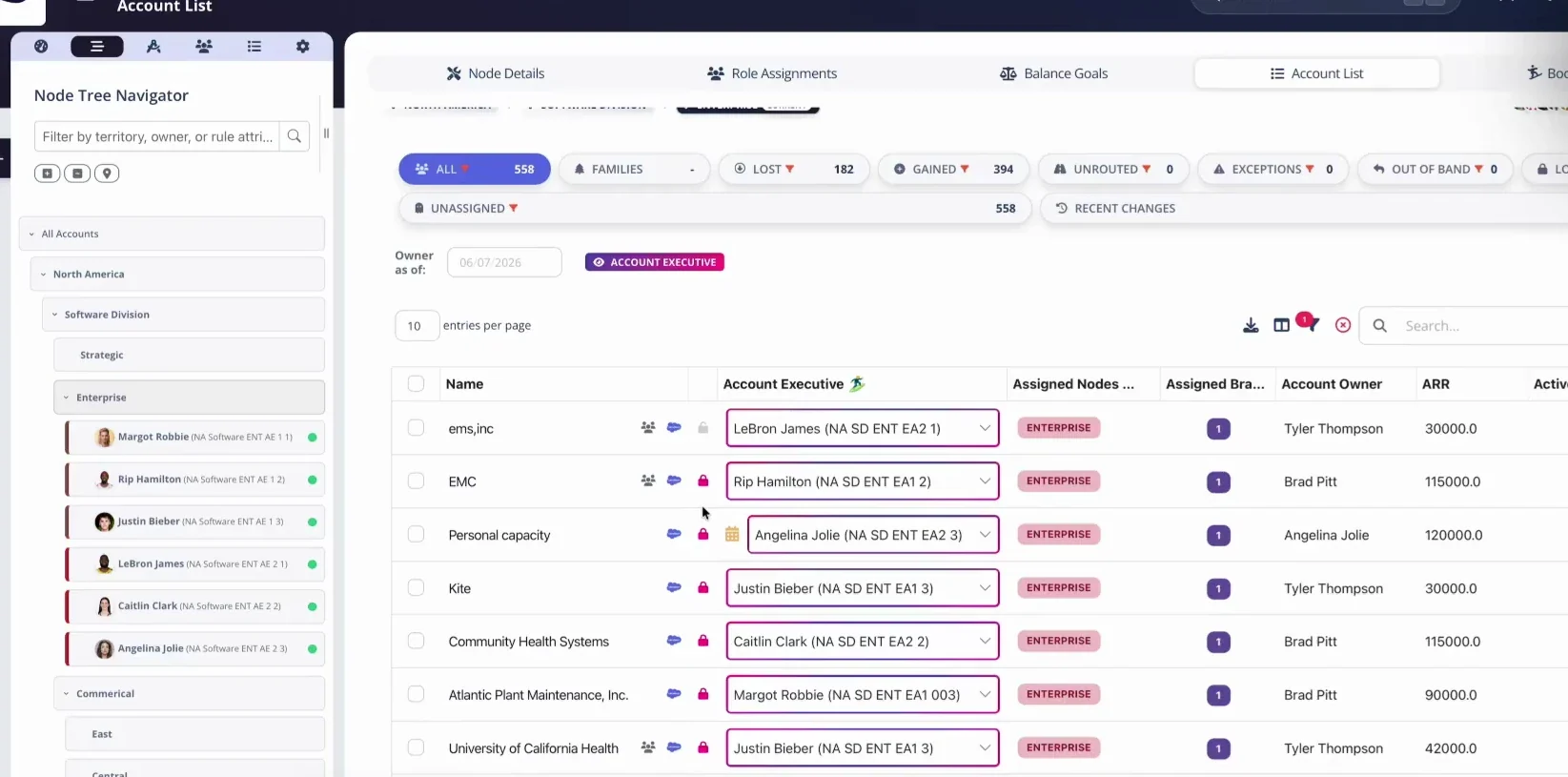
Locked-account indicators preserve approved continuity decisions while the rest of the book remains available for optimization.
The Workload Test
For The Workload Test, make the implicit policy inspectable at account level. Use Account Locking Criteria to test whether the prior state, rationale, communication, effective date, and operating result agree; keep the account-level evidence visible.
The Continuity Test
For The Continuity Test, make the implicit policy inspectable at account level. Use Holdover Policy to test whether the prior state, rationale, communication, effective date, and operating result agree; keep the account-level evidence visible.
How to Put Territory Transition Periods Into Practice
Define the start, end, protected work, temporary roles, old and new responsibilities, decision owner, communication, CRM states, extension rule, and reconciliation checkpoint before transition begins. Classify incoming feedback as a data correction, policy question, exception request, or escalation. For the planning team, the practical test is whether the reader knows what changed, when it takes effect, and where evidence receives an answer. Use one current-state baseline to keep every territory transition periods scenario comparable.
The Business Objective
For The Business Objective, name the required input, output, owner, and control. Use expiration to test whether the prior state, rationale, communication, effective date, and operating result agree; keep the account-level evidence visible.
Preserve the Prior State and Impact
A 60-day transition can preserve a late-stage deal with the former AE, give the new AE customer context immediately, and transfer final opportunity responsibility automatically at expiry. Classify incoming feedback as a data correction, policy question, exception request, or escalation. For the planning team, the practical test is whether the reader knows what changed, when it takes effect, and where evidence receives an answer. Keep account-level results beside the territory transition periods summary so temporary coverage remains inspectable after approval.
Prepare Managers and Account-Level Materials
For Prepare Managers and Account-Level Materials, produce a reviewable output before the next decision begins. Use Account Locking Criteria to test whether the prior state, rationale, communication, effective date, and operating result agree; keep the account-level evidence visible.
Explain the Method and Tradeoff
For Explain the Method and Tradeoff, produce a reviewable output before the next decision begins. Use Holdover Policy to test whether the prior state, rationale, communication, effective date, and operating result agree; keep the account-level evidence visible.
Decision Worksheet
| Decision | Evidence to inspect | Control |
|---|---|---|
| Explain the change | Holdover Policy and business rationale | Approved narrative |
| Show the impact | temporary coverage and expiration | Manager and seller reports |
| Prepare go-live | CRM, policies, temporary rules, and support paths | Effective date and named owners |
| Close the transition | Corrections, exceptions, expirations, and unresolved commitments | Reconciliation checkpoint |
Decision Narrative
State the business change, the problem the model solves, the tradeoff leadership accepted, and the facts that would cause a later revision. For territory transition periods, use Holdover Policy to record the evidence, decision owner, affected account population, and condition that closes this review.
Prior-State Preservation
Freeze the current account and role state with a source date so every recipient can see what changed rather than receiving only the final roster. For territory transition periods, use temporary coverage to record the evidence, decision owner, affected account population, and condition that closes this review.
Manager Preview
Prepare managers before the field announcement with the method, account-level impact, scripts, likely questions, and limits of their discretion. For territory transition periods, use expiration to record the evidence, decision owner, affected account population, and condition that closes this review.
Seller Impact Report
Show each seller retained, lost, gained, locked, and temporarily held accounts with effective dates and the reason behind material changes. For territory transition periods, use transition period to record the evidence, decision owner, affected account population, and condition that closes this review.
Customer Impact Review
Identify customer obligations and relationships affected by the plan, then assign communication and handoff owners before go-live. For territory transition periods, use Account Locking Criteria to record the evidence, decision owner, affected account population, and condition that closes this review.
Policy Readiness
Publish the definitions, rules, eligibility, evidence, approvers, dates, examples, and exception paths that recipients need to interpret the change. For territory transition periods, use Holdover Policy to record the evidence, decision owner, affected account population, and condition that closes this review.
Data Correction Path
Route factual account and hierarchy errors to a correction workflow that preserves evidence and returns the updated record to the approved model. For territory transition periods, use temporary coverage to record the evidence, decision owner, affected account population, and condition that closes this review.
Policy Question Path
Answer questions about how the published rule applies without allowing private messages to become undocumented policy changes. For territory transition periods, use expiration to record the evidence, decision owner, affected account population, and condition that closes this review.
Exception Governance
Require a reason, approver, effective period, visible model impact, and expiration or review condition for every departure from the standard rule. For territory transition periods, use transition period to record the evidence, decision owner, affected account population, and condition that closes this review.
CRM Go-Live Check
Confirm the approved territories, roles, accounts, temporary arrangements, and effective dates are ready in CRM when the communication says they are. For territory transition periods, use Account Locking Criteria to record the evidence, decision owner, affected account population, and condition that closes this review.
Manager-Seller Consistency
Compare leadership, manager, seller, and system versions of the decision; resolve contradictions before they become field politics. For territory transition periods, use Holdover Policy to record the evidence, decision owner, affected account population, and condition that closes this review.
Support Capacity
Estimate question and correction volume, assign owners and response targets, and give managers a visible status path during the launch. For territory transition periods, use temporary coverage to record the evidence, decision owner, affected account population, and condition that closes this review.
Temporary Rule Register
List holdovers, interim coverage, vacancies, and other transition states with owners, dates, handoff behavior, and extension authority. For territory transition periods, use expiration to record the evidence, decision owner, affected account population, and condition that closes this review.
Effective-Date Control
Use one approved effective date across communication, policy, CRM, quota, coverage, and reporting unless a documented transition requires otherwise. For territory transition periods, use transition period to record the evidence, decision owner, affected account population, and condition that closes this review.
Launch Reconciliation
Compare the approved scenario with the live account and role state, isolate deployment failures, and publish the unresolved queue. For territory transition periods, use Account Locking Criteria to record the evidence, decision owner, affected account population, and condition that closes this review.
Question Pattern Review
Group launch questions into data, policy, exception, training, and system categories so recurring issues improve the process rather than generate one-off answers. For territory transition periods, use Holdover Policy to record the evidence, decision owner, affected account population, and condition that closes this review.
Frequently Asked Questions
How long should a territory transition last?
A territory transition period is the dated interval between approval of a future model and completion of temporary coverage, holdovers, customer handoffs, account reassignment, and normal operating ownership. A transition protects continuity and gives teams time to hand off work, but a long or vague period creates dual ownership, forecast ambiguity, delayed accountability, and a future model that never becomes fully real. Use the published definitions and complete-territory result instead of relying on one universal benchmark.
What happens to in-flight deals during a transition?
Define the start, end, protected work, temporary roles, old and new responsibilities, decision owner, communication, CRM states, extension rule, and reconciliation checkpoint before transition begins. A 60-day transition can preserve a late-stage deal with the former AE, give the new AE customer context immediately, and transfer final opportunity responsibility automatically at expiry. Publish the assumptions so another reviewer can reproduce the answer.
What evidence is required for territory transition periods?
For territory transition periods, assemble governed account data, current assignments, role capacity, and decision evidence for Holdover Policy, temporary coverage, and expiration. Date the sources and publish the definitions so another reviewer can reproduce the result and separate a factual correction from a policy exception.
How often should territory transition periods be reviewed?
Review territory transition periods on the formal planning cadence and whenever the inputs behind Holdover Policy, temporary coverage, and expiration change materially. Keep customer and pipeline ownership stable between reviews; reopen the model when strategy or new evidence changes the decision, not merely because a manager prefers a different assignment.
How should data corrections and policy exceptions be separated?
Disputes about territory transition periods should send incorrect account facts through the data-correction path and challenges to the published rule through policy governance. Any exception needs a reason, approver, effective period, and visible effect on the complete approved model.
What must be ready before a territory change goes live?
A change involving territory transition periods can go live only after the manager briefing, account-level report, published policy, CRM assignment, temporary coverage, support path, and effective date agree. Reconcile the live result after activation so the announcement and operating record cannot drift apart.
About the author: Kevin Davis is Co-Founder & CEO of BoogieBoard.
In Summary
Every temporary arrangement needs an expiry. Without one the transition is technically done but not actually done. Use the sequence above to keep the decision governed, evidence-based, and inspectable at both the account and territory levels.
See Territory Planning in Practice
Watch practical territory-design workflows on the BoogieBoard YouTube channel.