
5 Key Takeaways
- Effective dates are what let you answer 'who owned this in March' six months later. Most orgs cannot.
- Territory effective dating records when a territory, account association, role, exception, or policy state begins and ends so historical ownership and responsibility can be reconstructed accurately.
- Preserve the current assignment, define the approved future assignment and effective date, record the reason and approver, keep both states until activation, reconcile the live Territory2 records, and retain the prior-state audit trail.
- Exact dates introduce transition and attribution policy choices, while immediate overwrites are operationally simpler; the simplicity disappears when Finance, Sales, or the customer later asks who was responsible at a prior point.
- Effective dating fails when an ownership change and a revenue-attribution rule are treated as the same event, or when future assignments overwrite the current state before the approved activation date.
Effective dates are what let you answer 'who owned this in March' six months later. Most orgs cannot. That position is useful only when the planning team can translate it into inputs, decisions, controls, and a result the field can understand.
BoogieBoard treats territory effective dating as part of a governed change process. The model must connect market strategy with account-level evidence, productive capacity, explicit decision rights, and controlled activation. The objective is not to remove judgment. It is to make judgment visible and repeatable.
The central position is: Hidden discretion is the problem, not discretion. The sections below turn that position into definitions, alternatives, procedures, examples, controls, and an operating decision.
Working Definitions
- effective dating: recording when an assignment, role, exception, or policy state begins and ends.
- audit trail: a dated record of prior state, proposed change, decision owner, reason, approval, and activation.
- Current State Scenario: a preserved planning baseline that mirrors the live model before proposed changes.
- Territory2: the Salesforce object representing an individual territory in an Enterprise Territory Management model.
- attribution: the governed decision about which person, role, or period receives commercial credit for an outcome.
BoogieBoard's customer-coverage doctrine also reflects interviews with more than 50 Sales and Operations leaders responsible for customer and account-management motions. It is practitioner evidence, not a controlled prevalence study. For territory effective dating, use that observation only for the claim and population it directly supports.
Independent evidence provides a separate check for territory effective dating: Salesforce documents dated user service in assigned territories and recommends previewing account assignments in a Planning model before activation.
A Practical Decision Lens: Territory Effective Dating
Effective dating fails when an ownership change and a revenue-attribution rule are treated as the same event, or when future assignments overwrite the current state before the approved activation date. A practical test is to pick one surprising account and trace it end to end. Explain why it is in the segment, why it belongs in the territory, whether it is locked, which goals it affects, and what happens when the seller changes. If the answer requires several private spreadsheets, the model is not yet governed. In territory effective dating, test the choice against audit trail, then record any accepted exception in the decision log.
Use this module to make the hidden decision explicit. State the role, population, evidence, rule, exception path, and operating consequence. The objective is not a perfectly clean model; it is a model whose compromises are visible enough to approve, communicate, and improve. The territory effective dating review is complete only when Current State Scenario and the affected account roster tell the same story.
effective dating: The Decision Test
Territory effective dating records when a territory, account association, role, exception, or policy state begins and ends so historical ownership and responsibility can be reconstructed accurately. A complete architecture needs stable account identifiers, a current-state baseline, durable territories, explicit roles, repeatable assignment rules, exceptions, effective dates, and an activation record. effective dating, audit trail, and Current State Scenario should connect those elements without turning the current owner into the model itself. The territory effective dating review is complete only when Current State Scenario and the affected account roster tell the same story.
| Record | Required dates | Reason to preserve it |
|---|---|---|
| Territory and account association | Start and end | Reconstruct historical coverage |
| Role assignment | Assigned, effective, and released | Separate the durable territory from its occupant |
| Approved change | Decision and activation | Show whether the live state matched authorization |
| Opportunity attribution | Event date and policy period | Apply the published credit rule independently of current ownership |
Inputs and Assumptions: Territory Effective Dating
Exact dates introduce transition and attribution policy choices, while immediate overwrites are operationally simpler; the simplicity disappears when Finance, Sales, or the customer later asks who was responsible at a prior point. A practical test is to pick one surprising account and trace it end to end. Explain why it is in the segment, why it belongs in the territory, whether it is locked, which goals it affects, and what happens when the seller changes. If the answer requires several private spreadsheets, the model is not yet governed. Use one current-state baseline to keep every territory effective dating scenario comparable.
Use this module to make the hidden decision explicit. State the role, population, evidence, rule, exception path, and operating consequence. The objective is not a perfectly clean model; it is a model whose compromises are visible enough to approve, communicate, and improve. For territory effective dating, name the approver, the permitted evidence, and the condition that would justify a departure from the rule.
Start With the Business Objective
Preserve the current assignment, define the approved future assignment and effective date, record the reason and approver, keep both states until activation, reconcile the live Territory2 records, and retain the prior-state audit trail. Start With the Business Objective should produce one inspectable Salesforce decision before the process advances. Preserve the live state, validate identifiers and roles, model the proposed state, review account-level changes, record approval, and activate on a defined date. A late exception should not silently rewrite the rule or the baseline. For territory effective dating, name the approver, the permitted evidence, and the condition that would justify a departure from the rule.
Use current and future states side by side. Classify feedback as a data correction, policy exception, or preference, and preserve who made the decision. For the planning team, the practical test is whether another informed person can trace an active assignment back to the approved rule and scenario. Keep account-level results beside the territory effective dating summary so audit trail remains inspectable after approval.
Define Roles and Comparable Populations
If an account moves on April 1 after a March opportunity was created, the history should show March coverage, the April assignment, the approved transition rule, and the separate attribution decision for the deal. Use current and future states side by side. Classify feedback as a data correction, policy exception, or preference, and preserve who made the decision. For the planning team, the practical test is whether another informed person can trace an active assignment back to the approved rule and scenario. Keep account-level results beside the territory effective dating summary so audit trail remains inspectable after approval.
Define Roles and Comparable Populations should produce one inspectable Salesforce decision before the process advances. Preserve the live state, validate identifiers and roles, model the proposed state, review account-level changes, record approval, and activate on a defined date. A late exception should not silently rewrite the rule or the baseline. Give the territory effective dating decision a source date, an owner, and a condition that would trigger revision.
Decision Note: effective dating
For Decision Note: effective dating, connect the choice to seller, customer, and operating consequences. Use audit trail to test whether the live state, future scenario, and approved Salesforce result remain consistent; record exceptions instead of hiding them in a person field.
Stakeholder Consequences: Territory Effective Dating
A practical test is to pick one surprising account and trace it end to end. Explain why it is in the segment, why it belongs in the territory, whether it is locked, which goals it affects, and what happens when the seller changes. If the answer requires several private spreadsheets, the model is not yet governed. Before activating territory effective dating, show managers the effect on Current State Scenario and every downstream rule that depends on it.
Use this module to make the hidden decision explicit. State the role, population, evidence, rule, exception path, and operating consequence. The objective is not a perfectly clean model; it is a model whose compromises are visible enough to approve, communicate, and improve. For territory effective dating, document the effect on effective dating before the model advances.
See Collaboration and Audit Trails in the Planning Workflow
The relevant product workflow is Track Territory Collaboration and Audit Trails. BoogieBoard Scenario Planning keeps the account-level assumptions, tradeoffs, and proposed assignments visible while the team completes that work.
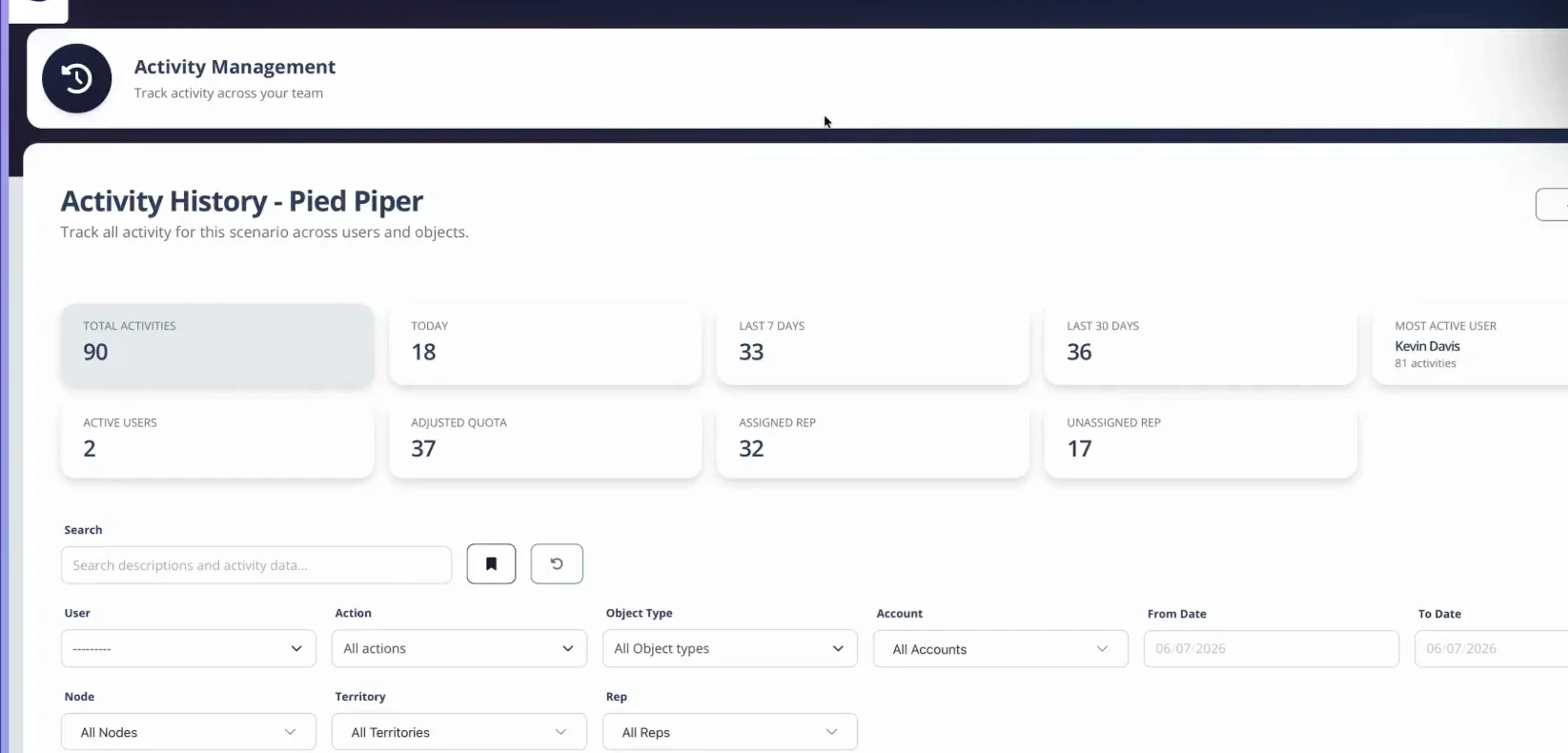
Activity History records territory actions by user and time so teams can review how the model changed.
Territory2: The Decision Test
For Territory2: The Decision Test, make the implicit policy inspectable at account level. Use Territory2 to test whether the live state, future scenario, and approved Salesforce result remain consistent; record exceptions instead of hiding them in a person field.
attribution: The Decision Test
For attribution: The Decision Test, make the implicit policy inspectable at account level. Use attribution to test whether the live state, future scenario, and approved Salesforce result remain consistent; record exceptions instead of hiding them in a person field.
effective dating: The Decision Test 2
For effective dating: The Decision Test 2, make the implicit policy inspectable at account level. Use effective dating to test whether the live state, future scenario, and approved Salesforce result remain consistent; record exceptions instead of hiding them in a person field.
A Practical Decision Lens 2: Territory Effective Dating
A practical test is to pick one surprising account and trace it end to end. Explain why it is in the segment, why it belongs in the territory, whether it is locked, which goals it affects, and what happens when the seller changes. If the answer requires several private spreadsheets, the model is not yet governed. Use one current-state baseline to keep every territory effective dating scenario comparable.
Use this module to make the hidden decision explicit. State the role, population, evidence, rule, exception path, and operating consequence. The objective is not a perfectly clean model; it is a model whose compromises are visible enough to approve, communicate, and improve. For territory effective dating, name the approver, the permitted evidence, and the condition that would justify a departure from the rule.
How the Alternatives Differ: Territory Effective Dating
Compare alternatives against the same population and definitions. One option may improve effective dating, another may protect audit trail, and a third may reduce disruption. Do not let each option use a different denominator or source date; that turns scenario review into a presentation contest. For territory effective dating, name the approver, the permitted evidence, and the condition that would justify a departure from the rule.
The right answer depends on the role and market. Fair does not mean equal across unlike jobs. It means comparable roles are measured by the same published standard, while legitimate differences in motion, capacity, and responsibility receive their own standard. Keep account-level results beside the territory effective dating summary so audit trail remains inspectable after approval.
Decision Note: audit trail
For Decision Note: audit trail, connect the choice to seller, customer, and operating consequences. Use Territory2 to test whether the live state, future scenario, and approved Salesforce result remain consistent; record exceptions instead of hiding them in a person field.
Decision Worksheet
| Decision | Evidence to inspect | Control |
|---|---|---|
| Define the population | effective dating and comparable roles | Named data owner |
| Measure the current state | audit trail and Current State Scenario | Source date and baseline |
| Choose the tradeoff | Scenario comparison and complete Territory Health | Recorded approver |
| Activate the result | Account roster, changes, quota, and transition rules | Effective date and correction path |
Source of Truth and Identity Controls
Create a field-level source map for territory effective dating. Name the authoritative system for account identity, hierarchy, segment, owner, territory, role, opportunity, and customer obligation. Reconcile records with a stable external ID, flag unmatched accounts, and prevent a local spreadsheet or custom person field from quietly becoming another golden record. Use effective dating as the account-level test for this control.
Current-to-Future Scenario Test
Preserve the live Salesforce configuration as a dated Current State Scenario before evaluating territory effective dating. Build the proposed model separately, compare every changed account and role, and keep rejected alternatives available. Reviewers should see both the summary tradeoff and the exact records behind it. For audit trail, record the assumption that would cause the future state to change.
Approval and Exception Review
Classify feedback on territory effective dating as a data correction, policy exception, or preference. Corrections update governed evidence; exceptions require a reason, owner, and expiry or review condition; preferences remain visible without silently changing the model. Name one Approver and use Current State Scenario to show which evidence that person considered.
Frequently Asked Questions
How do you handle territory effective dates?
Territory effective dating records when a territory, account association, role, exception, or policy state begins and ends so historical ownership and responsibility can be reconstructed accurately. Exact dates introduce transition and attribution policy choices, while immediate overwrites are operationally simpler; the simplicity disappears when Finance, Sales, or the customer later asks who was responsible at a prior point. Use the published definitions and complete-territory result instead of relying on one universal benchmark.
How do you attribute a deal after a territory change?
Preserve the current assignment, define the approved future assignment and effective date, record the reason and approver, keep both states until activation, reconcile the live Territory2 records, and retain the prior-state audit trail. If an account moves on April 1 after a March opportunity was created, the history should show March coverage, the April assignment, the approved transition rule, and the separate attribution decision for the deal. Publish the assumptions so another reviewer can reproduce the answer.
What data is required for territory effective dating?
For territory effective dating, assemble governed account data, current assignments, role capacity, and decision evidence for effective dating, audit trail, and Current State Scenario. Date the sources and publish the definitions so another reviewer can reproduce the result and separate a factual correction from a policy exception.
How often should territory effective dating be reviewed?
Review territory effective dating on the formal planning cadence and whenever the inputs behind effective dating, audit trail, and Current State Scenario change materially. Keep customer and pipeline ownership stable between reviews; reopen the model when strategy or new evidence changes the decision, not merely because a manager prefers a different assignment.
How should Salesforce and the planning layer divide responsibility?
For territory effective dating, keep the governed source data behind effective dating, audit trail, and Current State Scenario in its approved system, compare current and future states in the planning layer, and operate only approved assignments in Salesforce. Stable identifiers, field ownership, and a dated sync prevent competing records of truth.
How should territory changes be tested before activation?
Changes to territory effective dating should be tested by freezing the live Salesforce state, validating the inputs behind effective dating, audit trail, and Current State Scenario, modeling the proposed future scenario, inspecting account-level differences and exceptions, and recording approval. Activate on a defined date and reconcile the deployed result to the approved scenario.
About the author: Tyler Thompson is Co-Founder & CTO of BoogieBoard.
In Summary
Effective dates are what let you answer 'who owned this in March' six months later. Most orgs cannot. Use the sequence above to keep the decision governed, evidence-based, and inspectable at both the account and territory levels.
See Territory Planning in Practice
Watch practical territory-design workflows on the BoogieBoard YouTube channel.