5 Key Takeaways
- At six figures of accounts, manual assignment is not slow, it is impossible. The failure mode is silent, not loud.
- Accurate assignment at scale means every eligible account is matched to a governed identity, evaluated against reproducible rules, placed once or deliberately excluded, and reconciled without manual record-by-record judgment.
- Normalize identity and hierarchies, deduplicate with stable IDs, govern enrichment fields, compile assignment rules, process in batches, isolate unmatched and multi-matched records, sample results, reconcile totals, and monitor drift.
- More enrichment and more rule branches can reduce some unresolved cases, but they also increase conflicts, cost, and maintenance; scale rewards fewer governed facts and explicit exception handling.
- The process fails silently when totals appear complete but duplicate records, null criteria, overlapping rules, deliberate exclusions, and manual overrides are not reported as separate populations.
At six figures of accounts, manual assignment is not slow, it is impossible. The failure mode is silent, not loud. That position is useful only when the planning team can translate it into inputs, decisions, controls, and a result the field can understand.
BoogieBoard treats accurate territory assignment at scale as part of a governed change process. The model must connect market strategy with account-level evidence, productive capacity, explicit decision rights, and controlled activation. The objective is not to remove judgment. It is to make judgment visible and repeatable.
The central position is: Enriching too many accounts, too often, with too many vendors is the failure set. The sections below turn that position into definitions, alternatives, procedures, examples, controls, and an operating decision.
Working Definitions
- assignment rule: a repeatable condition that determines where an eligible record belongs.
- unassigned account: an account with no accountable role or eligible territory assignment.
- fuzzy match: a probabilistic comparison used to identify records that are similar but not identical.
- enrichment: the controlled addition or refresh of account attributes from an external data source.
- Territory2Rule: the Salesforce object that stores account-assignment rules for an Enterprise Territory Management territory.
BoogieBoard observes that 20% to 60% of CRM accounts are unassigned to an AE, AM, or CSM, and the gap does not disappear with company size. The range includes deliberate exclusions and accidental routing gaps, which must be measured separately. For accurate territory assignment at scale, use that observation only for the claim and population it directly supports.
Independent evidence provides a separate check for accurate territory assignment at scale: Salesforce's territory-management best practices explain that assignment rules are evaluated by territory, advise against using the rule engine to clean data, and recommend keeping the standard rule structure inspectable.
What Is Accurate Territory Assignment At Scale?
Accurate assignment at scale means every eligible account is matched to a governed identity, evaluated against reproducible rules, placed once or deliberately excluded, and reconciled without manual record-by-record judgment. Separate identity, enrichment, and assignment. Identity determines which company the record represents; enrichment supplies governed facts; assignment applies policy. Combining those layers makes accurate territory assignment at scale difficult to diagnose. In accurate territory assignment at scale, test the choice against unassigned account, then record any accepted exception in the decision log.
Calculating and Testing Accurate Territory Assignment At Scale
For 100,000 accounts, the team can route by approved segment and country rules, hold 4,000 unresolved records in an exception queue, sample each outcome class, and activate only after counts and account lists reconcile. Take one account with a missing Website, two similar names, and conflicting employee counts. Establish identity first, choose the governed source, then rerun assignment. The answer should show how assignment rule, unassigned account, and fuzzy match changed the result. The accurate territory assignment at scale review is complete only when fuzzy match and the affected account roster tell the same story.
The Decision Rule
The process fails silently when totals appear complete but duplicate records, null criteria, overlapping rules, deliberate exclusions, and manual overrides are not reported as separate populations. A practical test is to pick one surprising account and trace it end to end. Explain why it is in the segment, why it belongs in the territory, whether it is locked, which goals it affects, and what happens when the seller changes. If the answer requires several private spreadsheets, the model is not yet governed. Use one current-state baseline to keep every accurate territory assignment at scale scenario comparable.
The Evidence Standard
More enrichment and more rule branches can reduce some unresolved cases, but they also increase conflicts, cost, and maintenance; scale rewards fewer governed facts and explicit exception handling. Use this module to make the hidden decision explicit. State the role, population, evidence, rule, exception path, and operating consequence. The objective is not a perfectly clean model; it is a model whose compromises are visible enough to approve, communicate, and improve. For accurate territory assignment at scale, name the approver, the permitted evidence, and the condition that would justify a departure from the rule.
The Population Test
For The Population Test, make the implicit policy inspectable at account level. Use assignment rule to test whether the source record, match result, assignment result, and exception queue reconcile; keep the account-level evidence visible.
How to Put Accurate Territory Assignment At Scale Into Practice
Normalize identity and hierarchies, deduplicate with stable IDs, govern enrichment fields, compile assignment rules, process in batches, isolate unmatched and multi-matched records, sample results, reconcile totals, and monitor drift. How to Put Accurate Territory Assignment At Scale Into Practice should produce a measurable account population before the next step begins. Record source fields, match result, rule result, exception class, and owner. Reconcile totals and account lists instead of assuming a completed job was correct. Give the accurate territory assignment at scale decision a source date, an owner, and a condition that would trigger revision.
| Outcome class | Required report | Operating action |
|---|---|---|
| Assigned once | Count and account roster | Sample and approve |
| Multi-matched | Competing rules and precedence | Resolve collision |
| Unresolved | Missing identity, data, or rule reason | Correct or route to queue |
| Deliberately excluded | Policy and review date | Keep outside coverage intentionally |
| Changed on rerun | Prior and new result | Validate before activation |
Common Models and Variations: Accurate Territory Assignment At Scale
No model removes judgment. Geographic, named-account, segment, industry, customer, and hybrid structures each solve a different constraint. Use the fewest logical layers that express the strategy, then state where a deliberate override is allowed. Complexity should correspond to a real customer or operating need, not inherited convention. Before activating accurate territory assignment at scale, show managers the effect on fuzzy match and every downstream rule that depends on it.
Policy and Governance: Accurate Territory Assignment At Scale
Use this module to make the hidden decision explicit. State the role, population, evidence, rule, exception path, and operating consequence. The objective is not a perfectly clean model; it is a model whose compromises are visible enough to approve, communicate, and improve. For accurate territory assignment at scale, document the effect on assignment rule before the model advances.
See Account Routing in the Planning Workflow
The relevant product workflow is Manage Unassigned and Unrouted Accounts. BoogieBoard Scenario Planning keeps the account-level assumptions, tradeoffs, and proposed assignments visible while the team completes that work.
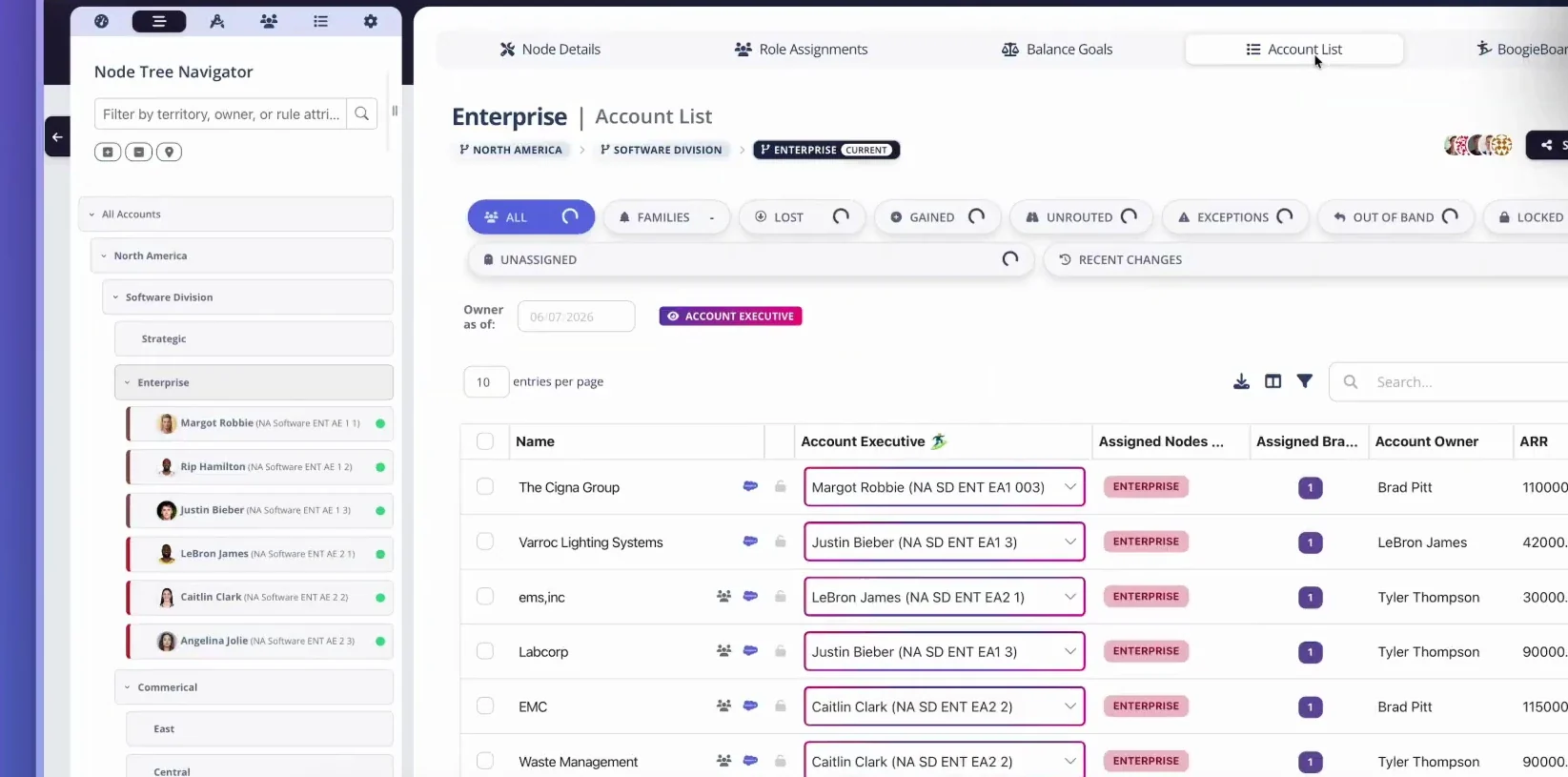
The account list exposes unassigned records so operators can inspect and correct assignment outcomes directly.
The Role Test
For The Role Test, make the implicit policy inspectable at account level. Use Territory2Rule to test whether the source record, match result, assignment result, and exception queue reconcile; keep the account-level evidence visible.
From the Accurate Territory Assignment At Scale Result to Action
Take one account with a missing Website, two similar names, and conflicting employee counts. Establish identity first, choose the governed source, then rerun assignment. The answer should show how assignment rule, unassigned account, and fuzzy match changed the result. The accurate territory assignment at scale review is complete only when fuzzy match and the affected account roster tell the same story.
The Workload Test
For The Workload Test, make the implicit policy inspectable at account level. Use unassigned account to test whether the source record, match result, assignment result, and exception queue reconcile; keep the account-level evidence visible.
The Continuity Test
For The Continuity Test, make the implicit policy inspectable at account level. Use fuzzy match to test whether the source record, match result, assignment result, and exception queue reconcile; keep the account-level evidence visible.
Source-System Responsibility
For Source-System Responsibility, trace the change from source data through Salesforce activation. Use enrichment to test whether the source record, match result, assignment result, and exception queue reconcile; keep the account-level evidence visible.
Common Failure Modes: Accurate Territory Assignment At Scale
The common failure is treating a data defect as a routing defect. A rule cannot recover an account whose identity is missing or contradictory. Fix assignment rule, unassigned account, and fuzzy match at the governed source instead of adding another override. Give the accurate territory assignment at scale decision a source date, an owner, and a condition that would trigger revision.
Decision Worksheet
| Decision | Evidence to inspect | Control |
|---|---|---|
| Govern the identity | assignment rule and unassigned account | Named source owner |
| Test the data | fuzzy match and enrichment | Match and duplicate report |
| Reconcile assignment | Assigned, unresolved, excluded, and multi-matched accounts | Account-level exception queue |
| Operate corrections | Prior value, evidence, corrected value, and rerun result | Owner and response time |
Identity Authority
Name the system and team that govern account identity; a display name is not enough to reconcile one company across imports, enrichment, CRM, and planning. For accurate territory assignment at scale, use assignment rule to record the evidence, decision owner, affected account population, and condition that closes this review.
Stable Identifier Coverage
Measure the eligible population with and without a stable external identifier, then isolate records whose identity depends on a mutable name or website. For accurate territory assignment at scale, use unassigned account to record the evidence, decision owner, affected account population, and condition that closes this review.
Parent-Child Hierarchy Review
Inspect parents, subsidiaries, branches, and acquired entities before routing; decide whether the hierarchy changes assignment, collaboration, reporting, or only rollup. For accurate territory assignment at scale, use fuzzy match to record the evidence, decision owner, affected account population, and condition that closes this review.
Required Field Controls
Identify the smallest set of fields every assignment rule truly needs, name their sources, and stop incomplete records before they enter silent routing failure. For accurate territory assignment at scale, use enrichment to record the evidence, decision owner, affected account population, and condition that closes this review.
Matching Rule Test
Run exact and fuzzy matching separately, record confidence and precedence, and sample both accepted and rejected matches instead of reviewing only obvious duplicates. For accurate territory assignment at scale, use Territory2Rule to record the evidence, decision owner, affected account population, and condition that closes this review.
Duplicate Resolution Queue
Give possible duplicates an owner, evidence requirement, disposition, and response time; preserve aliases and prior IDs when records are merged. For accurate territory assignment at scale, use assignment rule to record the evidence, decision owner, affected account population, and condition that closes this review.
Eligibility Population
Define which accounts are eligible for assignment before applying territory logic, and report deliberate exclusions separately from records that fail because data is missing. For accurate territory assignment at scale, use unassigned account to record the evidence, decision owner, affected account population, and condition that closes this review.
Rule Collision Review
List accounts that satisfy more than one rule, show which precedence resolved each collision, and test whether the same condition appears in multiple branches. For accurate territory assignment at scale, use fuzzy match to record the evidence, decision owner, affected account population, and condition that closes this review.
Unresolved Account Queue
Keep unmatched and unassigned accounts visible with a reason code, value at risk, age, and next action instead of treating them as absent from the model. For accurate territory assignment at scale, use enrichment to record the evidence, decision owner, affected account population, and condition that closes this review.
Deliberate Exclusion Register
Document non-serviceable, disqualified, house, or otherwise excluded accounts with the policy, owner, and review date that justify leaving them uncovered. For accurate territory assignment at scale, use Territory2Rule to record the evidence, decision owner, affected account population, and condition that closes this review.
Batch Count Reconciliation
Reconcile the starting eligible population with assigned-once, multi-matched, unresolved, and deliberately excluded outcomes before approving a batch. For accurate territory assignment at scale, use assignment rule to record the evidence, decision owner, affected account population, and condition that closes this review.
Account-Level Sampling
Sample changed, unchanged, high-value, edge-case, and exception accounts; trace each from source facts through matching, assignment, and live ownership. For accurate territory assignment at scale, use unassigned account to record the evidence, decision owner, affected account population, and condition that closes this review.
Correction Evidence
Require the account ID, disputed value, authoritative evidence, requested correction, and downstream assignments affected by the change. For accurate territory assignment at scale, use fuzzy match to record the evidence, decision owner, affected account population, and condition that closes this review.
Frequently Asked Questions
How do you assign 100,000 accounts to territories?
Accurate assignment at scale means every eligible account is matched to a governed identity, evaluated against reproducible rules, placed once or deliberately excluded, and reconciled without manual record-by-record judgment. More enrichment and more rule branches can reduce some unresolved cases, but they also increase conflicts, cost, and maintenance; scale rewards fewer governed facts and explicit exception handling. Use the published definitions and complete-territory result instead of relying on one universal benchmark.
What percentage of accounts end up unrouted?
Normalize identity and hierarchies, deduplicate with stable IDs, govern enrichment fields, compile assignment rules, process in batches, isolate unmatched and multi-matched records, sample results, reconcile totals, and monitor drift. For 100,000 accounts, the team can route by approved segment and country rules, hold 4,000 unresolved records in an exception queue, sample each outcome class, and activate only after counts and account lists reconcile. Publish the assumptions so another reviewer can reproduce the answer.
What data is required for accurate territory assignment at scale?
For accurate territory assignment at scale, assemble governed account data, current assignments, role capacity, and decision evidence for assignment rule, unassigned account, and fuzzy match. Date the sources and publish the definitions so another reviewer can reproduce the result and separate a factual correction from a policy exception.
How often should accurate territory assignment at scale be reviewed?
Review accurate territory assignment at scale on the formal planning cadence and whenever the inputs behind assignment rule, unassigned account, and fuzzy match change materially. Keep customer and pipeline ownership stable between reviews; reopen the model when strategy or new evidence changes the decision, not merely because a manager prefers a different assignment.
How should account-data errors be corrected?
Preserve the disputed account ID and prior value, identify the authoritative source, classify the issue as identity, hierarchy, attribute, match, or rule logic, approve the correction, and rerun assignment. Show the reporter the corrected result. Apply that rule to accurate territory assignment at scale using the definitions in this article.
How do you distinguish deliberate exclusions from routing failures?
Report eligible accounts that are assigned once, assigned more than once, unresolved by accident, and excluded deliberately. Policy exclusions are a coverage choice; accidental gaps are an operating defect. Apply that rule to accurate territory assignment at scale using the definitions in this article.
About the author: George James is Co-Founder & CPO of BoogieBoard.
In Summary
At six figures of accounts, manual assignment is not slow, it is impossible. The failure mode is silent, not loud. Use the sequence above to keep the decision governed, evidence-based, and inspectable at both the account and territory levels.
See Territory Planning in Practice
Watch practical territory-design workflows on the BoogieBoard YouTube channel.