5 Key Takeaways
- Most assignment errors are data errors wearing a routing costume. Make Website required at creation and half of them disappear.
- A territory assignment error is an account that receives no territory, the wrong territory, conflicting territories, or an assignment that cannot be reproduced from the governed data and rule.
- Require Website and a stable Provider ID at creation, resolve duplicates and hierarchies, validate rule inputs, preview unmatched and multi-matched accounts, reconcile the output, and publish a correction path.
- Stricter creation controls add work at the front door, while permissive entry feels faster; the downstream cost appears as duplicates, failed enrichment, routing exceptions, and assignments nobody trusts.
- The process fails when RevOps treats every bad result as a routing defect, because a faster rule cannot repair an account that lacks a usable identity or contains conflicting source facts.
Most assignment errors are data errors wearing a routing costume. Make Website required at creation and half of them disappear. That position is useful only when the planning team can translate it into inputs, decisions, controls, and a result the field can understand.
BoogieBoard treats reducing territory assignment errors as part of a governed change process. The model must connect market strategy with account-level evidence, productive capacity, explicit decision rights, and controlled activation. The objective is not to remove judgment. It is to make judgment visible and repeatable.
The central position is: Make Website a required field on record creation. The sections below turn that position into definitions, alternatives, procedures, examples, controls, and an operating decision.
Working Definitions
- assignment rule: a repeatable condition that determines where an eligible record belongs.
- golden record: the governed account record whose identifiers and approved attributes anchor downstream planning.
- fuzzy match: a probabilistic comparison used to identify records that are similar but not identical.
- Provider ID: a stable external identifier used to reconcile one account across source systems.
- unassigned account: an account with no accountable role or eligible territory assignment.
BoogieBoard observes that 20% to 60% of CRM accounts lack an AE, AM, or CSM assignment, with accidental and deliberate gaps requiring different treatment. Website is also missing on roughly 10% to 30% of imported accounts. These are observed planning ranges, not universal market rates. For reducing territory assignment errors, use that observation only for the claim and population it directly supports.
Independent evidence provides a separate check for reducing territory assignment errors: Powell, Lawson, and Baker documented how spreadsheet errors persist in operational models and why review controls matter.
A Practical Decision Lens: Reducing Territory Assignment Errors
The process fails when RevOps treats every bad result as a routing defect, because a faster rule cannot repair an account that lacks a usable identity or contains conflicting source facts. A practical test is to pick one surprising account and trace it end to end. Explain why it is in the segment, why it belongs in the territory, whether it is locked, which goals it affects, and what happens when the seller changes. If the answer requires several private spreadsheets, the model is not yet governed. In reducing territory assignment errors, test the choice against golden record, then record any accepted exception in the decision log.
Why the Decision Matters: Reducing Territory Assignment Errors
Stricter creation controls add work at the front door, while permissive entry feels faster; the downstream cost appears as duplicates, failed enrichment, routing exceptions, and assignments nobody trusts. This decision affects more than visual symmetry. It changes market coverage, seller focus, quota credibility, customer continuity, performance interpretation, and the amount of manual administration required during the year. Poor design transfers work to managers and sellers, who then create informal rules to keep operating. The reducing territory assignment errors review is complete only when fuzzy match and the affected account roster tell the same story.
Calculating and Testing Reducing Territory Assignment Errors
An Enterprise account with a blank Website and stale employee count can miss both matching and segment rules; fixing the identity record before rerunning assignment addresses the cause instead of manually choosing an owner. For a large population, reconcile records assigned once, assigned more than once, left unresolved, and excluded by policy. Sample each outcome class and trace it back to source data and rule logic before activation. Use one current-state baseline to keep every reducing territory assignment errors scenario comparable.
The Evidence Standard
For The Evidence Standard, make the implicit policy inspectable at account level. Use unassigned account to test whether the source record, match result, assignment result, and exception queue reconcile; keep the account-level evidence visible.
The Population Test
For The Population Test, make the implicit policy inspectable at account level. Use assignment rule to test whether the source record, match result, assignment result, and exception queue reconcile; keep the account-level evidence visible.
Source-System Responsibility
Require Website and a stable Provider ID at creation, resolve duplicates and hierarchies, validate rule inputs, preview unmatched and multi-matched accounts, reconcile the output, and publish a correction path. Test the complete path from account creation through matching, enrichment, assignment, exception review, and CRM result. Software should expose why assignment rule, golden record, and fuzzy match produced the outcome. Give the reducing territory assignment errors decision a source date, an owner, and a condition that would trigger revision.
The Account-Level Test
For The Account-Level Test, make the implicit policy inspectable at account level. Use fuzzy match to test whether the source record, match result, assignment result, and exception queue reconcile; keep the account-level evidence visible.
How to Put Reducing Territory Assignment Errors Into Practice
How to Put Reducing Territory Assignment Errors Into Practice should produce a measurable account population before the next step begins. Record source fields, match result, rule result, exception class, and owner. Reconcile totals and account lists instead of assuming a completed job was correct. For reducing territory assignment errors, document the effect on assignment rule before the model advances.
See Account Routing in the Planning Workflow
The relevant product workflow is Manage Unassigned and Unrouted Accounts. BoogieBoard Scenario Planning keeps the account-level assumptions, tradeoffs, and proposed assignments visible while the team completes that work.
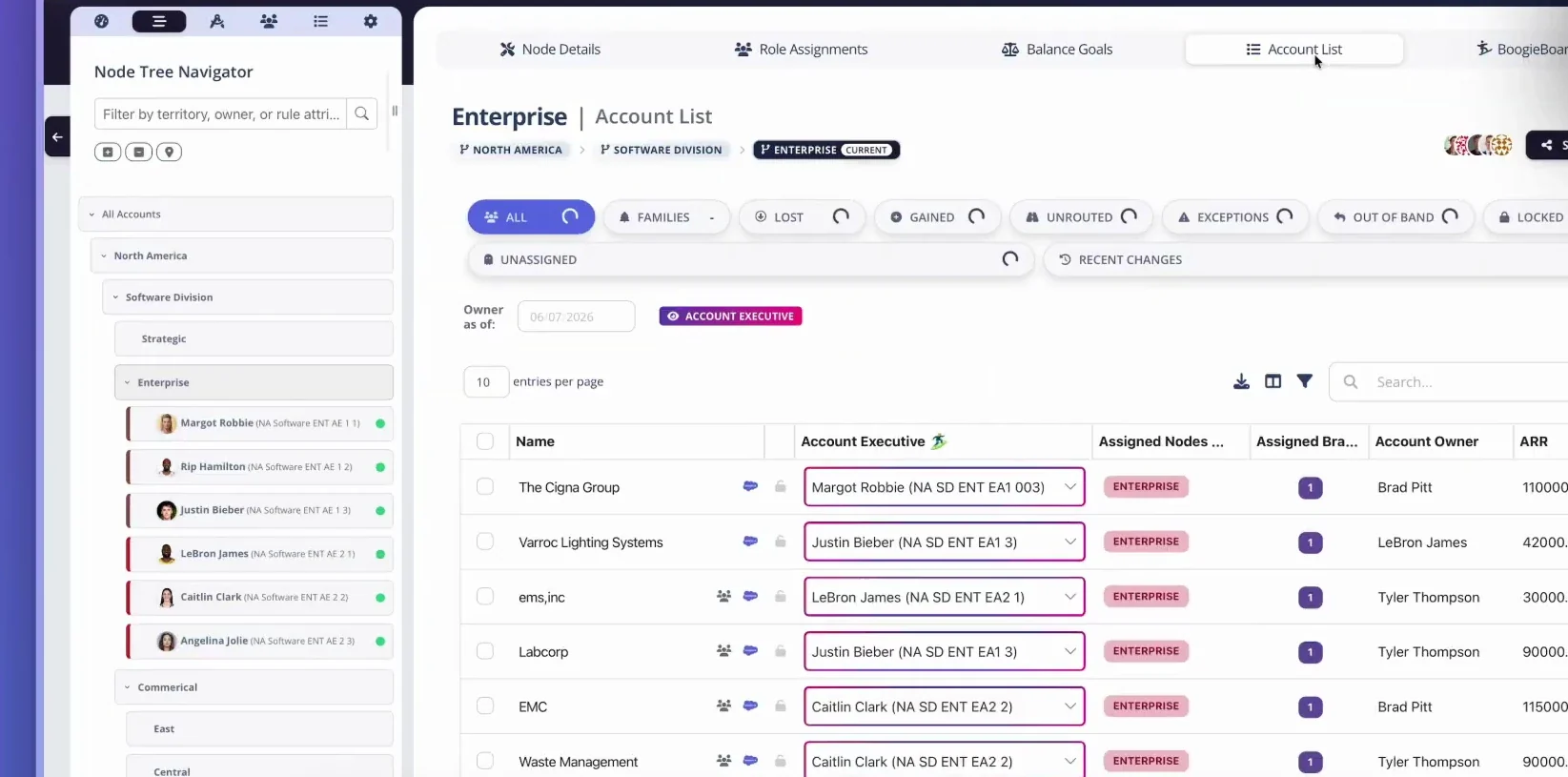
The account list exposes unassigned records so operators can inspect and correct assignment outcomes directly.
Map Each Field to a Source of Truth
For Map Each Field to a Source of Truth, produce a reviewable output before the next decision begins. Use unassigned account to test whether the source record, match result, assignment result, and exception queue reconcile; keep the account-level evidence visible.
Normalize Identity and Hierarchy
For Normalize Identity and Hierarchy, produce a reviewable output before the next decision begins. Use assignment rule to test whether the source record, match result, assignment result, and exception queue reconcile; keep the account-level evidence visible.
Test Matching and Duplicate Controls
For Test Matching and Duplicate Controls, produce a reviewable output before the next decision begins. Use golden record to test whether the source record, match result, assignment result, and exception queue reconcile; keep the account-level evidence visible.
Run Assignment Rules and Isolate Exceptions
For Run Assignment Rules and Isolate Exceptions, produce a reviewable output before the next decision begins. Use fuzzy match to test whether the source record, match result, assignment result, and exception queue reconcile; keep the account-level evidence visible.
Reconcile Counts and Account Results
For Reconcile Counts and Account Results, produce a reviewable output before the next decision begins. Use Provider ID to test whether the source record, match result, assignment result, and exception queue reconcile; keep the account-level evidence visible.
Publish the Correction Path and Monitor Drift
For Publish the Correction Path and Monitor Drift, produce a reviewable output before the next decision begins. Use unassigned account to test whether the source record, match result, assignment result, and exception queue reconcile; keep the account-level evidence visible.
Practical Implications
A territory assignment error is an account that receives no territory, the wrong territory, conflicting territories, or an assignment that cannot be reproduced from the governed data and rule.
Decision Worksheet
| Decision | Evidence to inspect | Control |
|---|---|---|
| Govern the identity | assignment rule and golden record | Named source owner |
| Test the data | fuzzy match and Provider ID | Match and duplicate report |
| Reconcile assignment | Assigned, unresolved, excluded, and multi-matched accounts | Account-level exception queue |
| Operate corrections | Prior value, evidence, corrected value, and rerun result | Owner and response time |
Identity Authority
Name the system and team that govern account identity; a display name is not enough to reconcile one company across imports, enrichment, CRM, and planning. For reducing territory assignment errors, use assignment rule to record the evidence, decision owner, affected account population, and condition that closes this review.
Stable Identifier Coverage
Measure the eligible population with and without a stable external identifier, then isolate records whose identity depends on a mutable name or website. For reducing territory assignment errors, use golden record to record the evidence, decision owner, affected account population, and condition that closes this review.
Parent-Child Hierarchy Review
Inspect parents, subsidiaries, branches, and acquired entities before routing; decide whether the hierarchy changes assignment, collaboration, reporting, or only rollup. For reducing territory assignment errors, use fuzzy match to record the evidence, decision owner, affected account population, and condition that closes this review.
Required Field Controls
Identify the smallest set of fields every assignment rule truly needs, name their sources, and stop incomplete records before they enter silent routing failure. For reducing territory assignment errors, use Provider ID to record the evidence, decision owner, affected account population, and condition that closes this review.
Matching Rule Test
Run exact and fuzzy matching separately, record confidence and precedence, and sample both accepted and rejected matches instead of reviewing only obvious duplicates. For reducing territory assignment errors, use unassigned account to record the evidence, decision owner, affected account population, and condition that closes this review.
Duplicate Resolution Queue
Give possible duplicates an owner, evidence requirement, disposition, and response time; preserve aliases and prior IDs when records are merged. For reducing territory assignment errors, use assignment rule to record the evidence, decision owner, affected account population, and condition that closes this review.
Eligibility Population
Define which accounts are eligible for assignment before applying territory logic, and report deliberate exclusions separately from records that fail because data is missing. For reducing territory assignment errors, use golden record to record the evidence, decision owner, affected account population, and condition that closes this review.
Rule Collision Review
List accounts that satisfy more than one rule, show which precedence resolved each collision, and test whether the same condition appears in multiple branches. For reducing territory assignment errors, use fuzzy match to record the evidence, decision owner, affected account population, and condition that closes this review.
Unresolved Account Queue
Keep unmatched and unassigned accounts visible with a reason code, value at risk, age, and next action instead of treating them as absent from the model. For reducing territory assignment errors, use Provider ID to record the evidence, decision owner, affected account population, and condition that closes this review.
Deliberate Exclusion Register
Document non-serviceable, disqualified, house, or otherwise excluded accounts with the policy, owner, and review date that justify leaving them uncovered. For reducing territory assignment errors, use unassigned account to record the evidence, decision owner, affected account population, and condition that closes this review.
Batch Count Reconciliation
Reconcile the starting eligible population with assigned-once, multi-matched, unresolved, and deliberately excluded outcomes before approving a batch. For reducing territory assignment errors, use assignment rule to record the evidence, decision owner, affected account population, and condition that closes this review.
Account-Level Sampling
Sample changed, unchanged, high-value, edge-case, and exception accounts; trace each from source facts through matching, assignment, and live ownership. For reducing territory assignment errors, use golden record to record the evidence, decision owner, affected account population, and condition that closes this review.
Correction Evidence
Require the account ID, disputed value, authoritative evidence, requested correction, and downstream assignments affected by the change. For reducing territory assignment errors, use fuzzy match to record the evidence, decision owner, affected account population, and condition that closes this review.
Controlled Reprocessing
Rerun corrected records through the same governed rules, capture the prior and new outcomes, and avoid manual owner edits that bypass the model. For reducing territory assignment errors, use Provider ID to record the evidence, decision owner, affected account population, and condition that closes this review.
Data Drift Monitoring
Track null growth, staleness, duplicate creation, match-rate changes, manual overrides, and assignment exceptions after launch. For reducing territory assignment errors, use unassigned account to record the evidence, decision owner, affected account population, and condition that closes this review.
Rule Change Control
Version assignment logic, record the approver and effective date, preview the affected population, and preserve the prior result for comparison. For reducing territory assignment errors, use assignment rule to record the evidence, decision owner, affected account population, and condition that closes this review.
Ownership and Response Times
Assign operating owners to source fields, matching, routing, exceptions, and seller corrections, with service expectations appropriate to commercial impact. For reducing territory assignment errors, use golden record to record the evidence, decision owner, affected account population, and condition that closes this review.
Frequently Asked Questions
Why do accounts end up unassigned?
A territory assignment error is an account that receives no territory, the wrong territory, conflicting territories, or an assignment that cannot be reproduced from the governed data and rule. Stricter creation controls add work at the front door, while permissive entry feels faster; the downstream cost appears as duplicates, failed enrichment, routing exceptions, and assignments nobody trusts. Use the published definitions and complete-territory result instead of relying on one universal benchmark.
How do you catch territory routing errors early?
Require Website and a stable Provider ID at creation, resolve duplicates and hierarchies, validate rule inputs, preview unmatched and multi-matched accounts, reconcile the output, and publish a correction path. An Enterprise account with a blank Website and stale employee count can miss both matching and segment rules; fixing the identity record before rerunning assignment addresses the cause instead of manually choosing an owner. Publish the assumptions so another reviewer can reproduce the answer.
What data is required for reducing territory assignment errors?
For reducing territory assignment errors, assemble governed account data, current assignments, role capacity, and decision evidence for assignment rule, golden record, and fuzzy match. Date the sources and publish the definitions so another reviewer can reproduce the result and separate a factual correction from a policy exception.
How often should reducing territory assignment errors be reviewed?
Review reducing territory assignment errors on the formal planning cadence and whenever the inputs behind assignment rule, golden record, and fuzzy match change materially. Keep customer and pipeline ownership stable between reviews; reopen the model when strategy or new evidence changes the decision, not merely because a manager prefers a different assignment.
How should account-data errors be corrected?
Preserve the disputed account ID and prior value, identify the authoritative source, classify the issue as identity, hierarchy, attribute, match, or rule logic, approve the correction, and rerun assignment. Show the reporter the corrected result. Apply that rule to reducing territory assignment errors using the definitions in this article.
How do you distinguish deliberate exclusions from routing failures?
Report eligible accounts that are assigned once, assigned more than once, unresolved by accident, and excluded deliberately. Policy exclusions are a coverage choice; accidental gaps are an operating defect. Apply that rule to reducing territory assignment errors using the definitions in this article.
About the author: Kevin Davis is Co-Founder & CEO of BoogieBoard.
In Summary
Most assignment errors are data errors wearing a routing costume. Make Website required at creation and half of them disappear. Use the sequence above to keep the decision governed, evidence-based, and inspectable at both the account and territory levels.
See Territory Planning in Practice
Watch practical territory-design workflows on the BoogieBoard YouTube channel.