5 Key Takeaways
- A CRM can store account records without providing an account-data strategy; strategy defines which facts matter, where they come from, who owns them, and how they are used.
- The manual method starts with a field inventory, assigns a source of truth, matches provider identities, normalizes values, publishes quality rules, and runs a recurring data scrub.
- First-party and third-party data serve different roles. First-party evidence reflects direct relationships; third-party data expands coverage but requires provenance, matching, freshness, and permitted-use controls.
- A golden record is not a perfect record. It is the governed account representation the company agrees to use, with visible conflicts and a repeatable process for resolving them.
- Automation becomes valuable when scale, refresh frequency, provider overlap, territory rules, and seller corrections make exports and one-time cleanup projects impossible to govern reliably.
Revenue Operations can spend heavily on CRM, enrichment, intent, product data, and AI while sellers still ask a basic question: "Which account facts should I trust?" The problem is rarely a complete absence of data. It is the absence of a shared operating policy for choosing, matching, refreshing, and applying it.
An account-data strategy defines the information your revenue organization needs, the primary and secondary sources for each field, the standards that make a record usable, the owners who resolve conflicts, and the processes that consume the result. Territory design is one of those processes. Routing, scoring, segmentation, reporting, capacity planning, and customer coverage depend on the same foundation.
This guide follows the same practical choice structure Qobra uses for a system that cannot perform a specialized job natively: first understand the limitation, then document the manual method, then decide when a connected platform is justified.
The Core Challenge: Your CRM Stores Data but Does Not Create a Data Strategy
A CRM is designed to record customer and prospect activity. It can enforce required fields, validation rules, ownership, and workflows. It cannot independently decide whether a provider's employee count should override a seller's research, whether a subsidiary inherits its parent's segment, or how long an intent signal remains useful.
Without a strategy, predictable problems appear:
- two vendors provide different values for the same attribute;
- subsidiaries and parent companies are duplicated or mislinked;
- enrichment overwrites better first-party knowledge;
- stale fields continue driving territory rules;
- sellers correct records in notes or messages rather than governed fields;
- AI-generated facts enter the CRM without a verifiable source;
- Operations performs a major cleanup before planning and watches quality decay afterward.
The objective is not a mythical perfect database. It is a golden record: the governed representation of an account that downstream systems agree to use. A golden record can contain uncertainty. What makes it valuable is that sources, conflicts, owners, and decisions are explicit.
Method 1: Build and Operate the Strategy Manually
A manual account-data strategy can work when the company has a manageable record count, few providers, slow-changing rules, and disciplined ownership. It still requires more than a field dictionary.
Step 1: Inventory the Decisions and Required Fields
Begin with decisions, not vendors. List the questions the business must answer:
- Which market and segment does this account belong to?
- Is it a prospect, customer, partner, or disqualified account?
- Which parent organization should govern coverage?
- Does it meet the ICP?
- Which territory is eligible to own it?
- Is there evidence of pain, intent, whitespace, churn risk, or renewal timing?
Map each decision to the minimum fields required. If a field does not influence a decision, workflow, message, or measurement, question whether it belongs in the strategy.
Step 2: Assign Primary and Secondary Sources of Truth
For every material field, name the source hierarchy.
| Data type | Typical primary source | Useful secondary source | Resolution rule |
|---|---|---|---|
| Contract and ARR | Billing or finance system | CRM opportunity | Finance-controlled value wins |
| Customer status | Customer platform or CRM | Product usage | Named owner resolves conflict |
| Employee count | Selected enrichment provider | Company disclosure | Use dated, sourced value |
| Parent hierarchy | Corporate-linkage provider | Legal and seller research | Preserve provider ID and manual exception |
| Technology | Technographic provider | Discovery notes | Timestamp both; do not silently overwrite |
| Pain evidence | First-party research | Public evidence | Store source and confidence |
The source hierarchy prevents last-write-wins behavior. A seller's verified correction may be more useful than a vendor update, but only if the system records why the exception exists and when it should be reviewed.
Step 3: Match Identities Before Merging Values
The hardest data problem is often identity. Names and websites change. Brands share domains. Subsidiaries use a parent's site. Duplicate records represent the same legal entity.
Maintain provider identifiers where possible. Normalize domains and legal names. Separate the account's selling identity from its ultimate parent and immediate parent. Define whether territory rules run at the entity, family, or buying-center level.
Dun & Bradstreet's documentation distinguishes forms of corporate linkage such as headquarters, branches, domestic ultimate parents, and global ultimate parents. That is useful independent evidence for a practical rule: hierarchy is data, not a formatting preference. See the D&B corporate-linkage documentation.
Step 4: Normalize Values and Publish Data Contracts
Normalization turns provider-specific values into governed business values. Examples include:
- mapping many industry labels into approved sales industries;
- converting employee and revenue ranges into consistent bands;
- standardizing countries, states, and time zones;
- deciding whether a parent or subsidiary determines segment;
- defining null, unknown, not applicable, and conflicting values separately.
Publish a data contract for every field that drives automation. Include definition, format, valid values, source, refresh cadence, owner, fallback, and downstream uses. This is the difference between a field that happens to exist and a field the organization can safely automate.
Step 5: Create a Data Hygiene Dashboard
A Data Hygiene Dashboard is the operational view of whether account data is fit for the decisions it drives. It should monitor:
- missing values in required routing and design fields;
- duplicates and unresolved hierarchy links;
- records with conflicting sources;
- provider records that failed to match;
- stale time-sensitive fields;
- seller correction volume and age;
- accounts falling through every territory rule;
- accounts matching multiple incompatible rules.
Measure quality by consequence. A missing field that blocks 2,000 accounts from routing matters more than a cosmetic field that is incomplete on 20,000 records.
Step 6: Run a Recurring Scrub and Resolution Process
A data scrub is not merely an export and cleanup. It is a decision process:
- identify defects through the dashboard;
- group them by cause and downstream impact;
- assign an owner and resolution deadline;
- correct the source or transformation, not only the output;
- rerun matching and dependent rules;
- record exceptions and unresolved uncertainty;
- measure whether the same defect returns.
The cadence should match volatility. Contract values may update with transactions. employee counts may refresh monthly or quarterly. Corporate hierarchy might be reviewed before planning and on material events. Pain and intent evidence can decay much faster.
Limitations of the Manual Method
Manual governance is viable until coordination becomes the system. Watch for five warning signs:
Provider Overlap
Multiple enrichment tools write competing versions of the same fields, and no source hierarchy is enforced.
Uncontrolled Refreshes
A bulk enrichment job changes segments or territory eligibility without showing which records will move.
Identity Exceptions at Scale
Teams maintain large matching workbooks for domains, brands, subsidiaries, and parent relationships. The workbook becomes more authoritative than the CRM but has no durable audit trail.
Planning-Season Cleanup
Data quality is treated as a project immediately before territory planning. The team spends weeks cleaning records, then uses one-time transformations that cannot be repeated during the year.
Seller Distrust
Sellers ignore official priorities because they cannot see the source, freshness, or correction path. They build private account lists and the company loses the resulting learning.
BoogieBoard's survey of 583 companies found broad use of major providers such as ZoomInfo, HG Insights, and Dun & Bradstreet alongside substantial dissatisfaction with third-party data. The observation does not prove that any provider is universally weak. It shows why vendor purchase and data strategy cannot be treated as the same decision.
Method 2: Connect Data Governance to Territory Operations
Automation should preserve the strategy rather than conceal it. A connected workflow can pull records and provider identities, apply normalized definitions, expose quality failures, test territory rules, and preview changes before writing approved assignments back to the CRM.
The useful operating sequence is:
- sync the current account and ownership state;
- retain source fields and provider identifiers;
- normalize only through published mappings;
- surface unmatched, missing, stale, and conflicting records;
- test routing and territory logic in a draft Scenario;
- inspect accounts that move or remain unassigned;
- approve the future state;
- deploy controlled changes and preserve the history.
BoogieBoard Account Routing connects the data contract to the coverage decision. RevOps can see whether records satisfy territory rules, investigate why they do not, and compare future assignments without using the live CRM as the design environment.
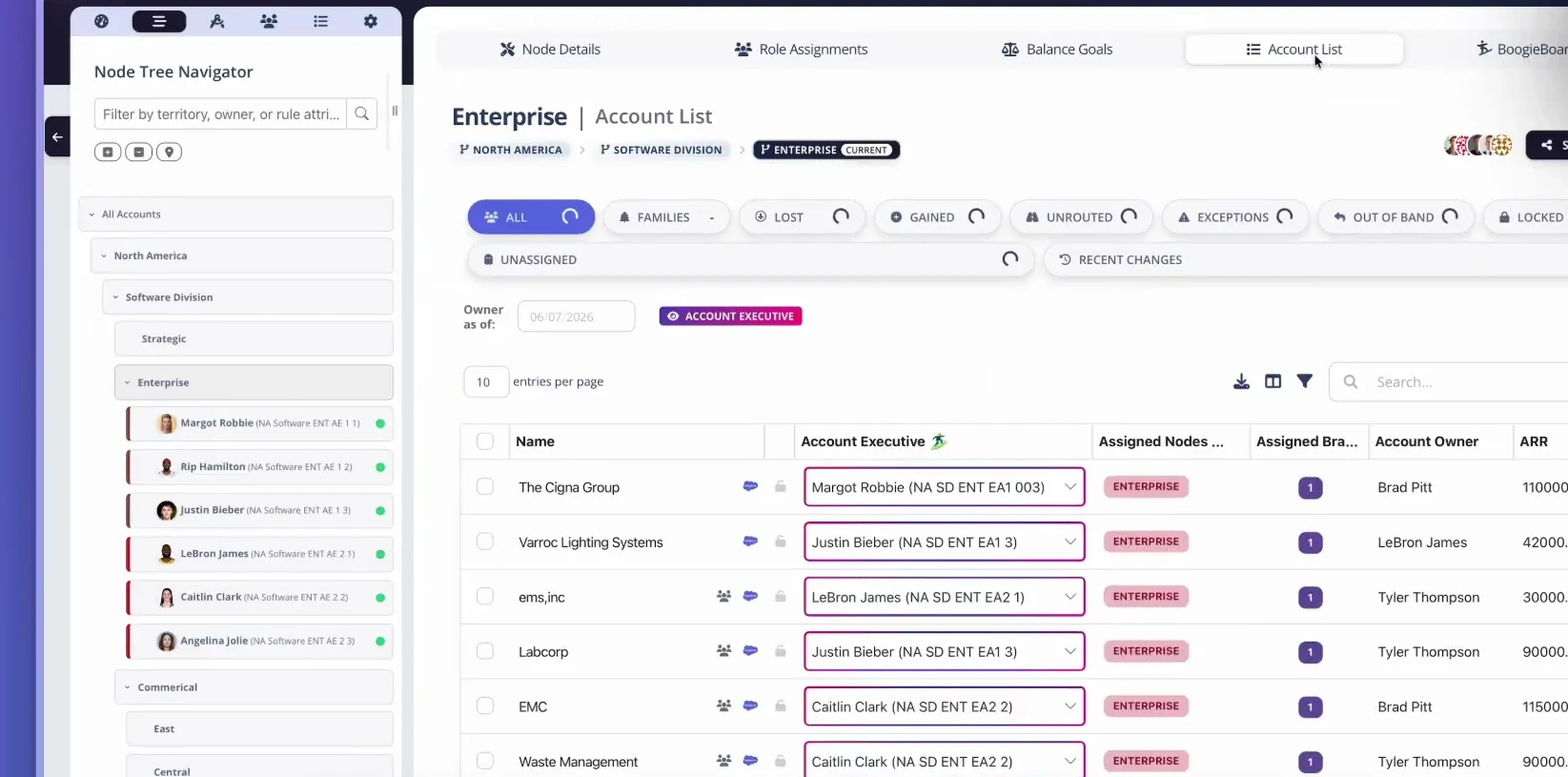
The account list exposes unassigned records so operators can inspect and correct assignment outcomes directly.
This is especially important when an enrichment refresh changes a field used by Territory Logic. A new employee band or parent association should not silently move a strategic account. The system should show the proposed consequence, apply Account Locking Criteria where continuity requires it, and make the exception visible.
Choosing the Right Operating Model
| Condition | Manual governance may fit | Connected operating model is usually better |
|---|---|---|
| Team and record scale | Small and stable | Large, growing, or multi-region |
| Providers | One primary provider | Several overlapping sources |
| Refresh cadence | Infrequent | Continuous or frequent |
| Territory logic | Simple and static | Multi-variable with exceptions |
| Hierarchy | Limited | Complex corporate families |
| Change control | Few downstream automations | Routing, scoring, planning, and reporting depend on fields |
| Seller feedback | Low volume | Structured corrections needed at scale |
Do not automate an unresolved policy. If nobody can decide which source wins or what a segment means, software will only apply the ambiguity faster. Define the contract first, then use automation to enforce it consistently.
A 30-Day Account-Data Operating Plan
The strategy becomes useful when it has an owner and a cadence. A focused first month can establish the operating spine without attempting to clean every record.
Week 1: Scope the Decisions
Choose one high-value workflow, such as territory eligibility or segment assignment. Inventory only the fields it depends on, profile their completeness and distributions, and identify the teams that create or consume them.
Week 2: Lock the Data Contract
Define the field meaning, primary source, secondary source, permitted values, refresh cadence, owner, conflict rule, and downstream use. Review a sample of edge cases with Sales, Systems, and Finance. Record unresolved questions rather than hiding them in transformations.
Week 3: Reconcile and Test
Match identities, normalize values, resolve high-impact defects, and run the workflow in a draft environment. Inspect records that are unassigned, multiply assigned, unexpectedly moved, or dependent on a low-confidence value.
Week 4: Publish and Monitor
Activate the approved logic, open a seller correction channel, and launch the first Data Hygiene Dashboard. Set a weekly operating review for defects that affect routing or planning and a less frequent policy review for definitions and source changes.
At the end of 30 days, the team should have a repeatable method for one decision, not a presentation claiming the entire database is clean. Extend the same contract pattern to the next workflow. This creates durable progress and reveals where the architecture, provider mix, or ownership model needs to change.
What to Document for Every Provider
Maintain the commercial and technical context around external data: contract owner, annual spend, covered markets, field inventory, provider identifiers, match rate, refresh method, permitted use, overwrite policy, and exit plan. Sharing the relevant parts with sellers can also improve trust. People are more likely to correct data constructively when they understand what the company bought and how it expects the source to be used.
Keep AI Inside the Same Contract
LLM-assisted research does not need a separate standard. It needs the same provenance and decision controls as every other source. Store the underlying evidence, distinguish extracted fact from model inference, timestamp the research, and assign a human owner for consequential fields.
Do not let generated output overwrite a governed CRM value or trigger account movement without review. A model can help summarize public evidence, classify a pain hypothesis, or identify records that deserve investigation. It should not become an invisible source of truth. When a seller challenges a generated claim, the reviewer must be able to inspect the original evidence and correct the reusable prompt or rule, not just one output.
An account-data strategy succeeds when the sales team can answer three questions without archaeology: What do we believe about this account? Where did that belief come from? What happens if it is wrong? That clarity makes better territory planning possible, but it also improves every system that relies on the same account.
Frequently Asked Questions
What is the difference between first-party and third-party account data?
First-party data comes from your company's direct interactions and systems, such as contracts, CRM activity, product usage, research, and support history. Third-party data comes from external providers. Both can be valuable; they need different sourcing, freshness, and conflict rules.
Should one system be the source of truth for every field?
No. The organization needs a governed source for each field or decision, not one universal system for all facts. Finance may govern ARR, a linkage provider may inform hierarchy, and verified seller research may govern a specific pain hypothesis.
How should teams use LLM-generated account research?
Treat it as a research aid, never as an unsourced fact. Require links to primary evidence, record the date, separate inference from observation, and prevent generated claims from automatically changing routing or territory ownership.
How often should account data be refreshed?
Match cadence to volatility and consequence. Transactional fields may update continuously; company size or hierarchy can refresh periodically; intent and engagement signals may expire quickly. Publish the cadence and monitor staleness.
What should a Data Hygiene Dashboard measure first?
Start with defects that change business outcomes: records that cannot route, match conflicting rules, have unresolved parents, or use stale fields in prioritization. Completeness percentages without decision context can be misleading.
See the Workflow
Watch account and territory workflows on the BoogieBoard YouTube channel.
About the author: George James is Co-Founder & CPO of BoogieBoard.
Related Content
- Salesforce Territory Tracking: Complete 2026 Guide
- Salespeople Are Surfers, Not Hunters
- Balance Goals: Complete Guide to Territory Equity