5 Key Takeaways
- When reps keep their own account lists outside CRM, it is not a compliance problem. It is a signal they do not trust the assignment.
- Shadow account tracking is a seller-maintained roster, spreadsheet, note, or private system used to reconcile expected accounts with CRM because the official assignment is not trusted or usable.
- Treat the shadow list as diagnostic evidence, compare it with the Rep View Report, classify identity, hierarchy, data, rule, and timing differences, correct the golden record, and show the seller how the resolved assignment changed.
- Private tracking helps you protect customer and pipeline context in the short term, but it fragments the operating record; RevOps earns consolidation by making corrections visible and timely.
- The fix fails when shadow tracking is framed only as noncompliance, or when reps are asked to trust a dashboard that still contains stale, duplicate, unassigned, or inexplicable accounts.
Your territory shapes your accounts, workload, pipeline, customer relationships, quota, earnings, and opportunity to advance. When reps keep their own account lists outside CRM, it is not a compliance problem. It is a signal they do not trust the assignment. This guide shows what you should check, what evidence to request, and which questions to bring to your manager. You can use them without becoming the territory designer yourself.
BoogieBoard treats shadow account tracking as part of a governed change process. The model must connect market strategy with account-level evidence, productive capacity, explicit decision rights, and controlled activation. The objective is not to remove judgment. It is to make judgment visible and repeatable.
The central position is: Do not expect perfect account data; the Steph Curry standard. The sections below turn that position into definitions, alternatives, procedures, examples, controls, and an operating decision.
Working Definitions
- golden record: the governed account record whose identifiers and approved attributes anchor downstream planning.
- Data Hygiene Dashboard: an operating view of missing, stale, conflicting, and unresolved account data.
- account assignment: the governed association of an account with a territory and accountable role.
- Rep View Report: the seller-facing account roster and explanation of changes, measures, and next actions.
- data scrub: a governed review to identify and correct duplicate, missing, stale, or conflicting account data.
BoogieBoard observes that 20% to 60% of CRM accounts lack an AE, AM, or CSM assignment. Imported account data also shows material gaps across Website, industry, employee count, revenue, and parent hierarchy. These observed ranges explain why sellers build shadow lists; they do not validate every item on a private roster. For shadow account tracking, use that observation only for the claim and population it directly supports.
Independent evidence provides a separate check for shadow account tracking: Powell, Lawson, and Baker documented how spreadsheet errors persist in operational models and why review controls matter.
A Practical Decision Lens: Shadow Account Tracking
The fix fails when shadow tracking is framed only as noncompliance, or when reps are asked to trust a dashboard that still contains stale, duplicate, unassigned, or inexplicable accounts. A practical test is to pick one surprising account and trace it end to end. Explain why it is in the segment, why it belongs in the territory, whether it is locked, which goals it affects, and what happens when the seller changes. If the answer requires several private spreadsheets, the model is not yet governed. In shadow account tracking, test the choice against Data Hygiene Dashboard, then record any accepted exception in the decision log. You should be able to trace the result from your account roster to the published rule.
Use this module to make the hidden decision explicit. State the role, population, evidence, rule, exception path, and operating consequence. The objective is not a perfectly clean model; it is a model whose compromises are visible enough to approve, communicate, and improve. The shadow account tracking review is complete only when account assignment and the affected account roster tell the same story. If your territory is an outlier, ask whether the difference is intentional, temporary, or a data error.
Why the Decision Matters: Shadow Account Tracking
Private tracking helps you protect customer and pipeline context in the short term, but it fragments the operating record; RevOps earns consolidation by making corrections visible and timely. This decision affects more than visual symmetry. It changes market coverage, seller focus, quota credibility, customer continuity, performance interpretation, and the amount of manual administration required during the year. Poor design transfers work to managers and sellers, who then create informal rules to keep operating. The shadow account tracking review is complete only when account assignment and the affected account roster tell the same story. If your territory is an outlier, ask whether the difference is intentional, temporary, or a data error.
The business consequence is clearest when a company cannot separate execution from starting conditions. If opportunity and workload are invisible, attainment becomes an ambiguous signal. A measured territory does not explain every result, but it gives leadership a defensible denominator for capacity, quota, and performance conversations. Use one current-state baseline to keep every shadow account tracking scenario comparable. Your manager should be able to explain the tradeoff without relying on a private spreadsheet.
Worked Example 1: A Decision You Can Reproduce
A rep may track a subsidiary privately because Salesforce lists the parent under another owner; resolving the hierarchy and governed role is more durable than demanding deletion of the spreadsheet. For a large population, reconcile records assigned once, assigned more than once, left unresolved, and excluded by policy. Sample each outcome class and trace it back to source data and rule logic before activation. Use one current-state baseline to keep every shadow account tracking scenario comparable. Your manager should be able to explain the tradeoff without relying on a private spreadsheet.
Take one account with a missing Website, two similar names, and conflicting employee counts. Establish identity first, choose the governed source, then rerun assignment. The answer should show how golden record, Data Hygiene Dashboard, and account assignment changed the result. For shadow account tracking, name the approver, the permitted evidence, and the condition that would justify a departure from the rule. Check how the decision changes your workload, pipeline, customer continuity, and quota context.
The Evidence Standard
For The Evidence Standard, make the implicit policy inspectable at account level. Use data scrub to test whether the source record, match result, assignment result, and exception queue reconcile; keep the account-level evidence visible. You should be able to see how the rule changes your accounts, role, workload, or customer responsibility.
The Population Test
For The Population Test, make the implicit policy inspectable at account level. Use golden record to test whether the source record, match result, assignment result, and exception queue reconcile; keep the account-level evidence visible. You should be able to see how the rule changes your accounts, role, workload, or customer responsibility.
See Account Routing in the Planning Workflow
The relevant product workflow is Manage Unassigned and Unrouted Accounts. BoogieBoard Scenario Planning keeps the account-level assumptions, tradeoffs, and proposed assignments visible while the team completes that work.
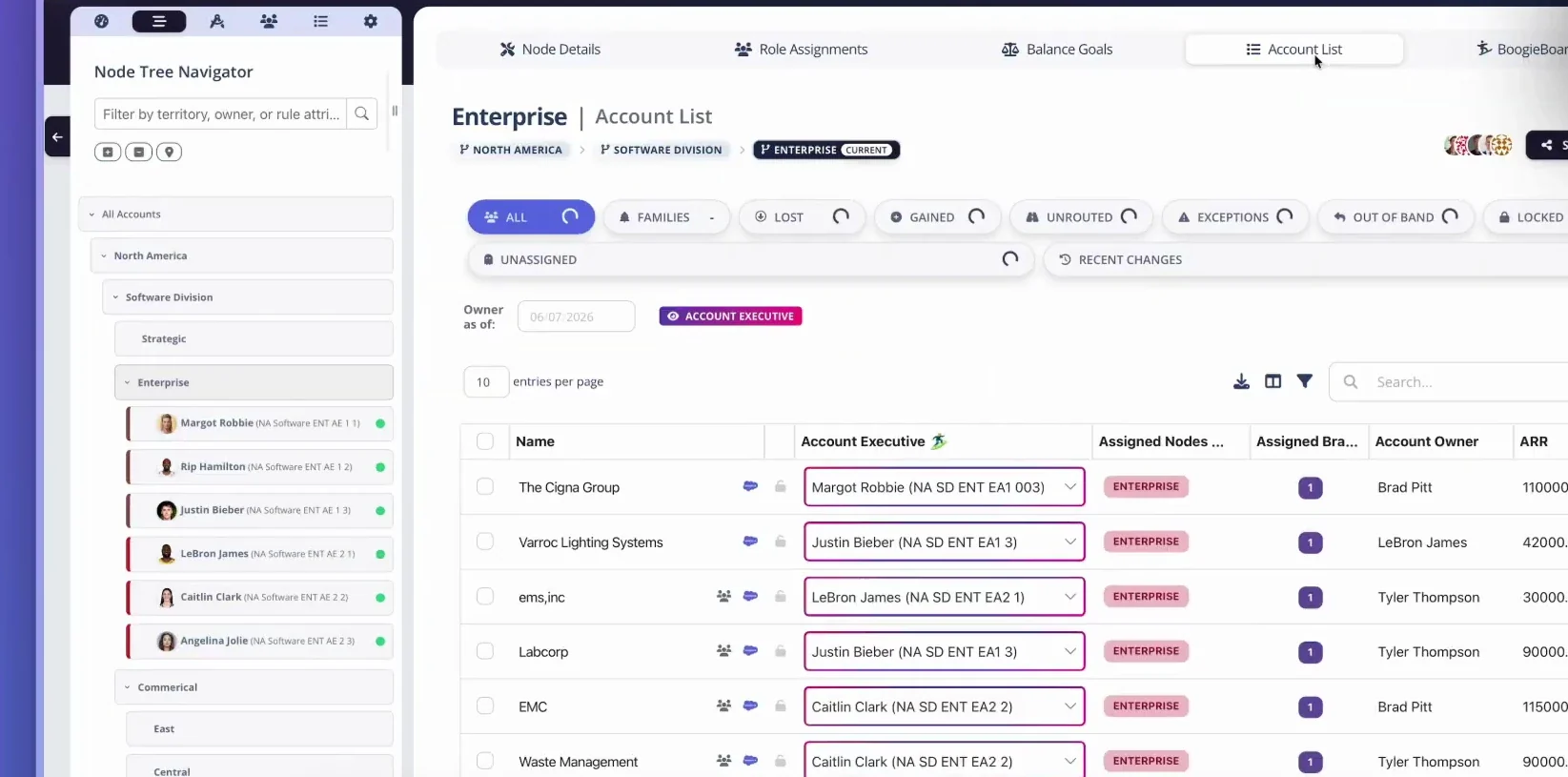
The account list exposes unassigned records so operators can inspect and correct assignment outcomes directly.
The Account-Level Test
For The Account-Level Test, make the implicit policy inspectable at account level. Use Data Hygiene Dashboard to test whether the source record, match result, assignment result, and exception queue reconcile; keep the account-level evidence visible. You should be able to see how the rule changes your accounts, role, workload, or customer responsibility.
The Role Test
For The Role Test, make the implicit policy inspectable at account level. Use account assignment to test whether the source record, match result, assignment result, and exception queue reconcile; keep the account-level evidence visible. You should be able to see how the rule changes your accounts, role, workload, or customer responsibility.
Advanced Considerations: Shadow Account Tracking
Use this module to make the hidden decision explicit. State the role, population, evidence, rule, exception path, and operating consequence. The objective is not a perfectly clean model; it is a model whose compromises are visible enough to approve, communicate, and improve. For shadow account tracking, document the effect on golden record before the model advances. For your book, ask which accounts move and which measure justifies the change.
A practical test is to pick one surprising account and trace it end to end. Explain why it is in the segment, why it belongs in the territory, whether it is locked, which goals it affects, and what happens when the seller changes. If the answer requires several private spreadsheets, the model is not yet governed. In shadow account tracking, test the choice against Data Hygiene Dashboard, then record any accepted exception in the decision log. You should be able to trace the result from your account roster to the published rule.
Systems and Tooling: Shadow Account Tracking
Treat the shadow list as diagnostic evidence, compare it with the Rep View Report, classify identity, hierarchy, data, rule, and timing differences, correct the golden record, and show the seller how the resolved assignment changed. Automation is useful when it preserves source ownership, logs, reruns, and exceptions. It is dangerous when it overwrites disputed facts and moves accounts without an inspectable reason. In shadow account tracking, test the choice against Data Hygiene Dashboard, then record any accepted exception in the decision log. You should be able to trace the result from your account roster to the published rule.
Test the complete path from account creation through matching, enrichment, assignment, exception review, and CRM result. Software should expose why golden record, Data Hygiene Dashboard, and account assignment produced the outcome. The shadow account tracking review is complete only when account assignment and the affected account roster tell the same story. If your territory is an outlier, ask whether the difference is intentional, temporary, or a data error.
Approval and Decision Rights: Shadow Account Tracking
Use this module to make the hidden decision explicit. State the role, population, evidence, rule, exception path, and operating consequence. The objective is not a perfectly clean model; it is a model whose compromises are visible enough to approve, communicate, and improve. The shadow account tracking review is complete only when account assignment and the affected account roster tell the same story. If your territory is an outlier, ask whether the difference is intentional, temporary, or a data error.
A practical test is to pick one surprising account and trace it end to end. Explain why it is in the segment, why it belongs in the territory, whether it is locked, which goals it affects, and what happens when the seller changes. If the answer requires several private spreadsheets, the model is not yet governed. Use one current-state baseline to keep every shadow account tracking scenario comparable. Your manager should be able to explain the tradeoff without relying on a private spreadsheet.
Practical Implications
Shadow account tracking is a seller-maintained roster, spreadsheet, note, or private system used to reconcile expected accounts with CRM because the official assignment is not trusted or usable.
Decision Worksheet
| Decision | Evidence to inspect | Control |
|---|---|---|
| Govern the identity | golden record and Data Hygiene Dashboard | Named source owner |
| Test the data | account assignment and Rep View Report | Match and duplicate report |
| Reconcile assignment | Assigned, unresolved, excluded, and multi-matched accounts | Account-level exception queue |
| Operate corrections | Prior value, evidence, corrected value, and rerun result | Owner and response time |
What This Means for You
You do not need to rebuild the model to evaluate shadow account tracking. Check whether your accounts match the published population, whether your workload and opportunity are measured with understandable inputs, whether locked accounts remain in the final comparison, and whether your quota reflects material territory differences. Bring account IDs and evidence when you find an error.
Questions to Ask Your Manager
- Which official roster determines the accounts I should work?
- Which source, match, and assignment rule produced this account result?
- When were the account facts last refreshed and which fields are disputed?
- Which accounts are deliberately excluded versus accidentally unresolved?
- Where do I submit an account ID and evidence for correction?
- When will the corrected account be rerun and visible in CRM?
Identity Authority
Name the system and team that govern account identity; a display name is not enough to reconcile one company across imports, enrichment, CRM, and planning. For shadow account tracking, use golden record to record the evidence, decision owner, affected account population, and condition that closes this review.
Frequently Asked Questions
Why do reps keep their own account lists?
Shadow account tracking is a seller-maintained roster, spreadsheet, note, or private system used to reconcile expected accounts with CRM because the official assignment is not trusted or usable. Private tracking helps you protect customer and pipeline context in the short term, but it fragments the operating record; RevOps earns consolidation by making corrections visible and timely. Use the published definitions and complete-territory result instead of relying on one universal benchmark. Ask your manager to show how that standard applies to your book.
How do you get reps to trust CRM territory data?
Treat the shadow list as diagnostic evidence, compare it with the Rep View Report, classify identity, hierarchy, data, rule, and timing differences, correct the golden record, and show the seller how the resolved assignment changed. A rep may track a subsidiary privately because Salesforce lists the parent under another owner; resolving the hierarchy and governed role is more durable than demanding deletion of the spreadsheet. Publish the assumptions so another reviewer can reproduce the answer. You should be able to reproduce the answer from your roster and the stated inputs.
What data is required for shadow account tracking?
For shadow account tracking, assemble governed account data, current assignments, role capacity, and decision evidence for golden record, Data Hygiene Dashboard, and account assignment. Date the sources and publish the definitions so another reviewer can reproduce the result and separate a factual correction from a policy exception. Request the source date when the underlying account facts look stale.
How often should shadow account tracking be reviewed?
Review shadow account tracking on the formal planning cadence and whenever the inputs behind golden record, Data Hygiene Dashboard, and account assignment change materially. Keep customer and pipeline ownership stable between reviews; reopen the model when strategy or new evidence changes the decision, not merely because a manager prefers a different assignment. Ask when your territory will next receive a formal review.
How should account-data errors be corrected?
Preserve the disputed account ID and prior value, identify the authoritative source, classify the issue as identity, hierarchy, attribute, match, or rule logic, approve the correction, and rerun assignment. Show the reporter the corrected result. Apply that rule to shadow account tracking using the definitions in this article. Check that your locked accounts remain in the final health calculation.
How do you distinguish deliberate exclusions from routing failures?
Report eligible accounts that are assigned once, assigned more than once, unresolved by accident, and excluded deliberately. Policy exclusions are a coverage choice; accidental gaps are an operating defect. Apply that rule to shadow account tracking using the definitions in this article. You need a system when manual reconciliation makes the rule impossible to inspect.
About the author: Kevin Davis is Co-Founder & CEO of BoogieBoard.
In Summary
When reps keep their own account lists outside CRM, it is not a compliance problem. It is a signal they do not trust the assignment. Use the sequence above to keep the decision governed, evidence-based, and inspectable at both the account and territory levels.
See Territory Planning in Practice
Watch practical territory-design workflows on the BoogieBoard YouTube channel.