
5 Key Takeaways
- Capacity planning tells you how much coverage you need. Territory planning designs it. If the handoff is fuzzy the design is fuzzy.
- A practical growth plan converts hiring dates, ramp, productivity, and serviceable market into a sequence of viable territories.
- Create current, funded, and contingent capacity scenarios.
- Precarving improves continuity and onboarding, but an uncertain hiring plan can strand opportunity.
- Dividing the market by approved headcount assumes every seat arrives on time and produces immediately, creating books that are undercovered from launch.
Capacity planning tells you how much coverage you need. Territory planning designs it. If the handoff is fuzzy the design is fuzzy. That position is useful only when the planning team can translate it into inputs, decisions, controls, and a result the field can understand.
BoogieBoard treats territory planning for a growing team as part of a governed change process. The model must connect market strategy with account-level evidence, productive capacity, explicit decision rights, and controlled activation. The objective is not to remove judgment. It is to make judgment visible and repeatable.
The central position is: Do not start with fairness, start with coverage. The sections below turn that position into definitions, alternatives, procedures, examples, controls, and an operating decision.
Working Definitions
- capacity planning: the process of matching productive role capacity to market coverage.
- ramp schedule: a defined input used when evaluating territory planning for a growing team.
- productivity baseline: a defined input used when evaluating territory planning for a growing team.
- Territory Viability: whether a book provides enough serviceable opportunity for its assigned role.
- to-be-hired territory: a defined input used when evaluating territory planning for a growing team.
The framework reflects BoogieBoard's consulting work and interviews with more than 300 companies. It is practitioner evidence used to form hypotheses, not a controlled causal study. For territory planning for a growing team, use that observation only for the claim and population it directly supports.
Independent evidence provides a separate check for territory planning for a growing team: G2's Sales Planning category treats territory, quota, capacity, scenario modeling, and CRM connection as related planning capabilities.
Why the Decision Matters: Territory Planning For A Growing Team
Precarving improves continuity and onboarding, but an uncertain hiring plan can strand opportunity. Keep a fallback scenario that recombines books without changing the hierarchy. The business consequence is clearest when a company cannot separate execution from starting conditions. If opportunity and workload are invisible, attainment becomes an ambiguous signal. A measured territory does not explain every result, but it gives leadership a defensible denominator for capacity, quota, and performance conversations. In territory planning for a growing team, test the choice against ramp schedule, then record any accepted exception in the decision log.
This decision affects more than visual symmetry. It changes market coverage, seller focus, quota credibility, customer continuity, performance interpretation, and the amount of manual administration required during the year. Poor design transfers work to managers and sellers, who then create informal rules to keep operating. The territory planning for a growing team review is complete only when productivity baseline and the affected account roster tell the same story.
Common Models and Variations: Territory Planning For A Growing Team
A practical growth plan converts hiring dates, ramp, productivity, and serviceable market into a sequence of viable territories. Capacity planning determines how much coverage is needed; territory planning designs the books. The model in this subsection is useful only when its organizing rule matches the selling motion. Compare options by opportunity, workload, continuity, explainability, and maintenance burden. A structure that looks simple at launch can create expensive exceptions when accounts change segment, sellers leave, or related companies need coordinated coverage. The territory planning for a growing team review is complete only when productivity baseline and the affected account roster tell the same story.
No model removes judgment. Geographic, named-account, segment, industry, customer, and hybrid structures each solve a different constraint. Use the fewest logical layers that express the strategy, then state where a deliberate override is allowed. Complexity should correspond to a real customer or operating need, not inherited convention. Use one current-state baseline to keep every territory planning for a growing team scenario comparable.
capacity planning: The Decision Test
Dividing the market by approved headcount assumes every seat arrives on time and produces immediately, creating books that are undercovered from launch. A practical test is to pick one surprising account and trace it end to end. Explain why it is in the segment, why it belongs in the territory, whether it is locked, which goals it affects, and what happens when the seller changes. If the answer requires several private spreadsheets, the model is not yet governed. Use one current-state baseline to keep every territory planning for a growing team scenario comparable.
ramp schedule: The Decision Test
Use this module to make the hidden decision explicit. State the role, population, evidence, rule, exception path, and operating consequence. The objective is not a perfectly clean model; it is a model whose compromises are visible enough to approve, communicate, and improve. For territory planning for a growing team, name the approver, the permitted evidence, and the condition that would justify a departure from the rule.
productivity baseline: The Decision Test
A practical test is to pick one surprising account and trace it end to end. Explain why it is in the segment, why it belongs in the territory, whether it is locked, which goals it affects, and what happens when the seller changes. If the answer requires several private spreadsheets, the model is not yet governed. Keep account-level results beside the territory planning for a growing team summary so ramp schedule remains inspectable after approval.
See Codex in the Planning Workflow
The relevant product workflow is Fill Vacant AE and BDR Seats with Codex. BoogieBoard Scenario Planning keeps the account-level assumptions, tradeoffs, and proposed assignments visible while the team completes that work.
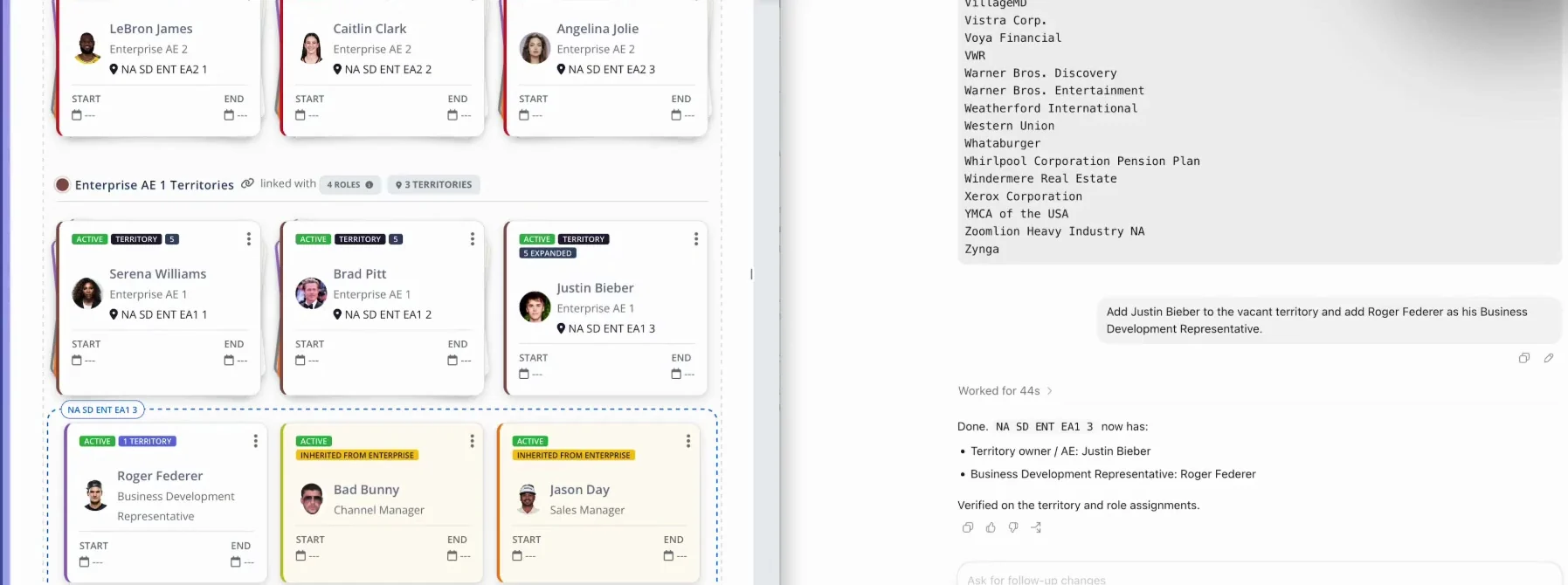
Codex applies a natural-language territory instruction and returns the updated role-assignment model for review.
Decision Note: capacity planning
Compare alternatives against the same population and definitions. One option may improve capacity planning, another may protect ramp schedule, and a third may reduce disruption. Do not let each option use a different denominator or source date; that turns scenario review into a presentation contest. Give the territory planning for a growing team decision a source date, an owner, and a condition that would trigger revision.
How to Put Territory Planning For A Growing Team Into Practice
Create current, funded, and contingent capacity scenarios. Define the productivity curve for each role, prebuild to-be-hired territories, and specify temporary coverage without treating a manager or vacant seat as fully productive. The control at this stage is a decision log. Separate factual corrections from policy exceptions, preserve rejected alternatives, and attach an effective date. For the planning team, the practical test is whether another informed person could reproduce the result from the same data and rules without relying on private context. Before activating territory planning for a growing team, show managers the effect on productivity baseline and every downstream rule that depends on it.
How to Put Territory Planning For A Growing Team Into Practice means producing one inspectable decision before advancing. Name the input, owner, output, and approval. Keep the current state as a baseline, and record assumptions that could change the result. This dependency order prevents a late preference from rewriting earlier definitions without anyone seeing the cost. For territory planning for a growing team, document the effect on capacity planning before the model advances.
Decision Note: capacity planning: Review 8
Governance begins with explicit decision rights. One Driver runs the process, one Approver chooses the final tradeoff, Contributors supply evidence, and Informed stakeholders receive the result. Publish the review cadence, correction path, exception authority, and source of truth with the approved roster. For territory planning for a growing team, document the effect on capacity planning before the model advances.
Calculating and Testing Territory Planning For A Growing Team
Four hires start one month apart and ramp over three months. The plan phases account transfers with each productivity milestone instead of moving every account on the first hire's start date. Create three scenarios. Scenario A minimizes movement, Scenario B minimizes variance on the primary goal, and Scenario C protects continuity while improving the two largest outliers. Compare complete territories after qualifying locks return. Select the scenario whose residual imbalance leadership is prepared to explain and operate. In territory planning for a growing team, test the choice against ramp schedule, then record any accepted exception in the decision log.
Assume six comparable territories cover 900 serviceable accounts. A count-only split begins at 150 accounts each. The team then measures capacity planning, ramp schedule, and productivity baseline; one territory holds 28% of high-potential accounts and another carries twice the near-term workload. The worked answer is not to force identical counts. It is to publish the priority, range, and tradeoff. The territory planning for a growing team review is complete only when productivity baseline and the affected account roster tell the same story.
How to Measure the Result: Territory Planning For A Growing Team
Measure the components before combining them. Report distributions for capacity planning, ramp schedule, and productivity baseline, then show the spread, median, outliers, and acceptable range. A composite score can support comparison, but it should never hide the account attributes and assumptions that produced it. The territory planning for a growing team review is complete only when productivity baseline and the affected account roster tell the same story.
Use both current-state and future-state views. Report account movement, locked accounts, unassigned records, family splits, vacancies, and quota differences beside Territory Health. Monitor outcomes later, but avoid claiming that attainment alone proves the design was correct; product, market, timing, execution, and quota also affect performance. Use one current-state baseline to keep every territory planning for a growing team scenario comparable.
Decision Worksheet
| Decision | Evidence to inspect | Control |
|---|---|---|
| Define the population | capacity planning and comparable roles | Named data owner |
| Measure the current state | ramp schedule and productivity baseline | Source date and baseline |
| Choose the tradeoff | Scenario comparison and complete Territory Health | Recorded approver |
| Activate the result | Account roster, changes, quota, and transition rules | Effective date and correction path |
Operational Review Note 1
Review territory planning for a growing team at three levels. At the company level, reconcile market coverage, capacity, quota, and disruption. At the territory level, compare the published goals, locked-account burden, vacancies, and workload. At the account level, inspect hierarchy, fit, ownership, open work, and the reason for every exception. These views should use the same scenario and source date.
This review pass emphasizes capacity planning. Require reviewers to state whether feedback is a data correction, a policy challenge, or a preference. Corrections update the evidence. Policy challenges go to the named approver. Preferences remain visible but do not silently change the model. This discipline keeps capacity planning, ramp schedule, and productivity baseline coherent through approval and activation.
Operational Review Note 2
Review territory planning for a growing team at three levels. At the company level, reconcile market coverage, capacity, quota, and disruption. At the territory level, compare the published goals, locked-account burden, vacancies, and workload. At the account level, inspect hierarchy, fit, ownership, open work, and the reason for every exception. These views should use the same scenario and source date.
This review pass emphasizes ramp schedule. Require reviewers to state whether feedback is a data correction, a policy challenge, or a preference. Corrections update the evidence. Policy challenges go to the named approver. Preferences remain visible but do not silently change the model. This discipline keeps capacity planning, ramp schedule, and productivity baseline coherent through approval and activation.
Operational Review Note 3
Review territory planning for a growing team at three levels. At the company level, reconcile market coverage, capacity, quota, and disruption. At the territory level, compare the published goals, locked-account burden, vacancies, and workload. At the account level, inspect hierarchy, fit, ownership, open work, and the reason for every exception. These views should use the same scenario and source date.
This review pass emphasizes productivity baseline. Require reviewers to state whether feedback is a data correction, a policy challenge, or a preference. Corrections update the evidence. Policy challenges go to the named approver. Preferences remain visible but do not silently change the model. This discipline keeps capacity planning, ramp schedule, and productivity baseline coherent through approval and activation.
Operational Review Note 4
Review territory planning for a growing team at three levels. At the company level, reconcile market coverage, capacity, quota, and disruption. At the territory level, compare the published goals, locked-account burden, vacancies, and workload. At the account level, inspect hierarchy, fit, ownership, open work, and the reason for every exception. These views should use the same scenario and source date.
This review pass emphasizes Territory Viability. Require reviewers to state whether feedback is a data correction, a policy challenge, or a preference. Corrections update the evidence. Policy challenges go to the named approver. Preferences remain visible but do not silently change the model. This discipline keeps capacity planning, ramp schedule, and productivity baseline coherent through approval and activation.
Frequently Asked Questions
How do you plan territories for a growing team?
A practical growth plan converts hiring dates, ramp, productivity, and serviceable market into a sequence of viable territories. Capacity planning determines how much coverage is needed; territory planning designs the books. Precarving improves continuity and onboarding, but an uncertain hiring plan can strand opportunity. Keep a fallback scenario that recombines books without changing the hierarchy. Use the published definitions and complete-territory result instead of relying on one universal benchmark.
How many territories do you need?
Create current, funded, and contingent capacity scenarios. Define the productivity curve for each role, prebuild to-be-hired territories, and specify temporary coverage without treating a manager or vacant seat as fully productive. Four hires start one month apart and ramp over three months. The plan phases account transfers with each productivity milestone instead of moving every account on the first hire's start date. Publish the assumptions so another reviewer can reproduce the answer.
What data is required for territory planning for a growing team?
For territory planning for a growing team, assemble governed account data, current assignments, role capacity, and decision evidence for capacity planning, ramp schedule, and productivity baseline. Date the sources and publish the definitions so another reviewer can reproduce the result and separate a factual correction from a policy exception.
How often should territory planning for a growing team be reviewed?
Review territory planning for a growing team on the formal planning cadence and whenever the inputs behind capacity planning, ramp schedule, and productivity baseline change materially. Keep customer and pipeline ownership stable between reviews; reopen the model when strategy or new evidence changes the decision, not merely because a manager prefers a different assignment.
How should Balance Goals and account locks work together?
For territory planning for a growing team, define Balance Goals tied to capacity planning, ramp schedule, and productivity baseline before applying locks. Then publish Account Locking Criteria, lock only qualifying accounts, optimize the movable book, and score the complete territory so locked burden and residual imbalance remain visible.
When should a spreadsheet be replaced with a planning system?
For territory planning for a growing team, a spreadsheet remains adequate while one owner can preserve capacity planning, ramp schedule, and productivity baseline, plus versions, account detail, approvals, and deployment without manual reconciliation obscuring the rule. Move to a planning system when scenario volume, collaboration, or audit work overwhelms the decision itself.
About the author: Tyler Thompson is Co-Founder & CTO of BoogieBoard.
In Summary
Capacity planning tells you how much coverage you need. Territory planning designs it. If the handoff is fuzzy the design is fuzzy. Use the sequence above to keep the decision governed, evidence-based, and inspectable at both the account and territory levels.
See Territory Planning in Practice
Watch practical territory-design workflows on the BoogieBoard YouTube channel.