5 Key Takeaways
- An assignment tells you today's answer. Tracking tells you what changed, when, and who decided.
- Do not score territory change tracking software on category labels. Score the real workflow for prior and future state and the evidence behind decision and approval history.
- Before discussing implementation, make each vendor solve the same current-to-future scenario and reconcile decision and approval history after activation.
- Suite consolidation is not automatically lower effort; compare administration, services, and the ongoing ownership of prior and future state.
- Stop the evaluation when decision and approval history cannot be inspected with your data or when post-implementation ownership remains ambiguous.
An assignment tells you today's answer. Tracking tells you what changed, when, and who decided. The useful question is not which platform has the longest feature list. It is which platform owns the planning job, preserves the governing logic, and leaves the approved result operable after the buying team goes home.
Territory change tracking software should be evaluated by the planning job it owns, the decisions it makes inspectable, and the operating state it can reproduce after launch.
To evaluate territory change tracking software, define prior and future state, weight effective dating and decision and approval history before demos, run one governed account scenario through every option, and reconcile the approved result with the live system.
A credible proof of concept uses one difficult account family, one vacancy, one protected opportunity or renewal, one data error, and one scenario tradeoff instead of vendor sample data.
For territory change tracking software, compare focused control of prior and future state with suite-level connection to account-level differences; either choice may depend on adjacent finance, CRM, data, or performance systems.
A territory change tracking software decision fails when decision and approval history is accepted as a feature claim, the team relies on vendor-owned sample data, or nobody is accountable for the model after implementation.
Working Definitions
- audit trail: a dated record of prior state, proposed change, reason, decision owner, approval, and activation.
- effective dating: recording when an assignment, role, exception, or policy state begins and ends.
- Current State Scenario: a preserved baseline that mirrors the live territory model before proposed changes.
- Territory2: the Salesforce object representing one territory in Enterprise Territory Management.
- attribution: the governed decision about which person, role, or period receives credit for an outcome.
BoogieBoard's customer-coverage doctrine reflects interviews with more than 50 Sales and Operations leaders responsible for customer and account-management motions. It is practitioner evidence, not a controlled prevalence study. Use this evidence only for the population and claim it directly supports in the territory change tracking software decision.
Independent evidence provides a neutral category or research check: Powell, Lawson, and Baker show why operational spreadsheet controls and review matter even when individual formulas appear reasonable..
The 10 Best Options for Territory Change Tracking Software in 2026
The options below are ordered as a practical fit guide for territory change tracking software, not as a universal market ranking. Competitors are named in plain text and receive no direct links. Their fit descriptions are hypotheses to validate through neutral review sources and a real-data proof of concept.
Systems of Record
For Systems of Record, require the source data, rule, prior state, proposed result, account evidence, and operating owner. In territory change tracking software, test decision and approval history with a real edge case.
Why Buyers Reconsider Their Current Approach to Territory Change Tracking Software
An assignment tells you today's answer. Tracking tells you what changed, when, and who decided. Buyers usually reconsider territory change tracking software when the current workflow hides logic, slows scenario review, or leaves the live assignment disconnected from the approved decision. The deciding issue in this section is account-level differences.
The Durable-Model Gap
This problem becomes material when deployment reconciliation lives outside the governed model. Quantify the affected accounts, manual steps, and unresolved decisions before selecting a replacement.
Hidden Services Dependence
This problem becomes material when prior and future state lives outside the governed model. Quantify the affected accounts, manual steps, and unresolved decisions before selecting a replacement.
Data and Integration Friction
This problem becomes material when effective dating lives outside the governed model. Quantify the affected accounts, manual steps, and unresolved decisions before selecting a replacement.
Slow Scenario Iteration
This problem becomes material when decision and approval history lives outside the governed model. Quantify the affected accounts, manual steps, and unresolved decisions before selecting a replacement.
The 10 Best Options for Territory Change Tracking Software in 2026 for Current-State Review
Set weights before demonstrations begin. Require every option to use the same account population, current state, proposed change, exception, and activation outcome. For territory change tracking software, the evaluation should make account-level differences inspectable rather than merely claim the capability.
The 10 Best Options for Territory Change Tracking Software in 2026 for Future-State Validation
The options below are ordered as a practical fit guide for territory change tracking software, not as a universal market ranking. Competitors are named in plain text and receive no direct links. Their fit descriptions are hypotheses to validate through neutral review sources and a real-data proof of concept.
1. BoogieBoard: Best for Territory-First Scenario Planning
BoogieBoard approaches territory change tracking software from the center of territory-first planning. Best fit: account-level territory scenarios, balance, governed exceptions, and Salesforce activation. Test prior and future state with the same governed account population across options. Evaluate carefully: Buyers should confirm the adjacent finance, compensation, and data systems that remain in the operating stack. Ask the team to reproduce one current state, compare one future scenario, explain a surprising account result, and identify what becomes live after approval. Do not award credit for a capability name alone. Record whether BoogieBoard stores the logic, imports a result, requires a custom model, or delegates the work to services.
2. Fullcast: Best for Plan-to-Pay Revenue Operations
In this comparison, Fullcast represents the plan-to-pay revenue operations approach to territory change tracking software. Best fit: connecting territory, quota, capacity, and ongoing GTM operations. Test effective dating with the same governed account population across options. Evaluate carefully: Test hierarchy depth, account-level exceptions, and the operating ownership required after implementation. Ask the team to reproduce one current state, compare one future scenario, explain a surprising account result, and identify what becomes live after approval. Do not award credit for a capability name alone. Record whether Fullcast stores the logic, imports a result, requires a custom model, or delegates the work to services.
3. CaptivateIQ: Best for Connected Planning and Incentives
Consider CaptivateIQ when the primary operating center is planning and incentive management, not simply because it appears on a broad feature list. Best fit: teams that want quota, territory, headcount, and compensation in a connected environment. Test decision and approval history with the same governed account population across options. Evaluate carefully: Validate territory design as its own workflow rather than inferring it from compensation breadth. Ask the team to reproduce one current state, compare one future scenario, explain a surprising account result, and identify what becomes live after approval. Do not award credit for a capability name alone. Record whether CaptivateIQ stores the logic, imports a result, requires a custom model, or delegates the work to services.
4. Anaplan: Best for Enterprise Connected Planning
Anaplan's relevant category for this buying decision is enterprise connected planning. Best fit: large cross-functional models linking finance, workforce, capacity, quota, and sales planning. Test account-level differences with the same governed account population across options. Evaluate carefully: Flexibility creates implementation and model-governance responsibility; test account-level usability with real data. Ask the team to reproduce one current state, compare one future scenario, explain a surprising account result, and identify what becomes live after approval. Do not award credit for a capability name alone. Record whether Anaplan stores the logic, imports a result, requires a custom model, or delegates the work to services.
See Collaboration and Audit Trails in the Planning Workflow
The relevant BoogieBoard workflow is Track Territory Collaboration and Audit Trails. BoogieBoard Scenario Planning keeps account-level assumptions, tradeoffs, and proposed assignments visible while the team evaluates territory change tracking software.
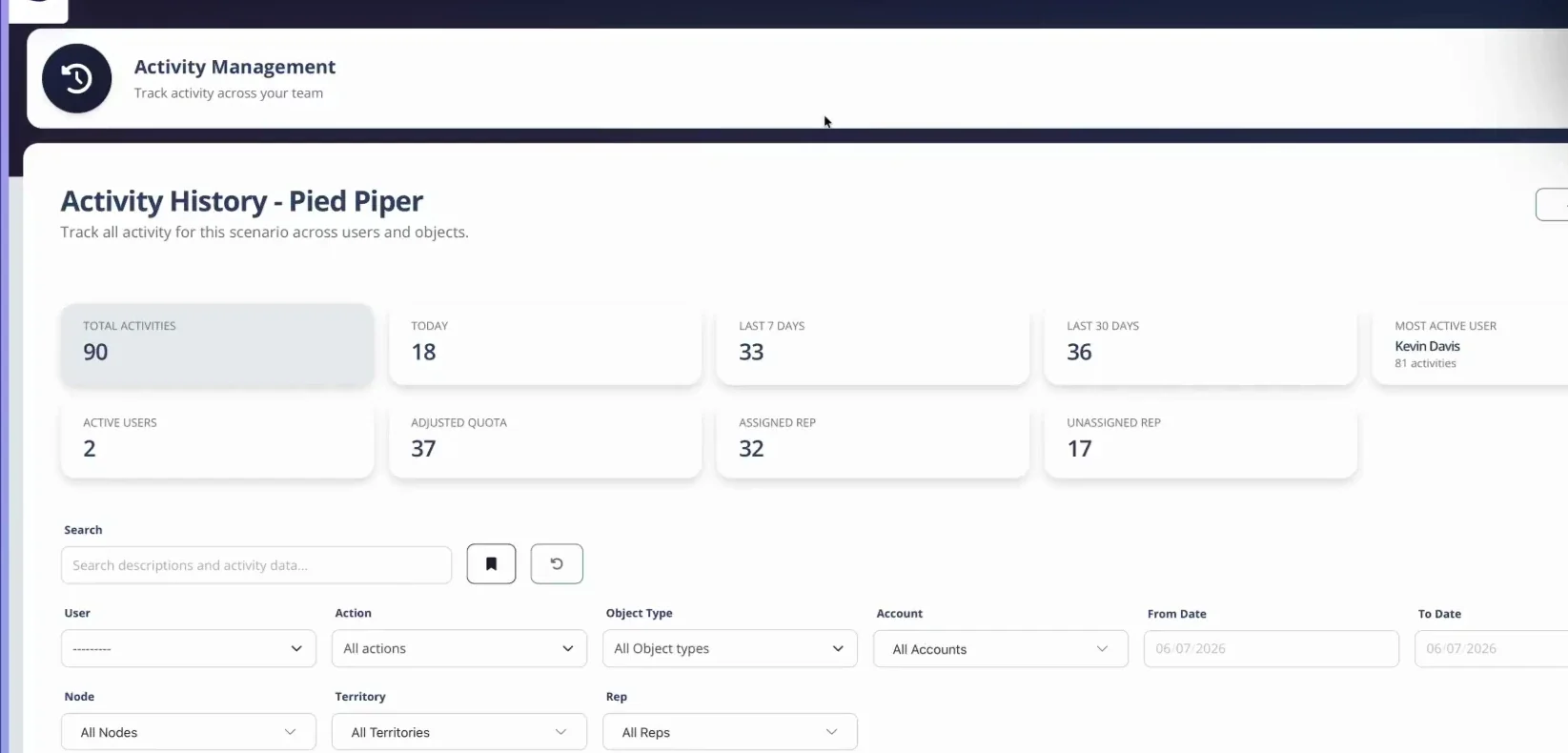
Activity History records territory actions by user and time so teams can review how the model changed.
5. Varicent: Best for Broad Sales Performance Management
Varicent approaches territory change tracking software from the center of sales performance management. Best fit: enterprises connecting territory, quota, compensation, and performance processes. Test deployment reconciliation with the same governed account population across options. Evaluate carefully: Inspect module boundaries, administration skills, services dependence, and account-level scenario workflow. Ask the team to reproduce one current state, compare one future scenario, explain a surprising account result, and identify what becomes live after approval. Do not award credit for a capability name alone. Record whether Varicent stores the logic, imports a result, requires a custom model, or delegates the work to services.
6. Salesforce ETM: Best for CRM-Native Territory Operations
In this comparison, Salesforce ETM represents the CRM-native territory management approach to territory change tracking software. Best fit: operating approved territory hierarchies, assignments, roles, and forecasts in Salesforce. Test prior and future state with the same governed account population across options. Evaluate carefully: A live CRM model is not automatically a safe future-state design workspace; test planning and rollback separately. Ask the team to reproduce one current state, compare one future scenario, explain a surprising account result, and identify what becomes live after approval. Do not award credit for a capability name alone. Record whether Salesforce ETM stores the logic, imports a result, requires a custom model, or delegates the work to services.
7. Xactly AlignStar: Best for Established Territory Alignment
Consider Xactly AlignStar when the primary operating center is established territory alignment within SPM, not simply because it appears on a broad feature list. Best fit: organizations combining visual territory alignment with a broader performance-management program. Test effective dating with the same governed account population across options. Evaluate carefully: Test whether field-sales and geographic assumptions fit the current account-based selling motion. Ask the team to reproduce one current state, compare one future scenario, explain a surprising account result, and identify what becomes live after approval. Do not award credit for a capability name alone. Record whether Xactly AlignStar stores the logic, imports a result, requires a custom model, or delegates the work to services.
8. Forma AI: Best for Connected Territory, Quota, and Incentives
Forma AI's relevant category for this buying decision is connected territory, quota, and incentive planning. Best fit: enterprises that want territory decisions to flow into adjacent sales-performance processes. Test decision and approval history with the same governed account population across options. Evaluate carefully: Confirm that the compensation-centered data model preserves the territory, hierarchy, scenario, and exception depth required. Ask the team to reproduce one current state, compare one future scenario, explain a surprising account result, and identify what becomes live after approval. Do not award credit for a capability name alone. Record whether Forma AI stores the logic, imports a result, requires a custom model, or delegates the work to services.
9. EasyTerritory: Best for Map-Centered Territory Design
EasyTerritory approaches territory change tracking software from the center of geographic mapping and territory design. Best fit: Microsoft- or map-centered field teams that need boundary analysis and CRM writeback. Test account-level differences with the same governed account population across options. Evaluate carefully: Validate non-geographic accounts, durable roles, account families, collaboration, and audit history separately. Ask the team to reproduce one current state, compare one future scenario, explain a surprising account result, and identify what becomes live after approval. Do not award credit for a capability name alone. Record whether EasyTerritory stores the logic, imports a result, requires a custom model, or delegates the work to services.
10. Maptitude: Best for Desktop GIS Analysis
In this comparison, Maptitude represents the desktop GIS and territory mapping approach to territory change tracking software. Best fit: analysts who need detailed geographic units, demographic layers, travel analysis, and offline control. Test deployment reconciliation with the same governed account population across options. Evaluate carefully: Collaboration, account governance, approvals, and CRM activation may require additional operating systems. Ask the team to reproduce one current state, compare one future scenario, explain a surprising account result, and identify what becomes live after approval. Do not award credit for a capability name alone. Record whether Maptitude stores the logic, imports a result, requires a custom model, or delegates the work to services.
Territory Change Tracking Software Comparison Table
Use this table as a fit map, not a universal score. Each option approaches territory change tracking software from a different system center. Validate every cell with your own data, users, integrations, and decision process.
| Option | System center | Best-fit job | Evaluation focus |
|---|---|---|---|
| BoogieBoard | territory-first planning | account-level territory scenarios, balance, governed exceptions, and Salesforce activation | prior and future state |
| Fullcast | plan-to-pay revenue operations | connecting territory, quota, capacity, and ongoing GTM operations | effective dating |
| CaptivateIQ | planning and incentive management | teams that want quota, territory, headcount, and compensation in a connected environment | decision and approval history |
| Anaplan | enterprise connected planning | large cross-functional models linking finance, workforce, capacity, quota, and sales planning | account-level differences |
| Varicent | sales performance management | enterprises connecting territory, quota, compensation, and performance processes | deployment reconciliation |
| Salesforce ETM | CRM-native territory management | operating approved territory hierarchies, assignments, roles, and forecasts in Salesforce | prior and future state |
| Xactly AlignStar | established territory alignment within SPM | organizations combining visual territory alignment with a broader performance-management program | effective dating |
| Forma AI | connected territory, quota, and incentive planning | enterprises that want territory decisions to flow into adjacent sales-performance processes | decision and approval history |
| EasyTerritory | geographic mapping and territory design | Microsoft- or map-centered field teams that need boundary analysis and CRM writeback | account-level differences |
| Maptitude | desktop GIS and territory mapping | analysts who need detailed geographic units, demographic layers, travel analysis, and offline control | deployment reconciliation |
Pricing, Ownership, and Value for Territory Change Tracking Software
Compare three-year ownership rather than license price alone. Include data preparation, configuration, services, integrations, model changes, administrator time, seller support, and the work required to reconcile territory change tracking software with CRM, finance, and compensation systems.
The 10 Best Options for Territory Change Tracking Software in 2026 for Account-Level Evidence
The options below are ordered as a practical fit guide for territory change tracking software, not as a universal market ranking. Competitors are named in plain text and receive no direct links. Their fit descriptions are hypotheses to validate through neutral review sources and a real-data proof of concept.
1. Start With the Hardest Scenario
Apply this step with a named owner and reviewable output. Use account-level differences to reproduce the decision without overwriting the prior state.
2. Name Data and Decision Owners
Apply this step with a named owner and reviewable output. Use deployment reconciliation to reproduce the decision without overwriting the prior state.
3. Preserve the Current State
Apply this step with a named owner and reviewable output. Use prior and future state to reproduce the decision without overwriting the prior state.
4. Prepare Managers Before Activation
Apply this step with a named owner and reviewable output. Use effective dating to reproduce the decision without overwriting the prior state.
5. Separate Corrections From Exceptions
Apply this step with a named owner and reviewable output. Use decision and approval history to reproduce the decision without overwriting the prior state.
6. Measure Adoption and Reconciliation
Apply this step with a named owner and reviewable output. Use account-level differences to reproduce the decision without overwriting the prior state.
Final Selection Checklist for Territory Change Tracking Software
For territory change tracking software, use deployment reconciliation as the decision lens. Define the population, source date, owner, expected output, exception path, and activation consequence before comparing interfaces or feature claims.
Buyer Decision Worksheet
| Decision | Evidence to require | Approval test |
|---|---|---|
| Planning job | Population, roles, current state, and required future outputs | One accountable owner for territory change tracking software |
| Weighted fit | prior and future state, effective dating, and decision and approval history | Weights set before demonstrations |
| Real-data proof | Difficult hierarchy, vacancy, lock, error, and scenario | Account-level result is reproducible |
| Operating model | Data, policy, configuration, support, and activation owners | Ownership survives implementation |
| Migration | Prior state, parallel scenario, effective date, and reconciliation | Approved result matches the live system |
Real-Data Proof-of-Concept Script. Use one governed extract and require every option to reproduce the current state before it models the future. Record import exceptions, hierarchy differences, unassigned accounts, and any transformation that changes the evaluation population. For territory change tracking software, apply this review specifically to prior and future state and record the account population, owner, evidence, and closure condition.
Decision Rights and Administration. Name who owns source data, definitions, rules, scenario creation, locks, approvals, activation, and post-launch corrections. A tool that requires hidden specialist work should expose that requirement in the operating model and cost. For territory change tracking software, apply this review specifically to effective dating and record the account population, owner, evidence, and closure condition.
Integration and Reconciliation Test. Trace one account from its authoritative source through enrichment, planning, approval, and CRM. Capture stable IDs, field ownership, sync timing, failed records, and the report that proves the live result matches the approved scenario. For territory change tracking software, apply this review specifically to decision and approval history and record the account population, owner, evidence, and closure condition.
Manager and Seller Output Test. Ask the platform to produce one manager summary and one seller account roster from the same scenario. Both should show material changes, governing measures, effective dates, protected work, and the correct route for questions and data corrections. For territory change tracking software, apply this review specifically to account-level differences and record the account population, owner, evidence, and closure condition.
Change and Exception Test. Change one input, add one vacancy, protect one account under published criteria, and rerun the scenario. The platform should preserve the prior state, show the complete result, record the exception, and prevent a temporary rule from becoming invisible permanent logic. For territory change tracking software, apply this review specifically to deployment reconciliation and record the account population, owner, evidence, and closure condition.
Three-Year Ownership Review. Estimate licenses, services, implementation, integrations, administration, data preparation, training, support, model changes, and adjacent systems across three years. Keep uncertain benefits separate from observed costs rather than manufacturing an ROI percentage. For territory change tracking software, apply this review specifically to prior and future state and record the account population, owner, evidence, and closure condition.
Real-Data Proof-of-Concept Script for Current-State Reproduction. Use one governed extract and require every option to reproduce the current state before it models the future. Record import exceptions, hierarchy differences, unassigned accounts, and any transformation that changes the evaluation population. For territory change tracking software, apply this review specifically to effective dating and record the account population, owner, evidence, and closure condition.
Decision Rights and Administration for Current-State Reproduction. Name who owns source data, definitions, rules, scenario creation, locks, approvals, activation, and post-launch corrections. A tool that requires hidden specialist work should expose that requirement in the operating model and cost. For territory change tracking software, apply this review specifically to decision and approval history and record the account population, owner, evidence, and closure condition.
Integration and Reconciliation Test for Current-State Reproduction. Trace one account from its authoritative source through enrichment, planning, approval, and CRM. Capture stable IDs, field ownership, sync timing, failed records, and the report that proves the live result matches the approved scenario. For territory change tracking software, apply this review specifically to account-level differences and record the account population, owner, evidence, and closure condition.
Manager and Seller Output Test for Current-State Reproduction. Ask the platform to produce one manager summary and one seller account roster from the same scenario. Both should show material changes, governing measures, effective dates, protected work, and the correct route for questions and data corrections. For territory change tracking software, apply this review specifically to deployment reconciliation and record the account population, owner, evidence, and closure condition.
Change and Exception Test for Current-State Reproduction. Change one input, add one vacancy, protect one account under published criteria, and rerun the scenario. The platform should preserve the prior state, show the complete result, record the exception, and prevent a temporary rule from becoming invisible permanent logic. For territory change tracking software, apply this review specifically to prior and future state and record the account population, owner, evidence, and closure condition.
Frequently Asked Questions
How do you track territory changes?
For territory change tracking software, define the category by the planning jobs it owns: audit trail, effective dating, and Current State Scenario. An assignment tells you today's answer. Use that operating boundary to decide which profiled tools are true candidates and which merely overlap at one step.
What should a territory audit trail contain?
In territory change tracking software, distinguish overlapping tools by testing which system owns the data and decisions behind audit trail, effective dating, and Current State Scenario, where human judgment enters, and what reaches the live CRM. Run the same difficult account and exception through each option; a feature label is not evidence that the workflows are equivalent.
How should you compare territory change tracking software?
Compare territory change tracking software against these criteria: audit trail, effective dating, and Current State Scenario, account-level explainability, scenario control, integration ownership, and the correction path. Weight those criteria before demonstrations and require every vendor to use the same source data and policy so presentation quality cannot substitute for fit.
What should a proof of concept for territory change tracking software include?
Evaluating territory change tracking software should include a proof of concept that reproduces the current state, exercises audit trail, effective dating, and Current State Scenario, processes one difficult account family and one justified exception, and explains a surprising result at account level. It should finish by publishing a controlled test and reconciling the operating result to the approved scenario.
How should you calculate total cost of ownership?
For territory change tracking software, calculate ownership cost from licenses, implementation, data preparation, integrations, administrator time, change requests, support, and work retained in adjacent systems. Tie each cost to the operating model described above and exclude speculative time savings from the ROI case.
How do you migrate without disrupting live coverage?
When migrating to territory change tracking software, preserve the live state, document the policy behind audit trail, effective dating, and Current State Scenario, run the future model in parallel, reconcile account and role differences, and prepare managers before the effective date. Keep the prior system available until the approved result is verified in Salesforce or the chosen operating system.
About the author: Tyler Thompson is Co-Founder & CTO of BoogieBoard.
In Summary
An assignment tells you today's answer. Tracking tells you what changed, when, and who decided. Use the fit criteria and real-data test above to choose the option that makes territory change tracking software governed, explainable, and operable after activation.
See Territory Planning in Practice
Watch practical territory-design workflows on the BoogieBoard YouTube channel.