More art than science
Fullstory is a behavioral data platform with about 150 people across its go-to-market organization. As it scaled, territory planning stayed manual and spreadsheet-based (“more art than science”), and it was creating inefficiencies and potential inequities across the sales teams.
The first problem was agreeing on what fair even meant.
Really defining what our measure of equitability is. Was it potential TAM? Was it the number of accounts? Was it the amount of ARR? Was it the number of prospects in a certain industry? There could be several definitions that we had for what made an equitable territory. And to try and optimize across all of those manually was really challenging.
The spreadsheets fought back. “Since we weren't doing this in a tool and we were doing it in sheets, it very quickly became hard to manage version control. You'd move one account and all of a sudden your model would break,” said Sam Miller. The data went stale fast, too: “the majority of our business is coming in Q4, even the last few weeks of Q4, so your data becomes stale very quickly,” noted Will Hergenrader, Manager of Sales and Marketing Strategy. And nobody could see equity at a glance: “There's no dashboarding, no capability to assess the equitability. It was just more gut feeling.”
Scale made it harder. “Our sales teams range across three continents, four different segments on each continent. So there's 12-ish teams that we're building territories for, and they all have completely different requirements,” Hergenrader explained. Then a RevOps leader departed, and “we simply just didn't have the manpower to spin this up ourselves.”
The stakes were more than a tidy spreadsheet. “In my experience, having a bad territory or an uneven territory can often be a major cause of rep attrition,” Hergenrader said.
Make fair measurable, team by team
Getting started was quick. “It was really pretty seamless. We were able to essentially take all of the fields that we wanted from our CRM, plug them right into BoogieBoard,” said Miller.
1Optimize for whatever fair means — per team
Instead of picking one definition of equity, Fullstory could optimize territories “for whatever metric or set of metrics that you defined as being key to optimize on.” And instead of one rule for everyone — “In spreadsheets, we probably would have just done an apply-all rule to every single team” — each team got its own parameters. “BoogieBoard gave us the ability to tailor to each of those specific teams, not only from the equability standpoint, but how we design each of those territories,” said Hergenrader.
2Change the plan in a click, compare every territory side by side
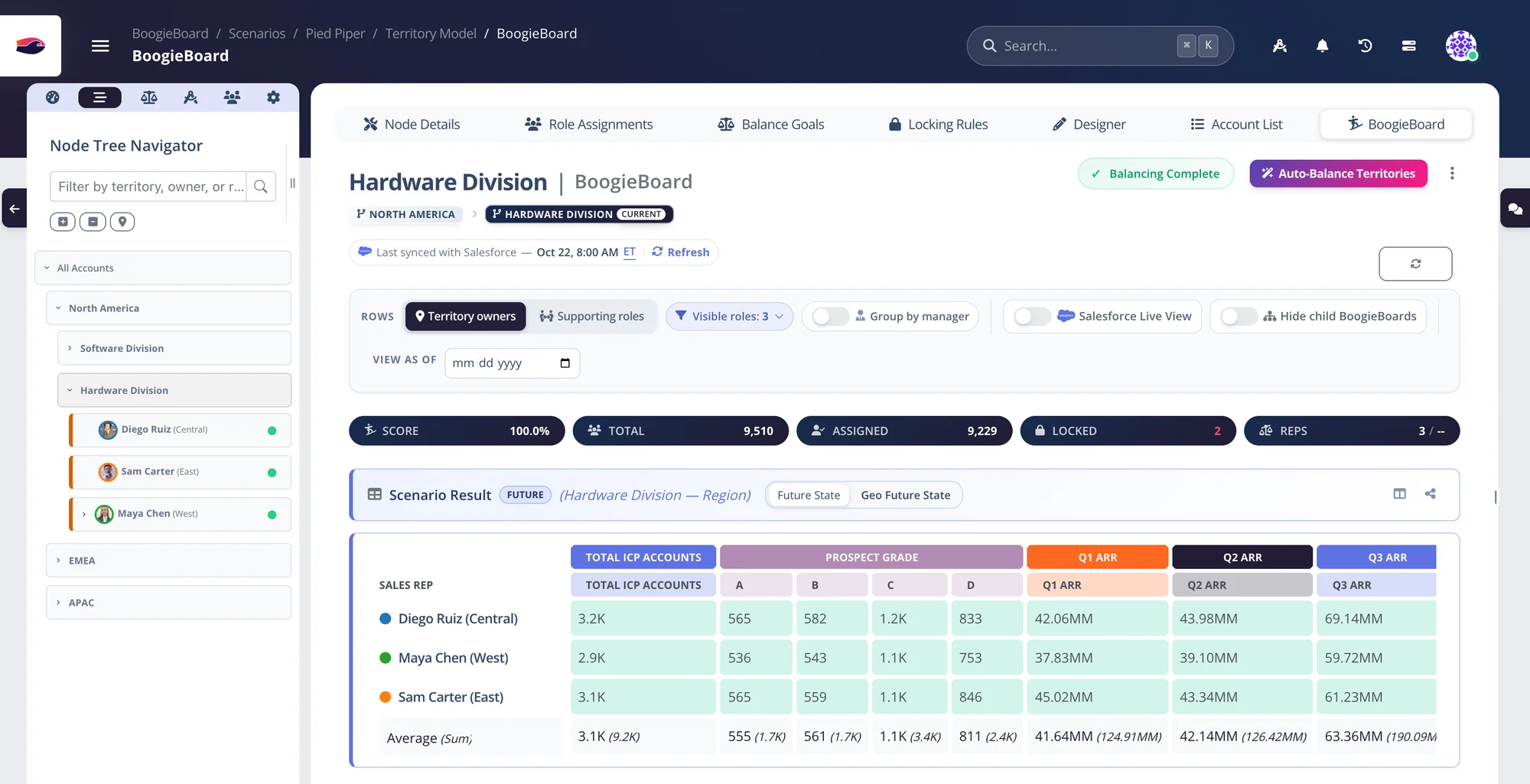
“If we decided, hey, we were going to need six territories in this segment and then we needed to move to eight, it was just a click of a button. And that used to take us hours,” Miller noted. Managers got “a very easy view to look across all territories at the same time. If I was a manager and I had six reps, I could see the breakdown across all of the territories within my team side by side.”
3One rep per account family, per region
Hierarchies were the hardest thing to hold in a spreadsheet. “Parent-child accounts and account hierarchies have always been a challenge,” said Miller. “Those are just hard to implement in a spreadsheet.” Fullstory's rule was strict: “We have some pretty stringent rules around account hierarchies, especially when it spans geography. We want one rep on a family of accounts per region.”
The BoogieBoard team built a custom hierarchy rule that “did exactly what we wanted” — one rep in North America, one in Europe and one in APAC on the same account family. “That was incredibly awesome and valuable for us,” Hergenrader said.
4Bring sales leaders into the plan
Transparency was the point. “Sales teams lose trust when territory decisions lack transparency. If it feels like a black box—with no clear visibility into how something that meaningfully impacts their day-to-day was decided—they're not going to trust you,” said Hergenrader. So Fullstory brought all of its sales management into BoogieBoard to “play around with how we had designed territories. They were able to make live feedback and we made changes based on that feedback.”