
What You'll Find Here
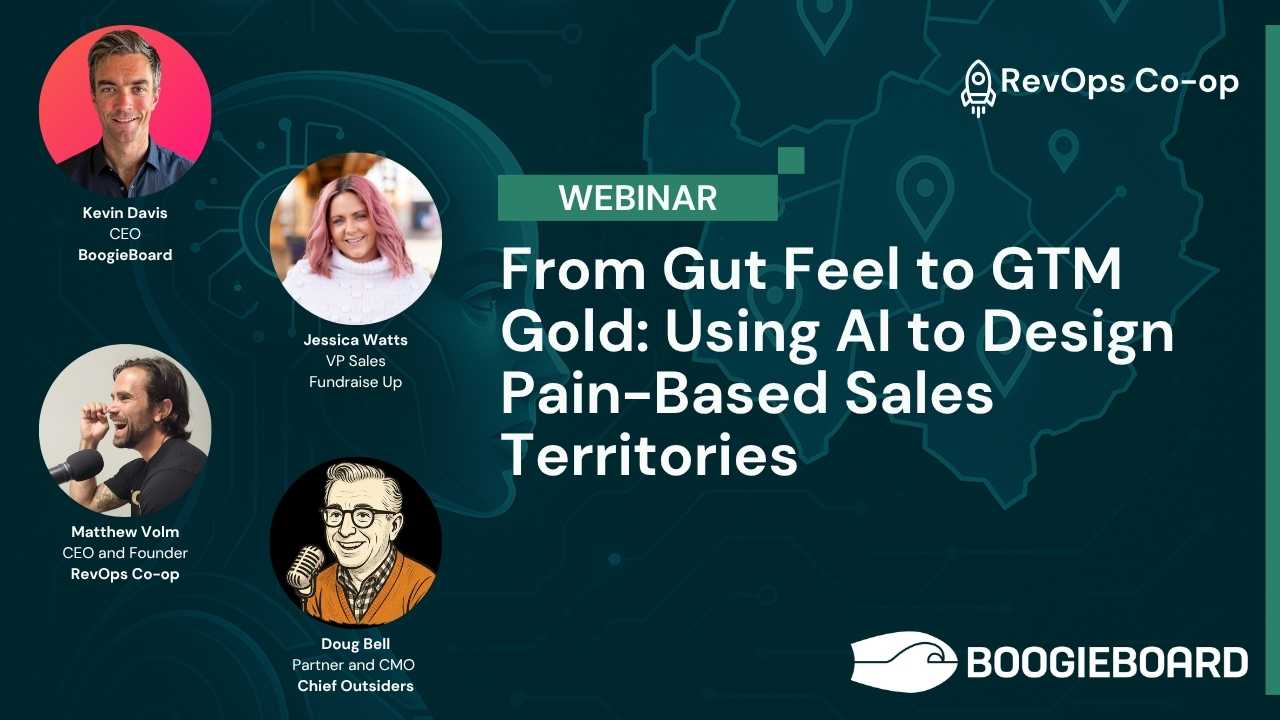
This webinar introduced a complete workflow for transforming territory design from "fast food" to "fine dining" using AI-powered market research. Below are all the prompts, templates, and tools demonstrated live during the session - ready for immediate use.
The Core Problem We Solved
Most territory design still happens like it's 1995 - dividing markets by ZIP codes and basic demographics instead of customer pain and market intelligence. The result? Territories that feel like mystery meat to sales teams and create a 30% performance gap between effective and ineffective organizations.


Our Solution: Quality Ingredients + Mise En Place
We combined CannonballGTM's market intelligence methodology with BoogieBoard's territory planning expertise:
- Sourcing: Use AI to discover quality market data "ingredients"
- Preparation: Apply mise en place principles to organize data into territory planning components
Like Anthony Bourdain said, mise en place is the foundation of professional cooking. This approach transforms territory design from amateur guesswork to professional methodology.

Complete Resource Library
💡 Follow BoogieBoard & Cannonball for more prompts and updated workflows.
Webinar Cards
Cannonball’s FOCUS Stage Prompts
1. Comprehensive Research Request: Market Analysis for Existential Data Point Discovery
This comprehensive research prompt replaces traditional market analysis with EDP-focused investigation. It guides deep research into market dynamics, competitive pressures, customer pain points, and regulatory landscapes, specifically to identify potential Existential Data Points.
The prompt structures systematic research across eight key areas: market size and growth, competitive landscape, customer challenges, business impact, regulatory risks, future trends, customer segmentation, and critical success factors. The output provides the foundation for identifying EDPs that create genuine urgency in your target market.
Claude Artifact | Google Drive
2. Buyer Persona Prompt
Building on market research, this prompt develops richly detailed buyer personas by analyzing the people involved in purchasing decisions. It directs research into professional backgrounds, digital footprints, and decision-making processes, specifically when facing critical business challenges.
Deploy: ChatGPT 4o
Claude Artifact | Google Drive
3. Market Context Prompt
This prompt generates a comprehensive narrative analysis of market maturity and adoption lifecycle, crucial for understanding how to position solutions during existential moments. The output helps determine where brands sit on the maturity curve and how to craft messaging that resonates with each stage of adoption.
For a comprehensive summary of the role of market context and the market context prompt, check out The Cannonball GTM Prompt Library and Guide: April 2025 Edition.
Claude Artifact | Google Drive
Cannonball’s INVESTIGATE Stage Prompts
4. Existential Data Point Analysis Framework
This advanced prompt transforms market research into actionable pain insights by identifying and validating Existential Data Points for your SaaS category. It analyzes research data to propose potential EDPs, evaluates each against criteria like urgency and measurability, and develops pain-based segments around the strongest EDP candidate.
The prompt provides a systematic evaluation methodology, creates visual representations of pain intensity, and generates strategic recommendations for targeting high-pain segments with Permissionless Value Propositions.
Note, this prompt requires that you run and load the results of the Comprehensive Research Request: Market Analysis for Existential Data Point Discovery. You might find us developing a handy mega prompt at some point in the future when Gemini 2.5 or Chat GPT can match Claude’s analytical and narrative capabilities. Until then, please use Claude for this prompt.
Claude Artifact | Google Drive
5. Pain-Based Segment Evaluator and Scoring
This quantitative prompt transforms qualitative pain analysis into scored business opportunities. It calculates economic potential for each pain-based segment, evaluating factors like pain intensity, conversion rates, and sales efficiency to create ranked targeting priorities.
The output includes segment forecasting formulas, viability scores, implementation recommendations, and strategic next steps for your highest-potential segments.
To see an example, check out our DISCO pain-based segment post.
Claude Artifact | Google Drive
6. Niche Data Sources
This prompt identifies specialized data sources relevant to specific market segments and customer needs. It helps uncover industry-specific information that provides deeper insights beyond generic market research.
Claude Artifact | Google Drive
BoogieBoard’s PREP Stage Prompts + Templates
7. Custom GPT: Balance Goal Generator for Territory Planning
This GPT analyzes your comprehensive market research and generates 15-20 specific Balance Goals tailored to your business model and market dynamics. Balance Goals are design parameters that define how accounts and opportunities are distributed across territories to create equitable sales coverage. It maps data sources from your research to actionable territory design parameters. Upload all market research from Steps 1-7 into the GPT. Your result will be specific Balance Goals you can implement in territory design to create equitable, high-performing sales territories.
Here is a deeper article on Balance Goals for reference.
8. Territory Planning Spreadsheet Template
This BoogieBoard Territory Planning Google Sheet is a comprehensive spreadsheet tool designed to help revenue operations teams design and balance sales territories effectively. It comes pre-loaded with formulas, reports, and organizational structure that align with territory planning best practices. The sheet enables teams to input account data, apply balancing criteria, and automatically calculate territory equity metrics to ensure fair distribution of opportunities across sales reps. With built-in reporting capabilities, teams can visualize territory balance, track key metrics, and iterate on different scenarios before finalizing their territory design. Simply make a copy of the Google Sheet and customize it with your account data to streamline the complex process of creating balanced, equitable sales territories.
9. Micro Industry Segmentation Prompt
This prompt helps you conduct comprehensive market research to identify evidence-backed market industries, sub-industries, and micro-industries through website analysis, competitive intelligence, and technology footprint research. The output is a detailed three-tier segmentation tree that reveals not just who the company serves today, but who they should logically target based on real-world data and usage patterns. Use this framework to build a complete understanding of market opportunities across industries, sub-industries, and micro-industries.
https://claude.ai/public/artifacts/e535faf8-bb46-45dc-ad67-35bc328111fd
10. Custom GPT: Complex Account Hierarchy Sales Strategist
This custom GPT analyzes your uploaded market research to identify complex organizational structure types (integrated corporations, holding companies, franchises, PE-owned firms, joint ventures, and cooperatives) and recommends the optimal sales team coordination approach. Based on the structures detected in your data, it will recommend whether to use "Single Voice" (centralized coordination), "Divided but Coordinated" (regional alignment), or "Everyone Goes Direct" (decentralized approach). The recommendations are grounded in a comprehensive framework that maps how different organizational types make buying decisions and where authority lies. For more detailed information about the underlying methodology and framework, see the complete guide: Guide: How to Sell Into Complex Account Hierarchies.
https://chatgpt.com/g/g-6873f29080a48191bf9eb029c83ea806-complex-account-hierarchy-sales-strategist
11. Territory Planning Project Hub Template
This Territory Planning Project Hub is a comprehensive Notion template that streamlines sales territory design from start to finish. It provides a centralized workspace for managing the entire territory planning process, including project objectives, task tracking, team coordination, account data management, scenario modeling, and implementation planning. Teams can duplicate this ready-to-use template and customize it by removing unnecessary sections while maintaining the structured framework needed to coordinate stakeholders, manage complex data requirements, and iterate through different territory design scenarios until implementation in their CRM system.
Territory Planning Project Hub Template
BoogieBoard’s SUPPORT Stage Templates
💡 Note: This section requires much more first party data.
Rules of Engagement Template
This template and guide provides a comprehensive framework for creating Rules of Engagement (ROE) - the internal policies and workflows that govern how a sales organization operates. It serves as a blueprint for building a centralized "source of truth" document that covers everything from account definitions and territory assignments to lead routing and compensation rules. The guide emphasizes making the ROE a dynamic, well-linked reference resource that sales teams can use to resolve disputes, understand processes, and navigate complex scenarios like account hierarchies, opportunity management, and partner relationships. Essentially, it's a roadmap for creating the "rulebook" that keeps sales teams aligned and eliminates confusion about how deals should be managed and credited.
Rules of Engagement (ROE) for Your Sales Organization | Template & Prompt Library
Launch Your Territories at Sales Kickoff
This BoogieBoard Sales Kickoff template helps revenue operations teams announce new sales territories and account assignments to their organization. The 10-section presentation framework guides you through explaining territory changes with a storytelling approach that builds buy-in from sales reps. It covers reviewing past performance, explaining your methodology, showcasing collaboration efforts, and presenting the new structure with visual summaries. The template emphasizes change management by acknowledging the emotional impact on sales teams and includes "vibe check" guidance for empathetic delivery. Teams can download and customize the Google Slides template to transform potentially contentious territory announcements into strategic presentations that demonstrate thoughtful planning and inspire confidence in the changes.
SKO Territory Launch Template & Prompt Library
Internal Post - Our Company’s Account Data Strategy Template & Prompt
This BoogieBoard Account Data Strategy template helps revenue operations teams create transparent communication with their sales teams about CRM data sources, quality challenges, and improvement processes. The comprehensive document explains the difference between first-party and third-party data, acknowledges common data accuracy issues, and details what RevOps is doing behind the scenes to maintain data quality. It includes a customizable table mapping data fields to their sources of truth, an FAQ section for common sales questions, and clear instructions for reporting data issues. Teams can either adapt the pre-built template directly by replacing placeholders with company-specific information, or use the included AI prompt to generate a fully customized version based on their unique data stack and processes.
Internal Post - Our Company's Account Data Strategy Template & Prompt
Live Case Study: FundraiseUp Results
What We Discovered:
- Existential Data Point: Donor retention rates below 42% create existential crises for nonprofits
- 6 Primary Industries → 18 Sub-Industries → 60+ Micro-Industries identified
- Pain-based segments from "Crisis" organizations to "Leaders"

What We Built:
- 17 specific Balance Goals tailored to nonprofit fundraising
- Micro-industry classifications for precise rep specialization
- "Divided but Coordinated" account hierarchy strategy
- Complete reporting framework with standardized measuring tools
Jessica Watts (VP of Sales, FundraiseUp) validated live: "This is exactly how we speak and discuss the problem in our deal cycles."

To learn more, connect here with BoogieBoard and check out the CannonballGTM Substack here: