
5 Key Takeaways
- Reps are right to be opinionated about territory. It is the single input to their income they do not control.
- Your territory is the company-controlled starting condition connecting serviceable opportunity, workload, customer obligations, quota, and the time available for you to convert that market into earnings.
- Ask for territory potential, workload, quota relativity (the relationship between territory conditions and proposed quota), locked obligations, holdovers, whitespace, ramp assumptions, and the review path, then compare your book only with genuinely comparable roles.
- No territory guarantees attainment and execution still matters, but effort cannot compensate indefinitely for an unwinnable starting condition; the company should show how quota and opportunity were considered together.
- The conversation fails when leadership treats every territory concern as an excuse or when a seller treats one disappointing account as proof of systemic unfairness without checking the complete book.
Your territory shapes your accounts, workload, pipeline, customer relationships, quota, earnings, and opportunity to advance. Reps are right to be opinionated about territory. It is the single input to their income they do not control. This guide shows what you should check, what evidence to request, and which questions to bring to your manager. You can use them without becoming the territory designer yourself.
BoogieBoard treats the territory conditions behind your earnings as part of a governed change process. The model must connect market strategy with account-level evidence, productive capacity, explicit decision rights, and controlled activation. The objective is not to remove judgment. It is to make judgment visible and repeatable.
The central position is: Sales is right to be opinionated; their livelihood depends on it. The sections below turn that position into definitions, alternatives, procedures, examples, controls, and an operating decision.
Working Definitions
- Territory Viability: whether a territory contains enough reachable opportunity for its assigned role.
- Balance Goal: a measurable objective for healthy opportunity, quality, workload, or continuity.
- quota relativity: the visible relationship between territory conditions and proposed quota.
- Book of Business: the accounts, customers, and responsibilities assigned to a role.
- holdover: a temporary, approved continuation of responsibility after the future territory changes.
BoogieBoard has observed 1,000-plus-rep planning cycles involving 8 to 20 Operations stakeholders and 80 to 120 Sales-leader stakeholders. The process is a governed change program, not a private analyst exercise. For the territory conditions behind your earnings, use that observation only for the claim and population it directly supports.
Independent evidence provides a separate check for the territory conditions behind your earnings: RepVue lets sellers compare sales organizations using seller-reported quota attainment, opportunity flow, product-market fit, culture, and compensation signals.
What Is The Territory Conditions Behind Your Earnings?
Your territory is the company-controlled starting condition connecting serviceable opportunity, workload, customer obligations, quota, and the time available for you to convert that market into earnings. A territory change has a business explanation and an operating consequence. The message should state what changed, why, how the decision was made, what it means for each person, and what happens next. In the territory conditions behind your earnings, test the choice against Balance Goal, then record any accepted exception in the decision log. You should be able to trace the result from your account roster to the published rule.
The territory conditions behind your earnings connects an approved territory decision with informed managers, prepared sellers, live systems, temporary rules, support paths, and an accountable operating state. Territory Viability, Balance Goal, and quota relativity make the transition inspectable. The the territory conditions behind your earnings review is complete only when quota relativity and the affected account roster tell the same story. If your territory is an outlier, ask whether the difference is intentional, temporary, or a data error.
Why the Decision Matters: The Territory Conditions Behind Your Earnings
No territory guarantees attainment and execution still matters, but effort cannot compensate indefinitely for an unwinnable starting condition; the company should show how quota and opportunity were considered together. This decision affects more than visual symmetry. It changes market coverage, seller focus, quota credibility, customer continuity, performance interpretation, and the amount of manual administration required during the year. Poor design transfers work to managers and sellers, who then create informal rules to keep operating. The the territory conditions behind your earnings review is complete only when quota relativity and the affected account roster tell the same story. If your territory is an outlier, ask whether the difference is intentional, temporary, or a data error.
The business consequence is clearest when a company cannot separate execution from starting conditions. If opportunity and workload are invisible, attainment becomes an ambiguous signal. A measured territory does not explain every result, but it gives leadership a defensible denominator for capacity, quota, and performance conversations. Use one current-state baseline to keep every the territory conditions behind your earnings scenario comparable. Your manager should be able to explain the tradeoff without relying on a private spreadsheet.
How the Alternatives Differ: The Territory Conditions Behind Your Earnings
The conversation fails when leadership treats every territory concern as an excuse or when a seller treats one disappointing account as proof of systemic unfairness without checking the complete book. The right answer depends on the role and market. Fair does not mean equal across unlike jobs. It means comparable roles are measured by the same published standard, while legitimate differences in motion, capacity, and responsibility receive their own standard. Use one current-state baseline to keep every the territory conditions behind your earnings scenario comparable. Your manager should be able to explain the tradeoff without relying on a private spreadsheet.
Compare alternatives against the same population and definitions. One option may improve Territory Viability, another may protect Balance Goal, and a third may reduce disruption. Do not let each option use a different denominator or source date; that turns scenario review into a presentation contest. For the territory conditions behind your earnings, name the approver, the permitted evidence, and the condition that would justify a departure from the rule. Check how the decision changes your workload, pipeline, customer continuity, and quota context.
Calculating and Testing Territory Conditions Behind Your Earnings
Two AEs with the same quota do not have equivalent earning conditions when one inherits mature pipeline and viable whitespace while the other carries stale data, support-heavy customers, and fewer reachable accounts. A seller loses ten accounts, retains two qualified opportunities temporarily, and receives eight replacement accounts. The communication should show the business reason, Territory Viability, Balance Goal, quota relativity, effective dates, and the route for one disputed hierarchy. For the territory conditions behind your earnings, name the approver, the permitted evidence, and the condition that would justify a departure from the rule. Check how the decision changes your workload, pipeline, customer continuity, and quota context.
Compare a poor launch with a governed one: surprise roster and offline CRM versus manager preview, account-level report, dated policies, live assignments, office hours, and a reconciled correction queue. Keep account-level results beside the the territory conditions behind your earnings summary so Balance Goal remains inspectable after approval. You need an account-level correction path when the source data does not match what you know.
See Balance in the Planning Workflow
The relevant product workflow is Design Territories with Quota Relativity. BoogieBoard Scenario Planning keeps the account-level assumptions, tradeoffs, and proposed assignments visible while the team completes that work.
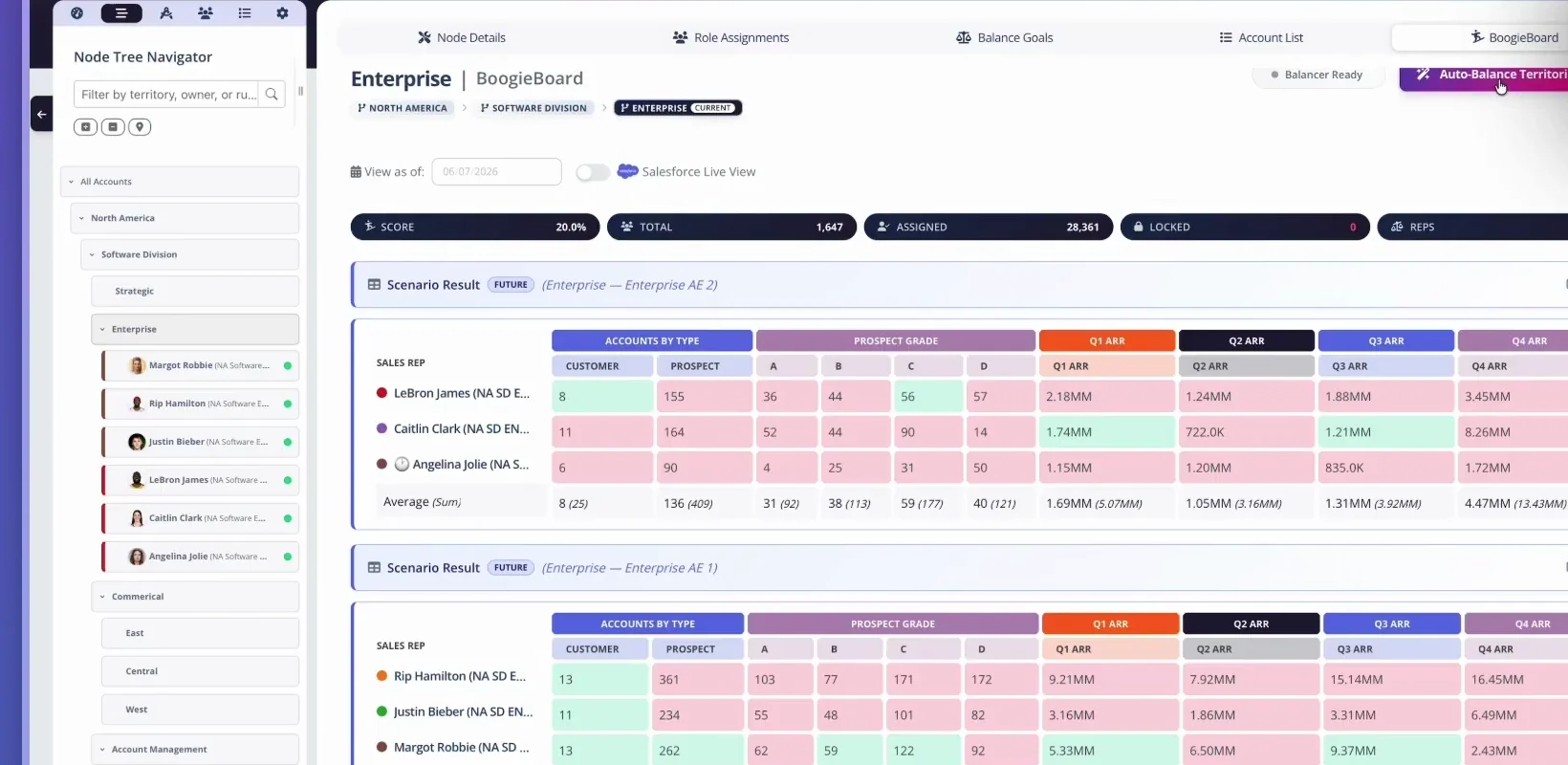
A scenario result compares quota-relative territory measures across reps before the proposed design goes live.
A Practical Decision Lens: The Territory Conditions Behind Your Earnings
A practical test is to pick one surprising account and trace it end to end. Explain why it is in the segment, why it belongs in the territory, whether it is locked, which goals it affects, and what happens when the seller changes. If the answer requires several private spreadsheets, the model is not yet governed. Keep account-level results beside the the territory conditions behind your earnings summary so Balance Goal remains inspectable after approval. You need an account-level correction path when the source data does not match what you know.
Use this module to make the hidden decision explicit. State the role, population, evidence, rule, exception path, and operating consequence. The objective is not a perfectly clean model; it is a model whose compromises are visible enough to approve, communicate, and improve. Give the the territory conditions behind your earnings decision a source date, an owner, and a condition that would trigger revision. Ask what evidence would cause leadership to revisit your territory after activation.
Inputs and Assumptions: The Territory Conditions Behind Your Earnings
Use this module to make the hidden decision explicit. State the role, population, evidence, rule, exception path, and operating consequence. The objective is not a perfectly clean model; it is a model whose compromises are visible enough to approve, communicate, and improve. Give the the territory conditions behind your earnings decision a source date, an owner, and a condition that would trigger revision. Ask what evidence would cause leadership to revisit your territory after activation.
A practical test is to pick one surprising account and trace it end to end. Explain why it is in the segment, why it belongs in the territory, whether it is locked, which goals it affects, and what happens when the seller changes. If the answer requires several private spreadsheets, the model is not yet governed. Before activating the territory conditions behind your earnings, show managers the effect on quota relativity and every downstream rule that depends on it. Your review should focus on documented facts and rules, not a negotiation for preferred accounts.
Stakeholder Consequences: The Territory Conditions Behind Your Earnings
A practical test is to pick one surprising account and trace it end to end. Explain why it is in the segment, why it belongs in the territory, whether it is locked, which goals it affects, and what happens when the seller changes. If the answer requires several private spreadsheets, the model is not yet governed. Before activating the territory conditions behind your earnings, show managers the effect on quota relativity and every downstream rule that depends on it. Your review should focus on documented facts and rules, not a negotiation for preferred accounts.
Use this module to make the hidden decision explicit. State the role, population, evidence, rule, exception path, and operating consequence. The objective is not a perfectly clean model; it is a model whose compromises are visible enough to approve, communicate, and improve. For the territory conditions behind your earnings, document the effect on Territory Viability before the model advances. For your book, ask which accounts move and which measure justifies the change.
Practical Implications
Ask for territory potential, workload, quota relativity, locked obligations, holdovers, whitespace, ramp assumptions, and the review path, then compare your book only with genuinely comparable roles.
Decision Worksheet
| Decision | Evidence to inspect | Control |
|---|---|---|
| Explain the change | Territory Viability and business rationale | Approved narrative |
| Show the impact | Balance Goal and quota relativity | Manager and seller reports |
| Prepare go-live | CRM, policies, temporary rules, and support paths | Effective date and named owners |
| Close the transition | Corrections, exceptions, expirations, and unresolved commitments | Reconciliation checkpoint |
What This Means for You
You do not need to rebuild the model to evaluate the territory conditions behind your earnings. Check whether your accounts match the published population, whether your workload and opportunity are measured with understandable inputs, whether locked accounts remain in the final comparison, and whether your quota reflects material territory differences. Bring account IDs and evidence when you find an error.
Questions to Ask Your Manager
- What business objective drove this decision, and what tradeoff did leadership accept?
- Which rules determine the accounts and customers in my territory?
- Which Balance Goals were used, and what range is considered acceptable?
- Which accounts were locked, and are they included in the final Territory Health result?
- How does my quota account for potential, workload, capacity, and ramp?
- Where do I submit a data correction or policy challenge, and when will I receive an answer?
Decision Narrative
State the business change, the problem the model solves, the tradeoff leadership accepted, and the facts that would cause a later revision. For the territory conditions behind your earnings, use Territory Viability to record the evidence, decision owner, affected account population, and condition that closes this review.
Prior-State Preservation
Freeze the current account and role state with a source date so every recipient can see what changed rather than receiving only the final roster. For the territory conditions behind your earnings, use Balance Goal to record the evidence, decision owner, affected account population, and condition that closes this review.
Frequently Asked Questions
Does my territory affect my quota?
Your territory is the company-controlled starting condition connecting serviceable opportunity, workload, customer obligations, quota, and the time available for you to convert that market into earnings. No territory guarantees attainment and execution still matters, but effort cannot compensate indefinitely for an unwinnable starting condition; the company should show how quota and opportunity were considered together. Use the published definitions and complete-territory result instead of relying on one universal benchmark. Ask your manager to show how that standard applies to your book.
Can I ask for a different territory?
Ask for territory potential, workload, quota relativity, locked obligations, holdovers, whitespace, ramp assumptions, and the review path, then compare your book only with genuinely comparable roles. Two AEs with the same quota do not have equivalent earning conditions when one inherits mature pipeline and viable whitespace while the other carries stale data, support-heavy customers, and fewer reachable accounts. Publish the assumptions so another reviewer can reproduce the answer. You should be able to reproduce the answer from your roster and the stated inputs.
What evidence is required for the territory conditions behind your earnings?
For the territory conditions behind your earnings, assemble governed account data, current assignments, role capacity, and decision evidence for Territory Viability, Balance Goal, and quota relativity. Date the sources and publish the definitions so another reviewer can reproduce the result and separate a factual correction from a policy exception. Request the source date when the underlying account facts look stale.
How often should the territory conditions behind your earnings be reviewed?
Review the territory conditions behind your earnings on the formal planning cadence and whenever the inputs behind Territory Viability, Balance Goal, and quota relativity change materially. Keep customer and pipeline ownership stable between reviews; reopen the model when strategy or new evidence changes the decision, not merely because a manager prefers a different assignment. Ask when your territory will next receive a formal review.
How should data corrections and policy exceptions be separated?
Disputes about the territory conditions behind your earnings should send incorrect account facts through the data-correction path and challenges to the published rule through policy governance. Any exception needs a reason, approver, effective period, and visible effect on the complete approved model. Check that your locked accounts remain in the final health calculation.
What must be ready before a territory change goes live?
A change involving the territory conditions behind your earnings can go live only after the manager briefing, account-level report, published policy, CRM assignment, temporary coverage, support path, and effective date agree. Reconcile the live result after activation so the announcement and operating record cannot drift apart. You need a system when manual reconciliation makes the rule impossible to inspect.
About the author: Kevin Davis is Co-Founder & CEO of BoogieBoard.
In Summary
Reps are right to be opinionated about territory. It is the single input to their income they do not control. Use the sequence above to keep the decision governed, evidence-based, and inspectable at both the account and territory levels.
See Territory Planning in Practice
Watch practical territory-design workflows on the BoogieBoard YouTube channel.