5 Key Takeaways
- Named-account coverage replaces geography with judgment, which means the account list becomes the whole design.
- A named-account territory assigns an explicit list of companies to a seller or team rather than deriving ownership primarily from geography.
- Define entry, removal, family, capacity, ownership, and lock rules.
- Named lists support focus and strategic judgment but can become permanent political assets.
- A famous-logo list with no selection rationale, family treatment, or capacity limit is an executive wish list, not a territory model.
Named-account coverage replaces geography with judgment, which means the account list becomes the whole design. That position is useful only when the planning team can translate it into inputs, decisions, controls, and a result the field can understand.
BoogieBoard treats named-account territories as part of a governed change process. The model must connect market strategy with account-level evidence, productive capacity, explicit decision rights, and controlled activation. The objective is not to remove judgment. It is to make judgment visible and repeatable.
The central position is: Salespeople are surfers, not hunters. The sections below turn that position into definitions, alternatives, procedures, examples, controls, and an operating decision.
Working Definitions
- named account: a defined input used when evaluating named-account territories.
- Target Account List: a defined input used when evaluating named-account territories.
- ICP: a defined input used when evaluating named-account territories.
- account scoring: a defined input used when evaluating named-account territories.
- Account Locking Criteria: the published rules for assignments that should not move.
BoogieBoard observes no-move rules for qualified opportunities or near-term renewals in roughly 50% to 75% of designs. The rules are constraints applied after Balance Goals are defined, and the complete book is still measured afterward. For named-account territories, use that observation only for the claim and population it directly supports.
Independent evidence provides a separate check for named-account territories: Keyplay recommends testing an ICP model against strong customers, known poor-fit accounts, and a control list instead of trusting a score at face value.
What Is Named-Account Territories?
A named-account territory assigns an explicit list of companies to a seller or team rather than deriving ownership primarily from geography. The account list is therefore the territory design. The useful distinction is between data, policy, and judgment. Data describes the accounts and roles. Policy states the repeatable rule. Judgment chooses among legitimate tradeoffs. When those layers are blended in a spreadsheet formula or a private manager request, named-account territories becomes difficult to explain and impossible to audit consistently. In named-account territories, test the choice against Target Account List, then record any accepted exception in the decision log.
Named-account territories is a governed coverage decision, not a label applied after accounts have already moved. It connects named account, Target Account List, and ICP to a defined role and market. The output should tell stakeholders what is being decided, which evidence is allowed, who approves exceptions, and how the result will be operated after launch. The named-account territories review is complete only when ICP and the affected account roster tell the same story.
A Practical Decision Lens: Named-Account Territories
A famous-logo list with no selection rationale, family treatment, or capacity limit is an executive wish list, not a territory model. Use this module to make the hidden decision explicit. State the role, population, evidence, rule, exception path, and operating consequence. The objective is not a perfectly clean model; it is a model whose compromises are visible enough to approve, communicate, and improve. The named-account territories review is complete only when ICP and the affected account roster tell the same story.
A practical test is to pick one surprising account and trace it end to end. Explain why it is in the segment, why it belongs in the territory, whether it is locked, which goals it affects, and what happens when the seller changes. If the answer requires several private spreadsheets, the model is not yet governed. Use one current-state baseline to keep every named-account territories scenario comparable.
Target Account List: The Decision Test
Named lists support focus and strategic judgment but can become permanent political assets. Expiry and review rules keep the list connected to evidence. A practical test is to pick one surprising account and trace it end to end. Explain why it is in the segment, why it belongs in the territory, whether it is locked, which goals it affects, and what happens when the seller changes. If the answer requires several private spreadsheets, the model is not yet governed. Use one current-state baseline to keep every named-account territories scenario comparable.
named account: The Decision Test
The common failure is optimizing the easiest field rather than the business objective. Equal account count, a generic revenue band, or one summed score can look objective while concealing fit, workload, timing, hierarchy, and service obligations. Convenience is not a rationale. For named-account territories, name the approver, the permitted evidence, and the condition that would justify a departure from the rule.
Decision Note: Target Account List
A second failure is letting exceptions define the model. Define Balance Goals first, then Account Locking Criteria. Apply qualifying locks, model the remaining book, and evaluate the complete result. If the constraints make a goal unattainable, disclose the residual imbalance instead of changing the rule in private. Keep account-level results beside the named-account territories summary so Target Account List remains inspectable after approval.
Calculating and Testing Named-Account Territories
An enterprise AE receives 35 ultimate-parent families, including 12 active pursuits and six customers. Subsidiaries follow the parent unless a documented buying-center exception applies. Assume six comparable territories cover 900 serviceable accounts. A count-only split begins at 150 accounts each. The team then measures named account, Target Account List, and ICP; one territory holds 28% of high-potential accounts and another carries twice the near-term workload. The worked answer is not to force identical counts. It is to publish the priority, range, and tradeoff. Give the named-account territories decision a source date, an owner, and a condition that would trigger revision.
Create three scenarios. Scenario A minimizes movement, Scenario B minimizes variance on the primary goal, and Scenario C protects continuity while improving the two largest outliers. Compare complete territories after qualifying locks return. Select the scenario whose residual imbalance leadership is prepared to explain and operate. Before activating named-account territories, show managers the effect on ICP and every downstream rule that depends on it.
Worked Example 2: A Decision You Can Reproduce
Define entry, removal, family, capacity, ownership, and lock rules. Build candidates from ICP, potential, relationship, and strategic evidence, then require an approver for manual additions. Create three scenarios. Scenario A minimizes movement, Scenario B minimizes variance on the primary goal, and Scenario C protects continuity while improving the two largest outliers. Compare complete territories after qualifying locks return. Select the scenario whose residual imbalance leadership is prepared to explain and operate. Before activating named-account territories, show managers the effect on ICP and every downstream rule that depends on it.
Assume six comparable territories cover 900 serviceable accounts. A count-only split begins at 150 accounts each. The team then measures named account, Target Account List, and ICP; one territory holds 28% of high-potential accounts and another carries twice the near-term workload. The worked answer is not to force identical counts. It is to publish the priority, range, and tradeoff. For named-account territories, document the effect on named account before the model advances.
Worked Example 3: A Decision You Can Reproduce
Assume six comparable territories cover 900 serviceable accounts. A count-only split begins at 150 accounts each. The team then measures named account, Target Account List, and ICP; one territory holds 28% of high-potential accounts and another carries twice the near-term workload. The worked answer is not to force identical counts. It is to publish the priority, range, and tradeoff. For named-account territories, document the effect on named account before the model advances.
Create three scenarios. Scenario A minimizes movement, Scenario B minimizes variance on the primary goal, and Scenario C protects continuity while improving the two largest outliers. Compare complete territories after qualifying locks return. Select the scenario whose residual imbalance leadership is prepared to explain and operate. In named-account territories, test the choice against Target Account List, then record any accepted exception in the decision log.
See Account Locks in the Planning Workflow
The relevant product workflow is Lock Accounts to Territories. BoogieBoard Scenario Planning keeps the account-level assumptions, tradeoffs, and proposed assignments visible while the team completes that work.
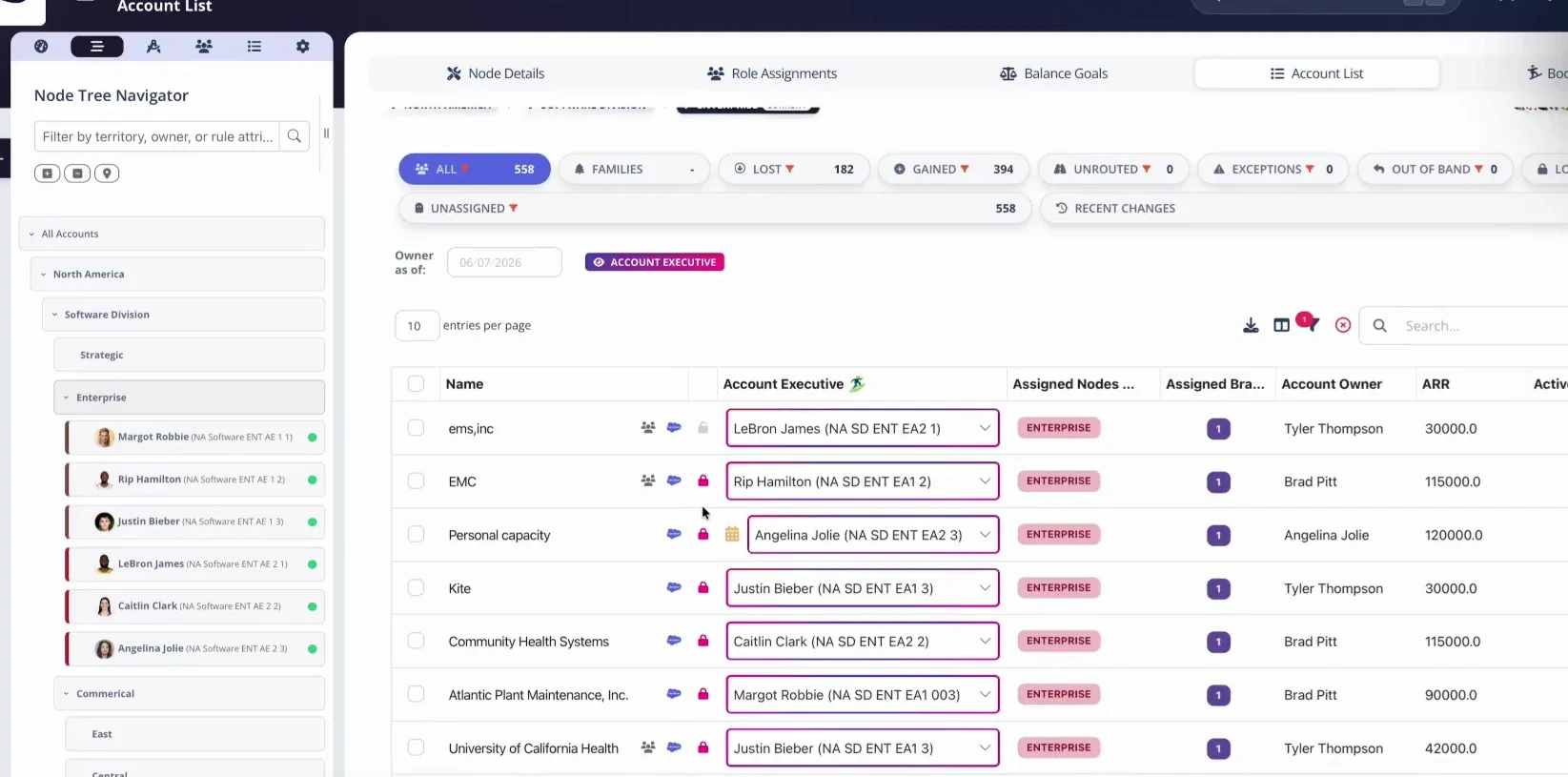
Locked-account indicators preserve approved continuity decisions while the rest of the book remains available for optimization.
Worked Example 4: A Decision You Can Reproduce
Create three scenarios. Scenario A minimizes movement, Scenario B minimizes variance on the primary goal, and Scenario C protects continuity while improving the two largest outliers. Compare complete territories after qualifying locks return. Select the scenario whose residual imbalance leadership is prepared to explain and operate. In named-account territories, test the choice against Target Account List, then record any accepted exception in the decision log.
Assume six comparable territories cover 900 serviceable accounts. A count-only split begins at 150 accounts each. The team then measures named account, Target Account List, and ICP; one territory holds 28% of high-potential accounts and another carries twice the near-term workload. The worked answer is not to force identical counts. It is to publish the priority, range, and tradeoff. The named-account territories review is complete only when ICP and the affected account roster tell the same story.
Stakeholder Consequences: Named-Account Territories
Use this module to make the hidden decision explicit. State the role, population, evidence, rule, exception path, and operating consequence. The objective is not a perfectly clean model; it is a model whose compromises are visible enough to approve, communicate, and improve. The named-account territories review is complete only when ICP and the affected account roster tell the same story.
A practical test is to pick one surprising account and trace it end to end. Explain why it is in the segment, why it belongs in the territory, whether it is locked, which goals it affects, and what happens when the seller changes. If the answer requires several private spreadsheets, the model is not yet governed. Use one current-state baseline to keep every named-account territories scenario comparable.
Operating and Governing the Model: Named-Account Territories
After activation, monitor assignment gaps, source-data changes, capacity events, and Territory Health. Use defined triggers and review windows instead of constant reshuffling. A territory model should absorb ordinary hiring, departure, and account changes without becoming a new annual reconstruction project. Use one current-state baseline to keep every named-account territories scenario comparable.
Governance begins with explicit decision rights. One Driver runs the process, one Approver chooses the final tradeoff, Contributors supply evidence, and Informed stakeholders receive the result. Publish the review cadence, correction path, exception authority, and source of truth with the approved roster. For named-account territories, name the approver, the permitted evidence, and the condition that would justify a departure from the rule.
account scoring: The Decision Test
Use this module to make the hidden decision explicit. State the role, population, evidence, rule, exception path, and operating consequence. The objective is not a perfectly clean model; it is a model whose compromises are visible enough to approve, communicate, and improve. For named-account territories, name the approver, the permitted evidence, and the condition that would justify a departure from the rule.
Account Locking Criteria: The Decision Test
A practical test is to pick one surprising account and trace it end to end. Explain why it is in the segment, why it belongs in the territory, whether it is locked, which goals it affects, and what happens when the seller changes. If the answer requires several private spreadsheets, the model is not yet governed. Keep account-level results beside the named-account territories summary so Target Account List remains inspectable after approval.
Decision Note: named account 2
Use this module to make the hidden decision explicit. State the role, population, evidence, rule, exception path, and operating consequence. The objective is not a perfectly clean model; it is a model whose compromises are visible enough to approve, communicate, and improve. Give the named-account territories decision a source date, an owner, and a condition that would trigger revision.
Common Models and Variations: Named-Account Territories
No model removes judgment. Geographic, named-account, segment, industry, customer, and hybrid structures each solve a different constraint. Use the fewest logical layers that express the strategy, then state where a deliberate override is allowed. Complexity should correspond to a real customer or operating need, not inherited convention. Before activating named-account territories, show managers the effect on ICP and every downstream rule that depends on it.
The model in this subsection is useful only when its organizing rule matches the selling motion. Compare options by opportunity, workload, continuity, explainability, and maintenance burden. A structure that looks simple at launch can create expensive exceptions when accounts change segment, sellers leave, or related companies need coordinated coverage. For named-account territories, document the effect on named account before the model advances.
Decision Worksheet
| Decision | Evidence to inspect | Control |
|---|---|---|
| Define the population | named account and comparable roles | Named data owner |
| Measure the current state | Target Account List and ICP | Source date and baseline |
| Choose the tradeoff | Scenario comparison and complete Territory Health | Recorded approver |
| Activate the result | Account roster, changes, quota, and transition rules | Effective date and correction path |
Frequently Asked Questions
What is a named account territory?
A named-account territory assigns an explicit list of companies to a seller or team rather than deriving ownership primarily from geography. The account list is therefore the territory design. Named lists support focus and strategic judgment but can become permanent political assets. Expiry and review rules keep the list connected to evidence. Use the published definitions and complete-territory result instead of relying on one universal benchmark.
How do you pick named accounts?
Define entry, removal, family, capacity, ownership, and lock rules. Build candidates from ICP, potential, relationship, and strategic evidence, then require an approver for manual additions. An enterprise AE receives 35 ultimate-parent families, including 12 active pursuits and six customers. Subsidiaries follow the parent unless a documented buying-center exception applies. Publish the assumptions so another reviewer can reproduce the answer.
What data is required for named-account territories?
For named-account territories, assemble governed account data, current assignments, role capacity, and decision evidence for named account, Target Account List, and ICP. Date the sources and publish the definitions so another reviewer can reproduce the result and separate a factual correction from a policy exception.
How often should named-account territories be reviewed?
Review named-account territories on the formal planning cadence and whenever the inputs behind named account, Target Account List, and ICP change materially. Keep customer and pipeline ownership stable between reviews; reopen the model when strategy or new evidence changes the decision, not merely because a manager prefers a different assignment.
How should Balance Goals and account locks work together?
For named-account territories, define Balance Goals tied to named account, Target Account List, and ICP before applying locks. Then publish Account Locking Criteria, lock only qualifying accounts, optimize the movable book, and score the complete territory so locked burden and residual imbalance remain visible.
When should a spreadsheet be replaced with a planning system?
For named-account territories, a spreadsheet remains adequate while one owner can preserve named account, Target Account List, and ICP, plus versions, account detail, approvals, and deployment without manual reconciliation obscuring the rule. Move to a planning system when scenario volume, collaboration, or audit work overwhelms the decision itself.
About the author: George James is Co-Founder & CPO of BoogieBoard.
In Summary
Named-account coverage replaces geography with judgment, which means the account list becomes the whole design. Use the sequence above to keep the decision governed, evidence-based, and inspectable at both the account and territory levels.
See Territory Planning in Practice
Watch practical territory-design workflows on the BoogieBoard YouTube channel.