
5 Key Takeaways
- An Executive Target Account List is a governed coverage decision, not another name for an ICP, a high account score, or a leader's informal wish list.
- Every account needs a documented selection reason, accountable owner, coverage treatment, effective date, and review or expiry date before it becomes an exception.
- Define Balance Goals first, then Account Locking Criteria. Apply qualifying locks, optimize the movable book, and evaluate the complete territories so the list's cost stays visible.
- Campaign lists should expire by default; persistent strategic lists require stronger evidence, named decision rights, and a regular renewal process.
- The best governance separates data corrections from policy exceptions and preserves an audit trail of who changed the list, why, and what the change displaced.
Executive attention can be useful in territory planning. A CEO may know that a particular company is entering a strategic market. A board member may have a relationship that creates a credible path into an account. A product leader may need a handful of design partners in a new industry. Those inputs should influence coverage.
The trouble begins when influence arrives as a spreadsheet of company names with no common selection standard, no expiry, and no record of what each assignment displaces. The list becomes a parallel territory system. Accounts receive special treatment because a senior person asked, while the rest of the model is expected to satisfy published workload and opportunity goals.
BoogieBoard commonly sees no-move rules in roughly 50% to 75% of territory designs. That observation does not mean every executive target should be locked. It means exceptions are normal enough to require explicit rules. A governed list lets leadership express strategy without turning every account-level request into a private negotiation.
What Is an Executive Target Account List?
An Executive Target Account List is a defined set of companies receiving deliberate sponsorship, prioritization, or coverage because they serve a stated strategic objective. The list may support a market-entry campaign, an executive relationship program, a named-account motion, or a small set of enterprise pursuits.
It is not the same as:
- An Ideal Customer Profile: an ICP describes the characteristics of companies the business is best equipped to serve.
- An account score: a score ranks or groups accounts using fit, intent, potential, or another model.
- An ordinary territory assignment: a standard assignment follows the Territory Logic governing a role or segment.
- A personal contact list: an executive relationship can be evidence, but it is not a coverage policy by itself.
- Every large logo: company size or brand recognition may matter, but neither proves strategic fit or seller capacity.
The distinction matters because each tool answers a different question. An ICP asks which companies resemble the market the business wants. A score asks which accounts appear stronger according to selected evidence. Territory Logic asks who should cover which accounts. An executive list asks which limited set deserves a specific, governed exception or additional motion.
Independent account-planning guidance points in the same direction. Adam Schoenfeld recommends testing an ICP model against best customers, known poor-fit accounts, and a control list instead of accepting a score at face value. The same discipline belongs here: selection should survive comparison with evidence, not merely reflect the seniority of the requester. See Keyplay's guidance on testing an ICP model.
The Four Components Every List Needs
1. Purpose and Scope
State what the list is intended to accomplish. Examples include securing lighthouse customers in a new vertical, coordinating executive sponsorship for active enterprise pursuits, finding design partners for a product launch, or protecting a small group of strategic customer relationships.
Then define the population. Is the list global or regional? Does it apply only to prospects, only to customers, or to both? Which roles participate? Is executive involvement a warm introduction, a recurring sponsor relationship, or merely a priority signal for account planning?
A list called "top accounts" is too vague. It does not tell Operations whether the objective is new revenue, market learning, retention, brand value, or relationship leverage. Those objectives can produce very different account choices and coverage treatments.
2. Selection Evidence
Every inclusion should have a reason that another operator can inspect. Useful evidence can include:
- fit with the current ICP or a defined expansion hypothesis;
- serviceable revenue or strategic market potential;
- a verified executive relationship and its strength;
- active buying evidence or a named business initiative;
- product or integration fit;
- customer expansion, renewal, or concentration risk;
- strategic learning value for a new product or segment;
- account-family importance across a parent and its subsidiaries.
Do not collapse all of these into a mysterious score. Record the evidence that matters for the objective. If an executive relationship is the reason, name the sponsor and define the expected action. If market-entry learning is the reason, record the hypothesis the account will help test.
3. Ownership and Coverage Treatment
Being on the list does not automatically tell the organization who owns the account. Define whether the account remains in its ordinary territory, moves to a named-account seller, receives an overlay, or gains an executive sponsor without changing commercial ownership.
For each account, record:
- primary territory and seller;
- supporting roles and executive sponsor;
- whether assignment is locked;
- the lock criterion and rationale;
- open opportunity, renewal, or relationship context;
- what happens if the seller changes roles;
- whether the account family must remain together.
This prevents a familiar collision: an executive believes sponsorship creates ownership, a seller believes the account remains theirs, and Operations has only a spreadsheet note. Support and ownership are separate decisions and should be modeled separately.
4. Review and Expiry
Every list needs an effective date and a review rule. Campaign lists should normally expire. Persistent lists should require renewal. An account should not remain strategic forever because it was strategic once.
Define the evidence required to continue special treatment. That could be a qualified relationship, active mutual plan, revenue threshold, product dependency, open strategic initiative, or explicit leadership renewal. Also define removal conditions: loss of fit, inactivity, closed initiative, duplicate family coverage, or capacity pressure that leadership no longer accepts.
Campaign List or Persistent Strategic List?
The governance should match the time horizon.
| Design question | Campaign target list | Persistent strategic list |
|---|---|---|
| Primary job | Focus a time-bound market or pipeline initiative | Sustain special coverage for enduring business importance |
| Typical duration | One quarter to one planning cycle | Multiple cycles, subject to renewal |
| Default at review | Expire unless renewed | Revalidate and continue only with evidence |
| Selection emphasis | Timely signal, campaign fit, reachable buying motion | Long-term potential, relationship, customer or market importance |
| Coverage treatment | Priority, sequence, or temporary support | Named ownership, overlay, sponsor, or explicit lock |
| Main risk | List sprawl during the campaign | Permanent political exception |
Do not use a persistent strategic list to avoid making a campaign decision. And do not use a campaign label to make a permanent reassignment without governance. Duration changes the burden of proof.
How to Build an Executive Target Account List
Step 1: Define the Objective and Decision Owner
Write one sentence describing the outcome. "Create pipeline" is not enough. A stronger objective is: "Identify 30 North American healthcare prospects where executive sponsorship can help validate and enter the payer segment during the next two quarters."
Assign the decision roles. A simple DACI model works well: one Driver runs the process, one Approver makes the final call, Contributors provide evidence, and Informed stakeholders receive the result. Executive sponsorship does not eliminate the need for one approver.
Step 2: Define Selection and Exclusion Criteria
Translate the objective into observable criteria. Include exclusions as well as positive indicators. For example, a company may fit the industry and size thresholds but be excluded because it is already an active customer with a different coverage motion, falls outside the serviceable market, or belongs to a parent family already represented.
Use the criteria to create candidates. Keep leader nominations as one input, not the whole method. Ask each nominator to attach the reason and expected executive contribution.
Step 3: Validate the Evidence
Check corporate hierarchy, CRM ownership, open opportunities, customer status, recent activity, and the fields used for selection. Resolve duplicates and subsidiaries before review. Distinguish a data correction from a policy exception: fixing a wrong parent is different from choosing to override the standard assignment.
Backtest the candidate method. Does it select known strong-fit accounts? Does it reject obvious poor-fit accounts? What does it do with a neutral control set? If the method produces surprising results, investigate rather than silently adding manual overrides.
Step 4: Define Balance Goals
Before deciding which accounts cannot move, define what healthy territories should contain. Balance Goals are measurable objectives for opportunity, quality, workload, or continuity. For this motion they might include strategic-account count, estimated potential, executive-sponsor load, active opportunity value, or customer complexity.
Publish the goals, their populations, data sources, and acceptable variance. This creates the standard against which the executive list's consequences can be measured.
Read the complete guide to Balance Goals and territory equity for the full sequence.
Step 5: Define Locking and Ownership Rules
Now define Account Locking Criteria: the rules for assignments that should remain in place because movement cost is unusually high. A qualifying executive relationship may be one criterion, but it should specify what "qualifying" means. Other criteria may cover late-stage opportunities, imminent renewals, active implementations, or accounts moved recently.
Apply qualifying locks, remove those accounts from the movable pool, and design the remainder against the Balance Goals. Then recombine the locked and movable accounts and measure the complete territories. A lock may be valid and still create an imbalance. Report that residual rather than hiding the account from the final calculation.
Step 6: Approve, Communicate, and Schedule Review
Show approvers the proposed list, evidence, assignment treatment, expected executive action, and territory impact. Capture rejected nominations as well as accepted ones so the decision can be understood later.
Communicate the final list to sellers and managers before executive outreach begins. Explain ownership, support, crediting implications, effective dates, and the path for correcting bad data or challenging a decision. Schedule the review when the list is approved, not months later when nobody remembers its purpose.
Manage Locks Without Losing the Territory Model
BoogieBoard Scenario Planning lets teams lock qualifying accounts to territories, model the remaining book, compare scenarios, and inspect the complete result before activation.
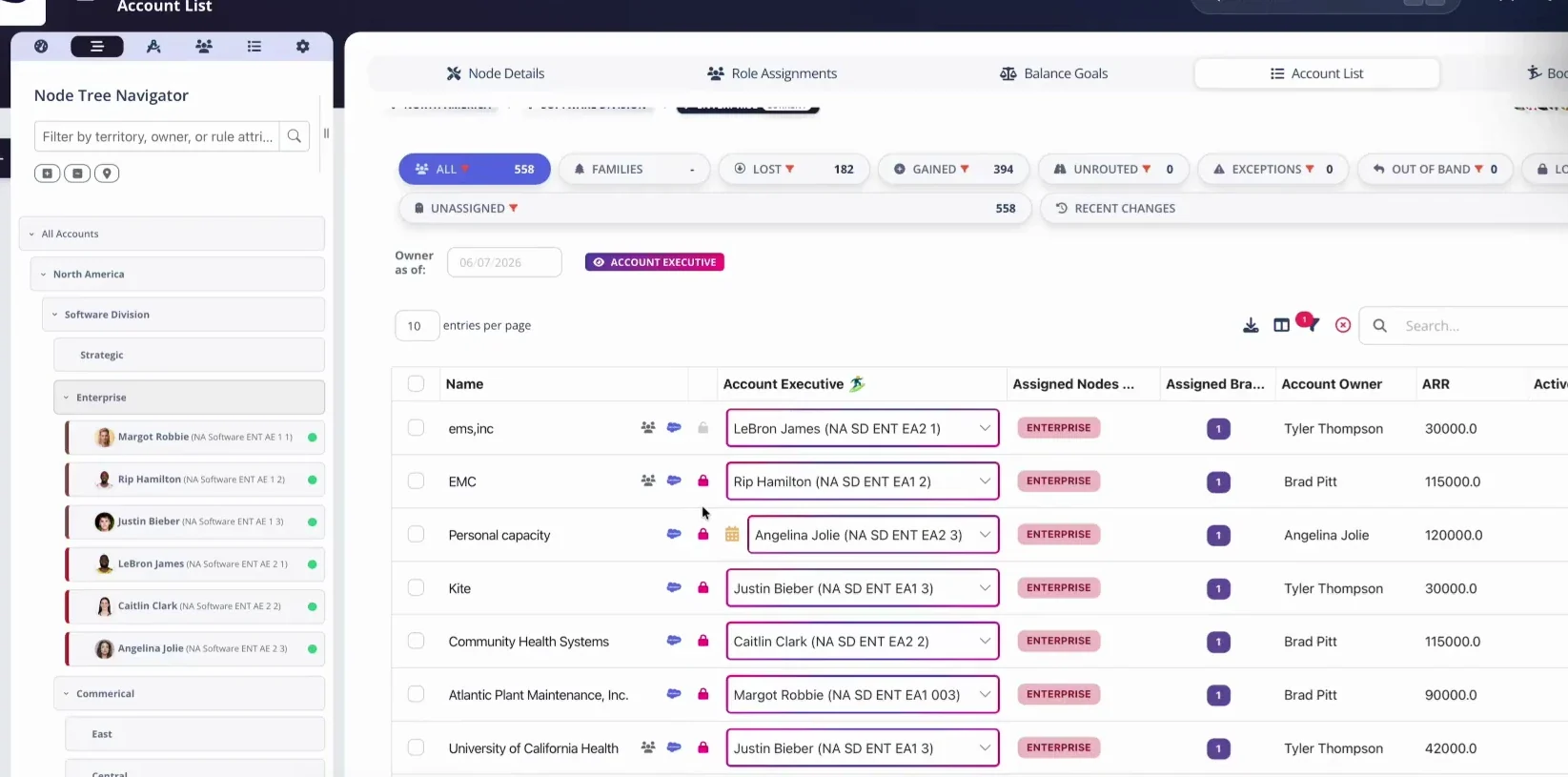
Locked-account indicators preserve approved continuity decisions while the rest of the book remains available for optimization.
Watch Lock Accounts to Territories for a short product demonstration.
Governance That Prevents List Creep
An executive list is credible only when its operating rules survive the first round of requests.
Use a Minimum Account Record
Require account name and ID, ultimate parent, objective, selection evidence, nominator, executive sponsor, commercial owner, support roles, lock status, effective date, expiry or review date, and decision history. Free-text notes can add context but should not replace structured fields.
Separate Access From Approval
Leaders should be able to propose accounts without gaining unilateral ability to change assignments. Operations should be able to validate data without becoming the final business approver. The system should preserve who proposed, validated, approved, and deployed each change.
Price the Exception
Every addition consumes something: seller capacity, executive attention, a position in a named-account book, or balance elsewhere. Show which Territory Health measures move when a candidate is added or locked. The question becomes "Is this tradeoff worth it?" rather than "Can we squeeze in one more?"
Govern Families, Not Just Rows
A famous subsidiary can be nominated without anyone noticing that its parent and sister companies sit in other territories. Decide whether the business buys centrally, locally, or both. Preserve coordinated coverage where it matters, and record intentional splits.
Make Renewal an Active Decision
Send reviewers the current evidence, outcomes, and coverage context. Require a yes or no decision. Silence should not preserve campaign exceptions indefinitely. For persistent accounts, record why the account remains strategic and whether the coverage treatment still fits.
Audit Changes
Keep a history of additions, removals, ownership changes, lock changes, and renewals. This protects seller trust and helps leaders evaluate whether the list produced the intended result. It also makes future planning faster because the team can distinguish stable strategy from accumulated requests.
Common Failure Modes
The Logo List
The list contains recognizable brands but no evidence of fit, access, timing, or capacity. Brand value may be a legitimate objective, but it must be named and weighed against other criteria.
The Executive Owns the Account
Sponsorship is mistaken for commercial ownership. Define the executive's action and preserve one accountable seller or territory.
The Permanent Lock
An account qualifies once and never returns to review. Require an expiry or renewal rule and evaluate the resulting territory with the lock included.
The Hidden Overlay
Multiple people work the account without explicit roles. Publish primary ownership, supporting roles, meeting cadence, and crediting treatment.
The Off-System Spreadsheet
The approved list lives apart from current territories and CRM context. Every change creates reconciliation work and conflicting versions. Keep the decision, evidence, assignment, and history connected.
Frequently Asked Questions
Should every executive target account be locked?
No. A target can receive priority or sponsorship while remaining movable. Lock only when it satisfies published Account Locking Criteria and the cost of reassignment is unusually high.
Who should own the list?
Revenue Operations often drives administration and evidence, while a revenue or company leader approves the business decision. Use explicit decision roles so executive nominations do not become self-approving assignments.
How often should the list be reviewed?
Review campaign lists at least at the end of the campaign or planning cycle. Persistent strategic lists should be revalidated on a defined cadence and whenever ownership, strategy, or account status materially changes.
What happens when a target account changes territories?
Apply the same transition rules used for other governed moves: effective date, opportunity and renewal treatment, relationship handoff, CRM update, and communication. Executive status does not excuse an ambiguous handoff.
Can account scoring create the list automatically?
Scoring can produce candidates, but the final decision may require evidence that a score does not contain, such as relationship strength, product-learning value, or customer continuity. Preserve both the model output and the human rationale.
How large should the list be?
Small enough that the promised coverage can actually occur. Set a capacity limit for sellers and executive sponsors, then show the tradeoff required to add an account beyond it.
About the author: Kevin Davis is Co-Founder & CEO of BoogieBoard.
In Summary
Executive target accounts are not inherently unfair or unmanageable. Ungoverned exceptions are. Define the objective, test the evidence, establish Balance Goals, apply explicit locks and ownership, measure the complete territory, and force every account back through review. Leadership keeps a strategic lever, while sellers and operators gain a system they can understand and defend.
See Territory Governance in Practice
Watch practical territory-design workflows on the BoogieBoard YouTube channel.