5 Key Takeaways
- Account prioritization should give you a better starting field: accounts with clear reasons to pursue them, not a longer list with a score nobody can explain.
- Your ICP describes who should fit, an account score ranks the evidence, and your Target Account List turns that judgment into the book you are expected to work.
- Hunting is selling. The goal is not to remove your judgment; it is to stop making every seller repeat the same invisible research with no shared learning.
- You should be able to see why an account ranks highly, how the model was tested, how many accounts you can work well, and how your feedback changes future lists.
- A fair territory does not simply have the same total score as another. Compare the number and mix of strong accounts, workload, timing, pipeline, and quota opportunity.
You know the difference between a target account and an account that was merely put in your name.
A real target gives you a reason to act. The company fits. The problem is plausible. The timing makes sense. You can see a path to the people who care. Even before the first conversation, the account gives you enough context to form a useful point of view.
An arbitrary account gives you a logo and a quota problem. It may have the right employee count or sit inside your geography, but nobody can explain why it belongs on your list. You spend the first hour proving what Operations could have known before assignment. If it is a bad fit, your disqualification becomes a private loss of time instead of evidence that improves the next list.
Account prioritization is supposed to change that experience. Done well, it gives you fewer mysteries, clearer reasons, and a better chance to spend your time on customers who might actually need what you sell. Done badly, it becomes a colorful score layered on top of the same old list.
What Exactly Is Account Prioritization?
Account prioritization is how a company decides which eligible customer or prospect accounts deserve attention first. It considers evidence such as fit, potential value, business pain, timing, relationships, and the work required to serve the account.
For you, the output is concrete: the accounts in your territory, the order in which you are expected to work them, and the assumptions behind your quota and pipeline expectations.
The practice used to rely heavily on geography, industry, and company size because those fields were easy to obtain. Those fields still help define a broad market. They rarely explain why one company is worth your time this week while another is not.
Modern teams can add business-model signals, technologies, hiring patterns, product use, intent, renewal events, account relationships, public records, and AI-assisted research. More data does not automatically create a better list. A better list comes from choosing evidence tied to real customer outcomes and showing you how the evidence was used.
ICP vs Account Score vs Target Account List
These three terms often arrive in the same meeting, but they do different jobs.
| Term | What it means | What you should receive |
|---|---|---|
| Ideal Customer Profile (ICP) | The shared description of the kind of company most likely to benefit from your product | Clear fit signals, exclusions, and recognizable examples |
| Account score | A grade or number that ranks each account against evidence of fit and timing | The important inputs and a plain-language reason for the result |
| Target Account List (TAL) | The governed set of accounts you or your team is expected to pursue | A workable list with ownership, priorities, context, and a feedback path |
If your company has an ICP but cannot turn it into account-level decisions, the ICP is still a presentation. If it has scores but cannot explain them, the score is a black box. If it has a Target Account List without seller capacity or ownership rules, the list is a wish list.
What Good Account Prioritization Should Do for You
Give You a Better Starting Field
Your time is finite. A useful prioritization model should reduce time spent proving basic fit and increase time spent understanding the customer's situation. It cannot predict every buyer, but it can keep obviously weak accounts from consuming the same attention as accounts with multiple reasons to engage.
The practical test is not whether every A-grade account buys. Ask whether higher-priority accounts consistently produce better conversations, more accepted opportunities, stronger deal values, or faster learning than lower-priority accounts.
Turn Your Judgment Into Shared Learning
When every rep builds a private list, the company runs many experiments without recording the conditions. One seller learns that a particular technology change creates urgency. Another learns that the same industry label contains three completely different business models. Unless those observations return to a shared process, the next territory starts from zero.
Centralizing account research should not silence you. It should give your feedback somewhere to go. A disqualification reason, a missing pain signal, a relationship detail, or an account that converted unexpectedly can all improve the model when the company captures them consistently.
Make the Company's Data Useful to You
Your company may already pay for enrichment, intent, CRM, warehouse, and AI tools. You should not have to become the integration layer among them. Prioritization turns those investments into usable sales context: who appears to fit, what changed, which assumption produced the score, and where to begin your research.
The Signals Behind Your Account List
Firmographic Signals
Revenue, employee count, industry, headquarters, and growth stage tell you whether an account belongs in a broad market. They are easy to understand, but they can be dangerously generic. Two companies with the same size and industry can have different systems, pressures, customers, and reasons to change.
Fit and Structural Signals
Fit signals describe whether the account resembles the customers your company serves well. They may include business model, technology environment, operating complexity, corporate structure, product compatibility, or similarity to successful customers.
Structure matters because the logo on your list may represent only one part of the buying system. A parent company, subsidiary, franchise, or portfolio company can require coordinated coverage. You should know whether you own one entity, the account family, or a local role within a larger relationship.
Pain Signals
Pain signals indicate that the customer may face the problem your product solves. Cannonball GTM demonstrated this with equipment-rental software company Texada. Instead of stopping at “equipment-rental companies,” the research looked for operational conditions such as equipment utilization, equipment mix, infrastructure activity, permits, and local demand. The result was a narrower list with a reason behind each account (Cannonball GTM methodology).
That is the difference between a category and a selling hypothesis. “Healthcare company” gives you a label. “Healthcare company facing this measurable operational pressure” gives you something to investigate and a more respectful opening conversation.
Timing and Intent Signals
Hiring, funding, leadership changes, research activity, contract events, product use, and renewal dates can tell you when an otherwise good-fit account may be more open to action.
Timing should modify fit, not replace it. A bad-fit company that downloads an ebook is still a bad fit. A strong-fit company showing no visible intent may still deserve deliberate account development rather than being discarded.
Relationship Signals
Open opportunities, executive relationships, partners, prior conversations, customer history, and account-family connections affect both priority and ownership. These signals also explain why some accounts stay with an existing seller during a territory change even when moving them would create a cleaner-looking distribution.
How to Evaluate the Account Prioritization Behind Your Territory
You do not need to build the scoring model to evaluate whether it supports your work. Use these five questions.
Step 1: Ask What Outcome the Model Is Trying to Improve
“Best accounts” is not a measurable answer. Is the company trying to improve new-logo conversion, average contract value, sales-cycle speed, expansion, retention, or entry into a new market?
The outcome changes the list. A model for high-value enterprise acquisition should not look like a model for high-volume pipeline. If the outcome is unclear, your activity will be judged against a target the list was not built to support.
Step 2: Ask Why Your Highest-Priority Accounts Rank Highly
Choose several A-grade accounts and ask for the two or three most important reasons behind each score. Then choose several low-grade accounts and ask what evidence is missing or negative.
The answer should be more useful than “the algorithm says so.” It might tell you the account resembles strong customers, uses a relevant technology, has a specific operational condition, or shows a meaningful timing event. That explanation helps you research and message the account. It also lets you spot obvious mistakes.
Step 3: Ask How the Model Was Tested
A good model should rank known strong accounts above known weak accounts. Keyplay recommends testing against contrasting lists: high-value customers, disqualified or bad-fit accounts, and a random control sample from the broader market. The expected pattern is not perfection; it is a meaningful decline from the strongest historical group to the weakest (Keyplay backtesting guide).
You can ask a simple question: “Do our best customers usually score better than accounts Sales consistently disqualifies?” If nobody has checked, the grade is an untested hypothesis.
Step 4: Check Whether the List Fits the Work You Are Expected to Do
A strong score does not make an account free to work. Your list size should reflect research depth, contact coverage, sales cycle, customer complexity, inbound work, and quota expectations.
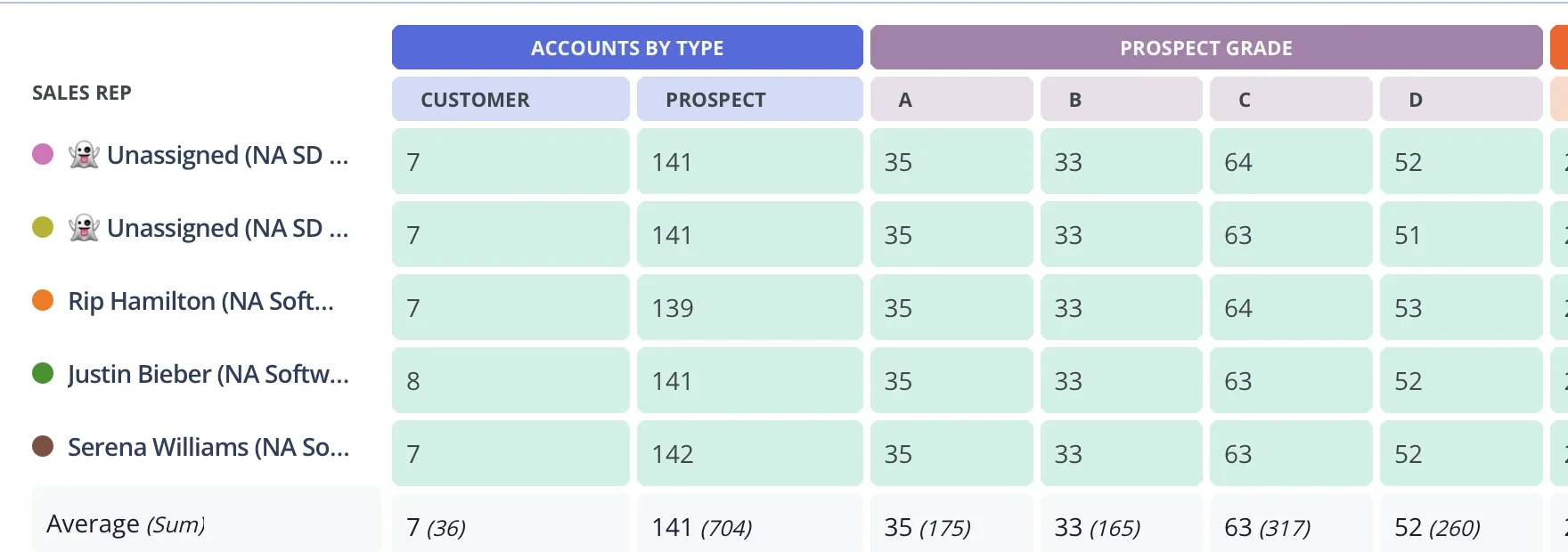
Prospect-grade columns make differences in account quality visible across proposed territories.
BoogieBoard can use prospect grades as one balancing input when distributing accounts across territories. That helps prevent one seller from receiving most of the strongest prospects while another receives an equally long but much weaker list. The grades rank individual accounts; the territory design compares the mix of grades, workload, customers, pipeline, and other conditions across complete books.
Do not accept a claim that two territories are fair because their account scores add to the same total. One territory with a single 100-point account is not equivalent to a territory with ten 10-point accounts. Ask to see counts by grade or tier and the other measures that affect your chance of success.
Step 5: Use the Feedback Path
Your company should tell you how to challenge a score, report stale information, mark a bad fit, or explain a signal the model missed. Good feedback includes evidence: the account changed its business, the subsidiary is covered elsewhere, the timing event is wrong, or the customer problem does not match the score.
The company should also tell you when the model and list will be refreshed. If feedback disappears into a message thread and the next list looks identical, the process is collecting objections rather than learning.
What This Means for You
Account prioritization changes your job in three useful ways when it works.
First, it lets you begin later in the discovery process. You can stop asking questions the company already knows, such as employee count or technology stack, and spend more time understanding internal priorities, buying dynamics, and the human consequences of the problem.
Second, it gives you a clearer basis for account planning. A list with reasons lets you decide where to deepen research, which message to test, and which accounts need patience rather than immediate outreach.
Third, it gives you a more specific way to challenge your territory. “My book is bad” is hard to resolve. “Thirty percent of my A-grade accounts belong to global parents owned elsewhere, and twelve have no supporting pain signal” gives your manager and Operations something they can inspect.
Questions worth asking before you commit your quarter:
- What are the strongest signals behind my top accounts?
- Which signals represent fit, and which represent timing?
- How was the model tested against customers and disqualified accounts?
- How many high-priority accounts can someone in my role work well?
- How were strong accounts distributed across peer territories?
- Where do I report a wrong score, hierarchy, owner, or account condition?
- When will my feedback appear in the next version?
Common Pitfalls to Watch For
- Industry, size, and geography are the whole model. Those fields can define a market but often fail to explain urgency.
- Every score is presented as equally certain. Some grades rest on strong first-party outcomes; others rely on incomplete external data. You should know the difference.
- The company adds scores across territories. Totals hide the number, concentration, and serviceability of strong accounts.
- The list never changes. Account conditions, relationships, and timing signals become stale.
- Seller feedback has no effect. Central research without field learning creates a different kind of blind spot.
- Engagement is treated as fit. A click can indicate timing; it does not prove that the company belongs in the ICP.
Warning: You Should Know Where Important Account Data Came From
Prioritization can combine licensed data, public records, first-party behavior, and AI-generated classifications. You do not need a data-governance lecture, but you do need enough transparency to trust and correct the account. Ask which important fields are verified, how recent they are, and how to report an error.
Frequently Asked Questions
What is account prioritization?
It is the process your company uses to rank eligible accounts by fit, potential, pain, timing, relationships, and workload. The output should help you decide where to spend attention and explain why those accounts are in your territory.
How can I tell whether an account score is useful?
Ask whether the score explains itself, ranks historically strong accounts above known bad fits, and predicts better sales outcomes than a broad market list. You should be able to inspect the important signals behind individual accounts.
Who should build Target Account Lists?
Revenue Operations usually owns the shared process, with evidence from Sales, Marketing, Product, Customer Success, and Finance. Sellers should not have to rebuild the entire market individually, but their field judgment must feed the model.
What should I do when a target account is clearly wrong?
Use the published feedback path and provide the account-level reason: bad fit, wrong hierarchy, stale timing, duplicate coverage, missing relationship, or another specific condition. Ask when the correction will be reviewed and reflected in the territory or next list version.
About the author: Tyler Thompson is Co-Founder & CTO of BoogieBoard.
In summary: A target account list should give you reasons, not just rankings. Evaluate the evidence, testing, workload, distribution, and feedback path before treating the score as truth.
Watch account prioritization in action
See how prospect grades can be distributed across territories in BoogieBoard's year-end rebalancing demo on YouTube.
Related framework: The Salespeople Are Surfers, Not Hunters hub explains why Operations should improve the forecast while sellers keep the human work of reading customers and timing.