5 Key Takeaways
- Your territory should provide a researched point of view about where opportunity is forming; it should not hand you a flat account list and call that strategy.
- The hunter model wastes seller time by making every rep repeat market research, invent account priorities, and run isolated experiments that the company never learns from.
- A modern targeting system combines Ideal Customer Profile evidence, pain research, timing signals, and relationship context, then turns those inputs into transparent Target Account Lists.
- You still supply the skill: discovery, judgment, creativity, and trust. Operations supplies the wave forecast by making the best available market evidence usable in your daily work.
- Judge any territory system by whether you can understand why an account matters, challenge bad evidence, act at the right moment, and improve the model with what you learn.
If you are carrying a quota, your territory determines where you spend the most finite resource you have: selling time. Yet the traditional advice is still to be a hunter. Find your own prey. Research every account from scratch. Build a personal list. Notice the signals. Be in the right place at the right time, largely on your own.
That story flatters individual effort, but it lets the company off the hook. Your skill should decide how well you engage a buyer, not whether you happened to discover the right account before everyone else. A modern revenue organization should give you a credible market view, explain why accounts were prioritized, and help you focus your pipeline effort where a real problem and a plausible buying moment meet.
Salespeople are not hunters anymore. They are surfers. The best surfer cannot create a wave, and the best seller cannot manufacture a market need. Both can study the conditions, choose the right break, arrive at the right time, and use hard-earned skill when the opportunity appears.
What Is a Modern Account-Prioritization System, and Why Does It Matter?
A modern account-prioritization system is the shared process that turns market research into seller focus. It connects four things that companies often leave scattered:
- Ideal Customer Profile (ICP): the evidence-based description of companies most likely to receive meaningful value from the product.
- Pain research: the specific operational conditions that create a reason to change, not just a generic industry label.
- Timing and intent: signals that indicate the problem may be active now.
- Target Account List (TAL): the named accounts a seller or team should work, with enough context to understand the choice.
This matters because a territory is not just an ownership boundary. It is a claim about where the company believes opportunity exists. When that claim is invisible, you are forced to shadow-plan: maintain your own spreadsheet, rebuild research, compare notes privately, and decide which official priorities to ignore. When the claim is visible, you can pressure-test it and spend more time selling.
The market itself has changed. G2's category landscape grew dramatically between 2013 and 2023, giving buyers far more software choices and sellers far more possible accounts, signals, and competitors to interpret. More available data does not automatically produce precision. It produces a larger research burden unless the organization converts it into a usable point of view. See G2's account of the expanding software marketplace.
Three Ways Companies Decide Where Sellers Should Focus
Not every targeting approach is equally mature. Most teams operate with one of three models, often without naming the choice.
Rep-Built Hunting
In the traditional model, each seller receives a geography, segment, or raw account universe and creates a personal hunting strategy.
What works: You retain autonomy and can use local knowledge quickly. A skilled rep can notice nuance that a centralized model misses.
What breaks: Every rep repeats the same research. Prioritization standards vary. Useful experiments disappear when someone leaves. New sellers inherit an account list without the reasoning behind it. The company cannot distinguish a weak territory from weak execution because there is no shared targeting hypothesis.
Centralized, Opaque Scoring
The company may buy enrichment and intent data, calculate one composite score, and send ranked accounts to sellers.
What works: Research is centralized, data can be refreshed, and sellers receive a smaller list.
What breaks: A summed score can hide the reason an account ranks highly. Ten points from firmographic fit are not equivalent to ten points from web activity. If you cannot see the component signals, you cannot adapt the message, challenge an error, or tell the company which hypothesis worked.
Transparent, Evidence-Led Prioritization
The strongest model combines centralized research with seller feedback. It separates fit, pain, timing, and relationship signals; publishes the logic; and preserves the underlying evidence at the account level.
What works: You know why to act, not just whom to contact. Operations learns from seller outcomes. New evidence can change one part of the model without rewriting the whole territory. The company develops institutional knowledge rather than a collection of private prospecting systems.
What to watch: Transparency does not make the model infallible. Data can be stale, pain research can be wrong, and a signal can be over-weighted. The operating system needs a feedback path, ownership, and a review cadence.
Core Capabilities Your Territory Should Give You
Qobra's source article evaluates commission systems by their capabilities. The equivalent test for a territory is not whether it contains enough accounts. It is whether the system helps you choose and act.
A Visible Prioritization Logic
You should be able to distinguish why an account is present:
- strong ICP fit;
- a specific pain hypothesis;
- active timing or intent;
- a strategic relationship;
- a customer expansion signal; or
- an explicit leadership bet.
A Balance Goal is a measurable design objective, such as giving comparable territories similar counts of high-fit accounts. It is useful at the territory level, but it should not erase account-level reasoning. A book can look balanced while containing very different selling conditions.
Current, Connected Data
Your priorities should update when the underlying facts change. A new executive, funding event, technology decision, product-usage pattern, renewal date, or engagement signal may change the case for action. That does not mean chasing every signal. It means the source and freshness of the evidence should be visible enough to judge.
Account-Level Context
A ranked list without context simply transfers research work back to you. The useful unit is a named account plus the evidence behind it: relevant initiatives, likely pain, organizational structure, known relationships, and the signal that made the timing interesting.
Cannonball GTM's published work with Texada illustrates this shift from broad firmographic targeting toward account research organized around specific pains and observable evidence. The point is not that one research method is universally correct. It is that the targeting hypothesis becomes concrete enough for a seller to use and the company to test. Read the Cannonball account-research method.
Feedback and Auditability
You need a fast way to mark a bad fit, correct a fact, explain a rejected hypothesis, or identify a signal that predicted a real conversation. Feedback should not vanish in a message thread. The company should know what changed, who changed it, and whether the learning applies to one account or the wider model.
Scenario Comparison
Before a new model becomes your territory, leaders should compare alternatives. A Scenario is a saved future-state territory design that can be measured before activation. Comparing Scenarios lets the company see whether a targeting choice improves account quality while creating unacceptable workload, customer disruption, or concentration elsewhere.
| What you need to see | Weak territory delivery | Strong territory delivery |
|---|---|---|
| Account reason | One total score or no reason | Fit, pain, timing, and relationship components |
| Evidence | Hidden in vendor systems | Source and freshness visible |
| Focus | A flat list | Prioritized tiers with a clear action |
| Feedback | Private notes and messages | Structured correction and learning path |
| Change | New list replaces old list | Scenario comparison and documented rationale |
Do Not Underestimate the Power of Transparency
Transparency is not an Ops courtesy. It changes what you can do. If you know that an account is prioritized because it matches a product-use case and recently hired the executive who owns that problem, you can research and message accordingly. If all you see is a score of 92, you still have to reconstruct the thesis.
Transparency also makes disagreement productive. You can say, "The account fits our size and industry criteria, but the pain evidence is wrong," instead of arguing that the list feels bad. That is better information for your manager and for the team maintaining the model.
BoogieBoard's first-party work across more than 300 company interviews repeatedly found the same structural issue: valuable market judgments live in individual heads, spreadsheets, and side conversations. The objective is not to eliminate seller judgment. It is to stop making every seller rebuild the company's market knowledge alone.
How This Affects Your Territory
You do not need to become a RevOps analyst to evaluate whether your territory gives you a workable wave forecast. Ask five questions:
- Why are these accounts here? Request the component reasons, not only a total score.
- What should I do first? Confirm which accounts are priorities now and what evidence supports the timing.
- What does the company want to learn? A new vertical, pain hypothesis, or signal should be treated as a test with a success measure.
- How do I correct the model? Find the channel for bad data, bad fit, and strategic exceptions.
- When will the model be reviewed? Priorities should not change daily, but they should not remain frozen after the evidence changes.
The seller's responsibility is equally clear. Use the context. Record outcomes. Separate "I do not like this account" from "this evidence is false." Share the reason a hypothesis succeeded or failed. That is how your work improves the next territory instead of disappearing into a personal notebook.
Choosing the Right Model for Your Team
The three approaches are not equally appropriate at every stage. A new company still discovering its market may need broad seller exploration, but it should capture what those sellers learn. A scaling team with repeatable wins should centralize proven evidence and reduce duplicate research. A mature, multi-segment organization needs governed models without making them so rigid that frontline learning cannot change them.
Use a simple decision test:
| Condition | What to preserve | What to add next |
|---|---|---|
| Market still emerging | Seller exploration and qualitative learning | Shared research format and weekly synthesis |
| Repeatable use cases forming | Local expertise | Component scoring, named hypotheses, and Target Account Lists |
| Multiple segments and products | Role-specific judgment | Separate models, data contracts, and Scenario comparison |
| High data volume | Human interpretation | Automated refresh, provenance, and exception monitoring |
Avoid the false choice between total seller freedom and a centrally dictated list. The better question is which work should be institutional and which work requires the person in the conversation. Data assembly, pattern detection, and repeatable research should compound across the company. Discovery, persuasion, relationship judgment, and creative problem solving remain seller work.
That division also clarifies accountability. Operations should be able to explain the forecast. Leadership should approve the market bets. You should be able to use the context, report what happened, and challenge weak assumptions with evidence. When each party owns its part, a bad result becomes something the organization can diagnose rather than another argument about effort.
One final test is portability. If you change roles or a new seller inherits your territory, can the next person understand the account choices and prior learning without interviewing everyone who touched the list? A durable targeting system preserves the reasoning, evidence, and outcomes. It reduces ramp time and stops market knowledge from leaving with an individual spreadsheet.
That record should include failed hypotheses as well as wins. Knowing that a pain signal repeatedly produced no conversations may be as valuable as finding a strong predictor. A system that records only successes encourages the company to repeat attractive but weak ideas.
How BoogieBoard Supports the New Way
BoogieBoard Scenario Planning gives Operations a place to combine account evidence, define Balance Goals, create Target Account Lists, and compare future assignments before they reach sellers. Scenario Results keep the account-level components visible so leaders can inspect whether a superficially balanced design contains the right kinds of opportunity.
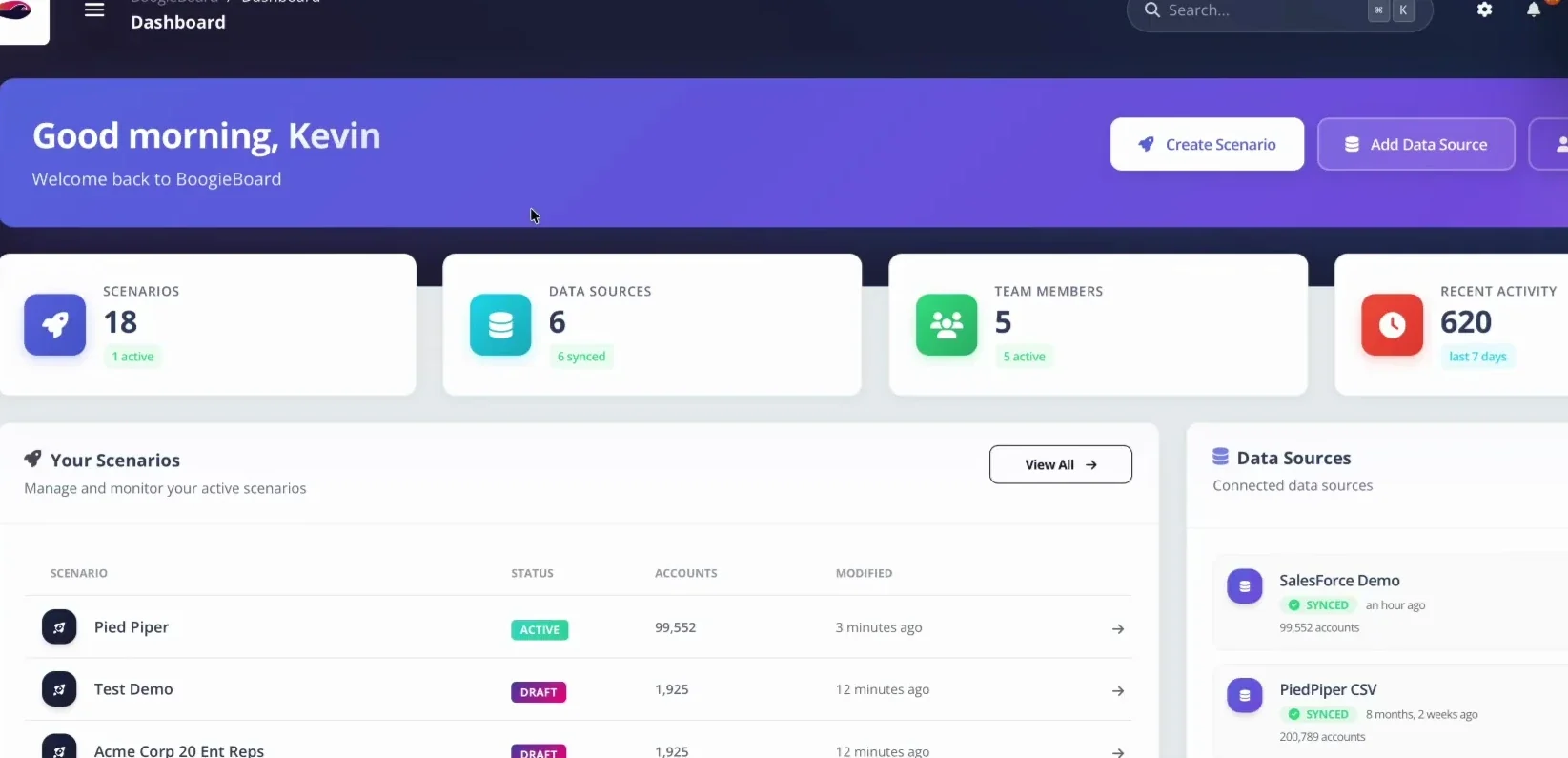
BoogieBoard keeps current and future territory scenarios separate so teams can model changes before activation.
The product does not replace the seller's skill or claim to predict every wave. It creates a shared forecast: the best available view of where to focus, what assumptions produced it, and how the company will learn from the result.
Salespeople are surfers because selling starts with conditions they do not control. The company chooses whether those conditions remain invisible. A strong territory operating system gives you a researched break, a timely reason to paddle, and enough context to apply your craft. The result is not less seller autonomy. It is more valuable autonomy, exercised where it has a credible chance to matter.
Frequently Asked Questions
Does centralized prioritization remove seller judgment?
No. It moves repetitive research and data assembly into a shared system while preserving seller judgment for interpretation, outreach, discovery, and relationship building. The system should also capture your corrections so judgment improves the shared model.
What is the difference between an ICP, an account score, and a Target Account List?
An ICP describes the attributes of companies likely to benefit. An account score evaluates evidence against selected criteria. A Target Account List names the accounts a team should work. The three should connect, but they are not interchangeable.
Should you trust intent data on its own?
No. Intent can indicate timing, but it does not prove fit, pain, authority, or a buying process. Use it as one component and inspect the source, freshness, and behavior represented.
What should you do when a priority account is clearly wrong?
Document the specific issue: incorrect data, weak fit, false pain hypothesis, stale signal, or ownership conflict. Route it through the published feedback path and keep working from the best available evidence while the correction is reviewed.
How often should Target Account Lists change?
The evidence can refresh continuously, but the seller-facing list needs a governed cadence. Stable tiers protect focus; scheduled reviews incorporate learning. Urgent changes should have explicit criteria rather than arrive as ad hoc requests.
About the author: Kevin Davis is Co-Founder & CEO of BoogieBoard.
Watch Territory Planning in Practice
See how teams compare account mix and future assignments on the BoogieBoard YouTube channel.
Related Content
- Account prioritization and Target Account Lists
- Your Account Data Strategy: The RevOps Guide
- Balance Goals: Complete Guide to Territory Equity