
5 Key Takeaways
- A territory plan should tell you which accounts you cover, why they belong together, what success looks like, and how changes or disputes will be handled.
- Strong plans begin with the company's strategy and the realities of the selling role, then use account data to test the design; they do not let available fields choose the strategy.
- Balance Goals define measurable standards for healthy opportunity and workload before Account Locking Criteria protect accounts whose movement cost is unusually high.
- You should be able to inspect your proposed book at the account level, compare it with the current state, and understand how the plan connects territory potential, capacity, and quota.
- The launch is part of the plan: sellers need advance communication, clear transition rules, a correction path, and a published source of truth after activation.
Your territory is not an administrative detail. It determines which accounts you can pursue, which relationships you inherit or lose, how much work sits behind your number, and whether a strong year looks realistically possible. When a new plan appears as a final spreadsheet, you are being asked to trust the result without seeing the assumptions that shaped it.
A high-impact territory plan gives you more than a list. It explains the business strategy, the rules that connect accounts to roles, the measures used to compare books, the treatment of active work, and the process for correcting errors. You may not make the final design decision, but you should be able to evaluate whether the plan is coherent and raise a specific concern with evidence.
This article translates the full planning process into the questions that matter to you as a seller. It also draws on BoogieBoard's interviews and work with more than 300 companies, where the recurring lesson is simple: territory planning is a change-management project wearing an analytics costume. The math matters. So do trust, timing, decision rights, and the quality of the handoff.
Independent research supports that broader view. Piercy, Cravens, and Morgan found territory design can influence sales-organization effectiveness both directly and through salesperson behavior. In other words, the shape and management of the territory affect more than a planning model. Read their field investigation of sales territory design.
What Is a Territory Plan?
A territory plan is the governed connection between a company's go-to-market strategy and the accounts, customers, prospects, roles, capacity, and quotas assigned to sellers. It describes the current coverage model, the proposed future model, the rules used to build it, and the way the company will activate and maintain it.
For you, a complete plan should answer six practical questions:
- What do I own? Which accounts, account families, geographies, segments, or customer responsibilities belong to your role?
- Why is this my book? What Territory Logic, meaning the published assignment rules, connects these accounts to you?
- Is the book workable? How does your opportunity, quality, workload, and customer burden compare with similar roles?
- What happens to work in flight? How are open opportunities, renewals, implementations, and relationships treated?
- How does the territory connect to quota? What evidence supports your goal relative to your market opportunity and capacity?
- How can an error or exception be challenged? Who owns data corrections, policy exceptions, and final decisions?
If the plan cannot answer those questions, it is incomplete even if every account has an owner in the CRM.
The Core Components of a Strong Plan
Business Objectives
The company should say what the design is trying to improve. It might need to enter a new market, protect customer continuity, increase specialization, create more viable books, reduce travel, align capacity with potential, or make quota more realistic.
You should expect tradeoffs. A model that prioritizes local coverage may accept wider account-count variation. A plan that protects every active opportunity may preserve near-term continuity but leave temporary imbalances. The important thing is that the priority is visible rather than reverse-engineered after your accounts arrive.
Stakeholders and Decision Rights
Territory planning touches executives, Finance, Revenue Operations, Sales leadership, managers, sellers, customer teams, and systems owners. A useful plan names who drives the process, who approves it, who contributes evidence, and who is informed. This is often called a DACI model: Driver, Approver, Contributors, and Informed.
For you, decision rights answer a basic question: where should a concern go? Your manager may validate selling context. Revenue Operations may correct hierarchy or ownership data. A revenue leader may decide whether a strategic exception is worth its cost. Those are different actions.
Territory Logic
Territory Logic is the set of rules that determines where accounts belong. It can use geography, segment, company size, named-account status, industry, customer status, product motion, parent-child hierarchy, or a combination.
You should be able to describe the logic in plain language. "Commercial healthcare prospects in the Central region go to this AE team, except published strategic accounts and named customer families" is understandable. A hidden chain of spreadsheet lookups is not.
Balance Goals and Account Locks
Balance Goals are the measurable objectives used to compare similar territories. They might cover high-fit prospects, serviceable potential, renewable revenue, account count, workload, intent signals, or customer complexity. Together they express what the company believes makes a healthy book.
Balance Goals come before Account Locking Criteria, the rules used to protect assignments when movement cost is unusually high. Locks may cover late-stage opportunities, imminent renewals, active implementations, strategic relationships, or accounts moved recently. The team applies qualifying locks, redesigns the remaining movable accounts, and then measures the complete books with locked accounts included.
That order matters to you. If planners hide locked accounts from the final comparison, your territory can look balanced on paper while carrying materially different opportunity or workload in practice.
Scenarios, Rules of Engagement, and Launch
A Scenario is one complete proposed future design. Comparing scenarios lets leaders see tradeoffs in opportunity, workload, account movement, hierarchy, and customer continuity before making the change.
Rules of Engagement, or ROE, explain how the plan operates after launch: account ownership, opportunity treatment, handoffs, overlays, conflicts, crediting dependencies, changes, and exception paths. The selected scenario and its ROE should reach you together. A clean allocation with unresolved operating rules is not a complete plan.
Six Common Territory Plan Types
1. Geographic Territories
Accounts are assigned by country, state, postal area, metro, travel radius, or another physical boundary. Geography can support local knowledge, time zones, language, or field coverage. Ask whether major account families cross boundaries and whether the design reflects actual service needs rather than historical lines.
2. Named-Account Territories
Specific accounts are assigned directly to a seller or team. Named accounts can be appropriate for enterprise pursuits, strategic customers, or focused markets. Ask how accounts enter and leave the list, whether parent companies are treated consistently, and what capacity limit keeps the book executable.
3. Segment-Based Territories
Accounts are grouped by measurable size or commercial tier, such as SMB, commercial, mid-market, and enterprise. Ask which account attribute determines the segment, how often it changes, and what happens when an account grows across the threshold.
4. Hybrid Territories
The plan combines dimensions such as geography, segment, industry, and named-account treatment. Hybrid plans can reflect real selling motions, but they can also become hard to explain. You should be able to follow the decision path for any account without learning a private formula.
5. Customer Books
Customer-facing roles may be assigned by recurring revenue, renewal timing, product usage, risk, expansion potential, complexity, or relationship continuity. Equal customer counts rarely mean equal work. Ask which service and growth obligations were included in the comparison.
6. Overlay or Pod Coverage
Specialists, BDRs, solution consultants, partners, or customer roles support a primary owner. Ask who holds the commercial relationship, how support capacity is allocated, and how conflicts are resolved when several roles touch the same account.
How a High-Impact Territory Plan Is Built
The company owns this procedure. Your role is to understand each stage well enough to contribute evidence and judge the result.
Step 1: Translate Strategy Into a Design Brief
Leadership should define the market, growth objectives, coverage motions, constraints, timing, and decisions the project must make. The brief should say what is changing and what is not.
What you should check:
- Does the stated strategy match how customers actually buy?
- Is your role expected to hunt, retain, expand, coordinate, or do several jobs?
- Are there service constraints such as language, time zone, travel, or product expertise?
- Which priorities are fixed, and which are still being tested?
If the brief says the company is increasing specialization but the proposed book mixes every industry and product, that is a specific inconsistency worth raising.
Step 2: Define Roles, Capacity, and Decision Rights
The plan should identify each role's responsibilities, expected capacity, ramp status, manager structure, and dependencies. Capacity is not just headcount. A new seller, a fully ramped seller, and a manager carrying a temporary book do not represent the same usable coverage.
Ask what assumptions were made about your available selling time and support. If your territory includes a heavy customer handoff, partner motion, or unusually complex account family, that workload belongs in the model.
Step 3: Assess the Current State
Before designing the future, planners should measure the present: assignments, vacant territories, account families, opportunities, renewals, recent moves, data quality, workload, potential, and performance context.
This is where your local knowledge is most useful. Flag duplicate accounts, incorrect parents, real buying centers, dormant records, relationship history, and work that the system cannot see. Separate factual corrections from requests to preserve a preferred account. A correction improves the evidence; an exception asks leadership to depart from the policy.
Step 4: Define Logic, Balance Goals, and Locks
The team translates strategy into Territory Logic and measurable Balance Goals. It then defines Account Locking Criteria, applies qualifying locks, and models the remaining accounts. You should receive plain-language definitions and examples before the result is final.
BoogieBoard Scenario Planning lets planning teams define goals, model alternative assignments, inspect account-level results, and compare quota and workload implications before activation.
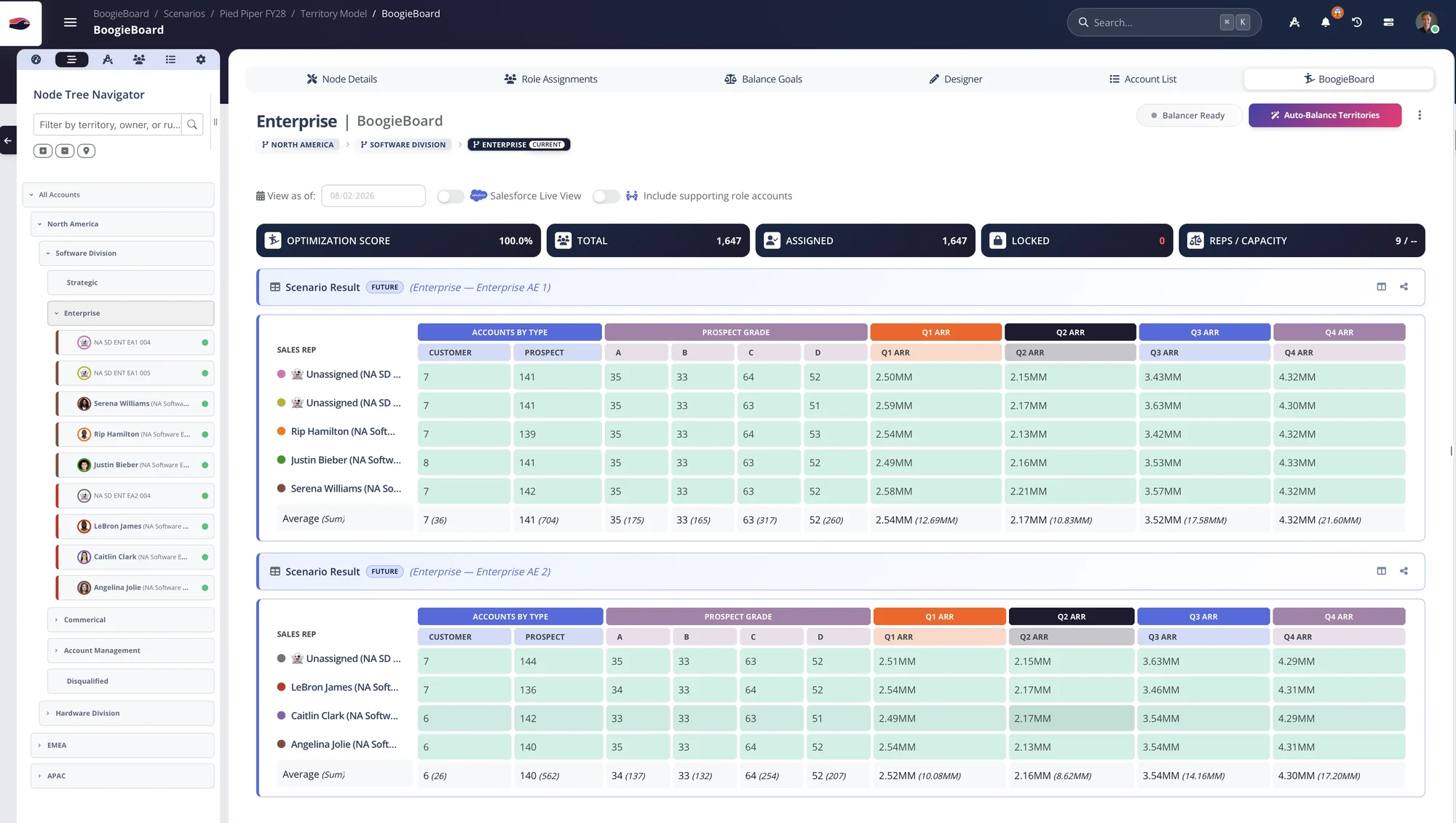
Scenario Results show customer and prospect mix, prospect grade, quarterly ARR, account locks, and rep capacity in one review surface.
Watch Even Out Quotas and Workload for a short example of how the comparison can work.
What you should ask for:
- the account attributes used in assignment;
- the Balance Goals and acceptable ranges for your role;
- the definition and count of locked accounts;
- the complete Territory Health (the book's measured condition) after locks return;
- the relationship between territory potential, capacity, and quota.
Step 5: Compare Scenarios and Choose Deliberately
No realistic plan optimizes everything. One scenario may minimize disruption. Another may improve opportunity balance. A third may preserve account families or customer continuity. Leaders should compare the options and record why the chosen tradeoff best fits the strategy.
For your review, look beyond averages. A territory can sit near the team average while holding one extreme renewal, one large account family, or a cluster of low-quality records. Ask to inspect distributions and account-level changes, especially where the model produces a surprising result.
Step 6: Communicate, Activate, and Operate
The plan should be communicated before it becomes a CRM surprise. You need your effective date, account roster, opportunity and renewal rules, handoff expectations, quota treatment, manager contact, correction window, and permanent source of truth.
Activation should update connected systems in a controlled sequence. The team should monitor unassigned accounts, conflicting ownership, broken workflows, and seller questions after launch. Your feedback should enter a governed correction process, not disappear into private messages.
Why Spreadsheet-Only Planning Breaks Trust
Spreadsheets can analyze data, but a multi-stakeholder territory decision quickly produces copies, hidden formulas, stale exports, and manual exceptions. One manager reviews a different version from another. An account moves in the CRM while the working model remains unchanged. A late request alters the assignment without updating the summary metrics.
For you, the problem is not the file format by itself. It is the loss of traceability. You should be able to see which data and rules produced your book, what changed from the current state, and who approved the final scenario. When those answers depend on finding the right attachment, the plan is difficult to defend.
Common Territory-Planning Mistakes
Starting With Available Data
The team balances what it can easily count instead of what the strategy says matters. Equal account counts may conceal unequal fit, potential, workload, or customer risk.
Treating Fairness as One Number
Your book can be strong on prospect potential and heavy on service work. A single composite score can hide that tradeoff. Ask for the component measures that materially affect your role.
Asking Sales Too Late
Sellers and managers first see the design after leadership approval. At that point feedback feels like resistance. Earlier input should validate assumptions and data without turning the process into account-by-account voting.
Locking Before Defining Health
Preferred accounts are protected first, then planners try to balance what remains. The correct sequence is Balance Goals, Account Locking Criteria, qualifying locks, movable-book optimization, and complete-book evaluation.
Building Around Incumbent Reps
Territories become personal portfolios that collapse when someone leaves. The durable unit should be the market or book, with people assigned to it and transition rules protecting work in flight.
Treating Launch as a CRM Update
Accounts change ownership without context, rules, or handoffs. That creates seller confusion and customer risk even if the design math is sound.
What This Means for You
You do not need to reproduce the planning model to ask good questions. Focus on what changes your ability to execute:
- Roster: Are all of your accounts present, correctly grouped, and genuinely serviceable?
- Opportunity: What evidence describes the potential and quality in your book?
- Workload: Which obligations, customers, renewals, and relationships consume your capacity?
- Continuity: Which active items are protected, transferred, or shared, and for how long?
- Quota: How did the company consider territory potential and your ramp or capacity?
- Rules: Where are ownership, handoff, overlap, and exception policies published?
- Correction: How do you report a factual error, and who decides a policy challenge?
Bring evidence with your concern. "This feels unfair" is understandable, but "18 of these accounts are subsidiaries already buying through a parent in another territory, and four are outside the stated segment" gives your manager something concrete to resolve.
Questions to Ask Your Manager
Before the plan takes effect, ask:
- What business objective drove this design, and which tradeoff did leadership knowingly accept?
- What Territory Logic determines which accounts are in my book?
- Which Balance Goals were used to compare my territory with similar roles?
- Which accounts were locked, under what criteria, and are they included in the final health measures?
- How does my quota reflect territory potential, capacity, and ramp assumptions?
- What happens to my open opportunities, renewals, and established customer relationships?
- How do I submit a data correction or challenge an exception, and when will I receive an answer?
- Where will the approved roster, rules, and future changes live after launch?
Those questions do not undermine the plan. A strong plan should be able to answer them.
Frequently Asked Questions
What makes a territory plan effective?
It connects strategy to explicit assignment rules, measurable territory standards, realistic capacity, governed exceptions, scenario comparison, and a complete launch process. You should be able to understand both your roster and the reasoning behind it.
When should sellers be involved?
Sellers should contribute role realities and account evidence before the final decision, review proposed changes with enough time to identify errors, and receive the approved plan before activation. Seller input should inform the design without becoming private ownership vetoes.
How often should territories be reviewed?
Use a planned cadence and trigger-based reviews for material strategy, capacity, market, or data changes. Avoid constant reshuffling. Your customer relationships and pipeline need enough stability to develop.
Can every territory be equally fair?
No. Markets and accounts are not identical, and the data is imperfect. The company can make its objectives, ranges, constraints, and tradeoffs explicit, then connect quota or capacity decisions to material differences.
What if my territory contains bad data?
Submit a factual correction with account IDs and evidence through the published process. A data correction should be handled separately from a request to override the design policy.
Should open opportunities always stay with the current seller?
Not always. The company should publish holdover criteria based on stage, activity, value, timing, relationship, and customer impact. Ask how ownership, support, duration, and crediting work for anything kept in flight.
About the author: George James is Co-Founder & CPO of BoogieBoard.
In Summary
A high-impact territory plan should help you act, not merely tell you where the accounts landed. You deserve a clear roster, understandable rules, visible measures, honest tradeoffs, transition protections, and a path to correct mistakes. Use the questions above to evaluate the plan through its effect on your work, customers, pipeline, quota, and chance to succeed.
See Territory Planning in Practice
Watch practical scenario and territory-design workflows on the BoogieBoard YouTube channel.