
5 Key Takeaways
- There is no universal "right" account count. A strategic AE may carry 1-20 total accounts while an SMB AE may carry 250-1,250.
- Customer and prospect books are different workloads. The prospect-to-customer ratio widens from roughly 3:1 in Strategic to 10:1 in SMB.
- CSM capacity cannot be modeled like AE or AM capacity. Down-market CSM coverage often becomes a pooled queue rather than a named book.
- Fair territories are not necessarily equal territories. Account count must be evaluated with potential, workload, customer obligations, and role design.
- Publish the segment definition and Territory Health (the measured condition of a book) behind every benchmark, then use Balance Goals (measurable design objectives) to test each book against them.
If you carry a quota, the number of accounts in your book affects your workload, pipeline, customer relationships, and chance to earn. "How many accounts should each rep have?" sounds like a staffing question. It is really a territory-definition question with direct consequences for you.
A book of 40 named customers with active renewals is not the same job as a book of 40 prospects. An Enterprise AE with 60 target accounts is not doing the same work as an SMB AE with 600. A CSM responsible for a pooled queue should not be compared with an account manager expected to build a relationship with every customer.
The useful benchmark is therefore not one number. It is a range tied to a clearly defined sales motion.
When you compare your book with that range, keep the comparison anchored to your actual job. You should be able to see whether your count separates customers from prospects, whether your segment uses the same boundary as the benchmark, and whether your support model leaves you with the same work. A number that omits your renewal load, account families, or required research cannot tell you whether your territory is viable.
Understanding Account Load: Role, Motion, and Segment
Account load is the number and mix of accounts a role is expected to cover. It has four parts:
- Role: AE, BDR, AM, and CSM books create different activities and obligations.
- Motion: Prospecting, expansion, renewal, and service work consume capacity differently.
- Segment: Strategic, Enterprise, Mid-Market, and SMB labels only become useful when their boundaries are explicit.
- Coverage model: Named, pooled, geographic, overlay, and account-family coverage change what "ownership" means.
Across territory designs we work with, employee count is the primary segment boundary in roughly 45-60% of organizations; annual revenue is primary in 20-30%. The modal employee thresholds are 100 and 1,000 employees, but actual Mid-Market definitions span from 50 to 2,000 employees. Segment names describe a sales motion, not a universal company-size standard.
That is why benchmarks should begin with definitions. If two companies call accounts "Enterprise" but one starts at 500 employees and the other at 5,000, their account-load numbers are not comparable.
Account count is a capacity input, not a definition of fairness. Research on satisfaction with sales-territory design treats workload, sales potential, competitive intensity, and other design factors as distinct parts of the seller's opportunity to perform. A large book of low-potential, dispersed accounts can be as unhealthy as a small book with too much concentrated potential (Grant, Cravens, Low, and Moncrief).
How Many Accounts Should a Sales Rep Have in 2026?
The following ranges come from territory designs BoogieBoard has worked with. Treat them as planning benchmarks, not staffing mandates.
Customer books
| Role | Strategic | Enterprise | Mid-Market | SMB |
|---|---|---|---|---|
| Account Executive | 1-5 | 5-20 | 25-40 | 40-100 |
| Account Manager | 1-3 | 5-25 | 25-50 | 40-100 |
| CSM | 1-40 | 10-500 | 100-1,000 pooled | 500-2,000 pooled |
Prospect books
| Role | Strategic | Enterprise | Mid-Market | SMB |
|---|---|---|---|---|
| Account Executive | 1-15 | 15-100 | 100-300 | 250-1,000 |
| BDR | 5-25 | 75-300 | 150-500 | 500-1,000 |
Total AE books when customers and prospects are combined
| Strategic | Enterprise | Mid-Market | SMB |
|---|---|---|---|
| 1-20 | 15-120 | 100-350 | 250-1,250 |
The spread is the finding. The same AE title can represent a book of fewer than 20 accounts or more than 1,000. A count-only standard hides the work.
How Account Load Varies Across Sales Roles
BDR account load
BDRs usually cover prospects, not customers. Upmarket, they may work a deliberately narrow set of accounts with deeper research, more stakeholders, and closer AE coordination. Down-market, they work a larger list with higher activity volume.
The BDR-to-AE prospect ratio also compresses down-market. Upmarket, BDRs often widen the funnel for a more selective AE book. In SMB, the roles may be working nearly the same prospect universe with different activity responsibilities.
Account Executive account load
AE books change most sharply by segment. Strategic AEs need room for account planning, executive relationships, multi-threading, and coordination across an account family. SMB AEs can carry far more prospects because the expected effort per account is lower and the motion is more standardized.
Do not combine customers and prospects into one count without showing the mix. At Mid-Market, for example, a rep with 35 customers and 150 prospects has a very different job from a rep with 5 customers and 180 prospects, even though both have 185 accounts.
Account Manager and CSM account load
AM and CSM titles are often treated as interchangeable capacity categories. The benchmarks show why that fails.
At Enterprise, an AM may carry 5-25 customers while a CSM range can run from 10 to 500. At Mid-Market and SMB, CSM coverage frequently becomes pooled. Once work is queue-based, "accounts per CSM" is a service-capacity measure, not a relationship-book measure.
Strategic coverage also reverses the normal AM pattern: AM books can be smaller than AE customer books because the job rewards depth, continuity, and coordinated expansion.
Sales leadership and capacity-planning roles
Managers do not usually own a conventional book, but their span changes the capacity of every territory beneath them. A manager responsible for five sellers can inspect exceptions and coach account strategy differently from a manager responsible for fifteen. The same applies to pooled CSM and BDR models: capacity depends on queue volume, service standards, conversion assumptions, and the number of people available to absorb the work.
Do not hide management or pooled-capacity assumptions inside an accounts-per-rep target. Record the manager, specialist, and support roles attached to each territory and test whether the operating model can service the resulting book.
Key Factors That Should Change Your Account Benchmark
Sales cycle, account maturity, and customer obligations
Experience changes compensation in the Qobra source because senior work is more complex. Account maturity plays the equivalent role here. Customers with upcoming renewals, implementation risk, active expansion, or unresolved service obligations consume more capacity than dormant accounts. Prospects with qualified opportunities consume more than unworked names.
Separate customers, active opportunities, and untouched prospects before setting a target. Then document the expected activity: account plans, outbound touches, executive meetings, renewal preparation, solution design, or pooled service. Two books with the same count are not equivalent when one requires several hours of coordinated work per account and the other is handled through a standardized motion.
Company size, hierarchy, and coverage model
One ultimate parent may contain dozens of subsidiaries, buying centers, or locations. In large-company datasets, 60-85% of accounts participate in a corporate-family relationship. Counting children without hierarchy context can make one territory look overloaded and another look empty while both contain the same number of real buying groups.
Company size also changes the role stack. Above 250 reps, most accounts in the designs we see have multiple roles attached. AE, BDR, CSM, partner manager, sales manager, and solutions consultant coverage cannot be represented faithfully by one owner field. Capacity should be tested by role and responsibility, not inferred from the primary account owner.
Segment definitions and data readiness
A precise benchmark applied to unreliable data creates false confidence. Annual revenue is the most error-prone common firmographic field in BoogieBoard imports: 15-50% may be missing, while 30-55% of populated values may be stale or wrong. Parent relationships are missing on 25-55% of accounts that should have one.
Treat the segment definition like a credential for the benchmark. State the field, threshold, source, refresh cadence, and fallback rule. Before changing account loads, validate the data that determine segment and hierarchy. The RevOps and Sales Account Data Strategy provides the ownership model for that work.
The Mechanics of a Fair Account-Load Model
Account thresholds, flex ranges, and capacity limits
Territory Health is the published definition of a viable territory. It should include the measures leadership believes give a seller a reasonable opportunity to succeed: ICP accounts, potential, customer load, pipeline, renewals, and workload.
Set a target range rather than one brittle number. A Mid-Market AE target might be 100-350 total accounts, with separate floors and ceilings for customers, prospects, qualified opportunities, and ultimate parents. A territory outside the range should trigger review, not an automatic account move.
Hard caps are appropriate when the work truly cannot be serviced above a threshold. Flex ranges are better when account potential and maturity vary. Fair does not mean every rep receives the same count; it means every territory is evaluated against the same disclosed definition.
Exceptions, temporary coverage, and special assignments
Some books legitimately sit outside the standard range. A new market may begin with fewer accounts. A strategic overlay may cover many accounts but engage only when a specific product or opportunity appears. A vacant territory may temporarily be pooled across a manager and neighboring reps.
Define the trigger, owner, duration, and exit condition for each exception. Otherwise a temporary arrangement becomes the permanent benchmark and distorts the next planning cycle.
Expert Tip: Scrutinize the Territory Definition
Do not accept a benchmark until you can answer five questions: What counts as an account? Which segments are included? Are customers and prospects separated? Are child accounts rolled to an ultimate parent? Which role is expected to perform which work? A high-quality number with a weak definition is still a weak benchmark.
The importance of transparent Balance Goals
Balance Goals turn the Territory Health definition into measurable constraints. Common goals include total accounts, ultimate parents, customer/prospect mix, account-score bands, ARR, renewals, industry, employee bands, and retained ownership.
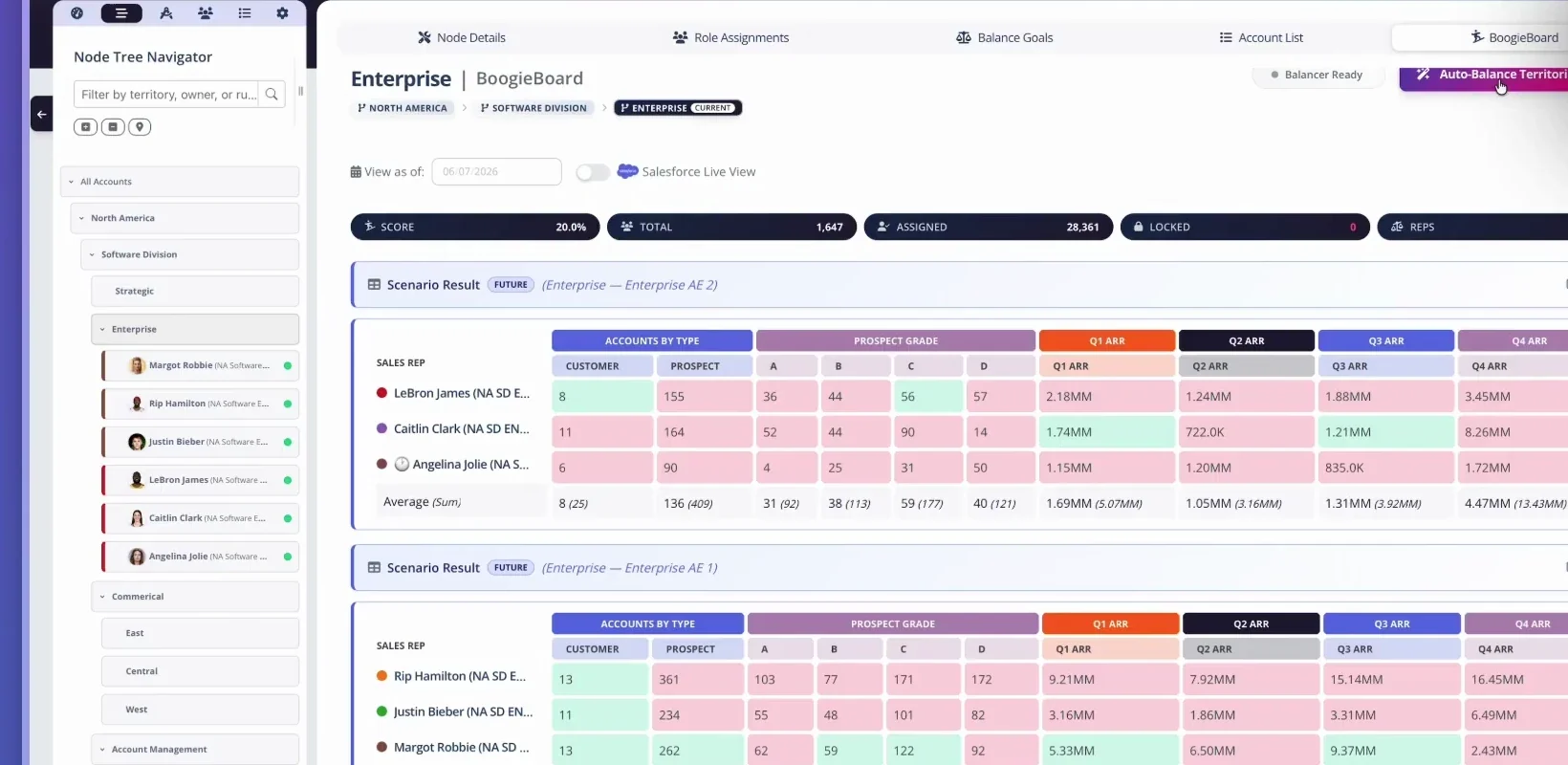
A scenario result compares quota-relative territory measures across reps before the proposed design goes live.
BoogieBoard lets teams compare books against several Balance Goals at once and preserve the tradeoffs in separate scenarios. That matters because optimizing only for account count can quietly make potential, workload, or disruption worse.
Show managers the definition, the measured result, and the approved exception. Research links satisfaction with territory design to role clarity, motivation, job satisfaction, and performance; transparency does not guarantee agreement, but it makes the decision inspectable.
How to Build a Better Account-Load Model
Improve the selling motion and support model
Before adding or removing accounts, ask whether the role has the right operating support. Better data, clearer routing, pooled research, solutions support, and defined customer-service tiers can increase usable capacity. Do not solve an inefficient motion by shrinking every book, and do not use a large book to compensate for poor prioritization.
Choose the segment and coverage model deliberately
Publish the employee, revenue, named-account, AUM, or industry-specific thresholds. Separate customers from prospects and clarify whether coverage is named, pooled, geographic, overlay, or account-family based. The benchmark only becomes actionable after those choices are explicit.
Note: Focus on Coverage Value, Not Just Volume
A larger book is not automatically more valuable. The objective is sufficient serviceable opportunity for the role, with a workload the coverage team can actually execute. Optimize for customer and market coverage, not the most impressive account count.
Challenge assumptions and negotiate exceptions with evidence
When a manager believes a book is too large or too small, compare the account-level data with the published Territory Health definition. Is the difference caused by real potential, renewals, hierarchy, or workload? Is it a data defect? Is the role temporarily covering a vacancy? Resolve the cause rather than negotiating an unexplained number.
Use scenarios before changing live assignments
Build durable territories first. Test the benchmark range with other Balance Goals, inspect outliers, protect locked accounts, and compare alternatives. Assign the current roster after the structure holds up. Territories should be durable; reps are fluid.
The practical sequence is: state the rules, separate the motions, define the roles, set ranges, add non-count measures, model alternatives, and explain the selected tradeoff. Account load is not a productivity contest. It is a coverage-design choice.
Questions to Ask About Your Account Load
A benchmark becomes useful when it helps you inspect your actual work. Ask your manager or Operations partner for the definitions and evidence behind your book:
- What counts as an account? Confirm whether the total includes customers, prospects, subsidiaries, disqualified records, pooled accounts, or account families.
- What work does the role own? Your capacity changes if you carry renewals, expansion, prospecting, account planning, partner coordination, or service obligations.
- Which accounts are expected to produce pipeline? A large book is not valuable if most records are weak fit, inaccessible, or outside the current motion.
- How was Territory Health defined? Territory Health means the measured condition of your book against published standards such as potential, workload, account quality, and customer obligations.
- What is the correction path? Know where to report duplicates, hierarchy errors, stale customer status, and accounts that cannot be worked.
Bring your account-level view to that conversation. Ask your manager to show you which records count toward your target, which work the model expects from you, and which Balance Goals were used to evaluate your book. If your territory sits outside a range, you should be able to see whether the cause is your customer load, your prospect mix, your account hierarchy, a temporary assignment, or a deliberate exception.
Use evidence when you challenge the model. Instead of saying your territory feels too large, show that required activity exceeds capacity, customer obligations are concentrated, or the count includes records outside the serviceable market. Instead of saying a peer has a better patch, compare the published Balance Goals, meaning the measurable objectives used to design the books.
Your manager should also explain temporary conditions. A vacant territory, new hire, major customer event, or protected opportunity may create a short-term exception. Ask for the owner, duration, and review date. Temporary coverage without an end condition has a habit of becoming permanent workload.
Finally, separate the book from your execution. You still own how you prioritize, research, engage, and progress accounts. The company owns providing a viable coverage model and an honest way to evaluate it. Good territory governance makes both responsibilities visible.
Use the benchmark to ask for clarity, not a guaranteed account count. Your strongest case is the evidence connecting your assigned work to your available capacity and your realistic chance to build pipeline. That gives you and your manager a concrete operating question to resolve.
Frequently Asked Questions
How many accounts should an account executive have?
As a planning benchmark, total AE books range from 1-20 in Strategic, 15-120 in Enterprise, 100-350 in Mid-Market, and 250-1,250 in SMB. Define the segment and customer/prospect mix before using the range.
How many accounts can a CSM manage?
Named Strategic coverage may be as low as 1-40 accounts. Enterprise ranges from 10-500. Mid-Market and SMB can reach 100-2,000 when coverage is pooled. A pooled queue should be capacity-modeled differently from a named book.
Should every rep have the same number of accounts?
No. Equal counts can be unfair when account potential, hierarchy, customer obligations, and workload differ. Use a shared Territory Health definition and several Balance Goals instead.
What should I measure besides account count?
Measure ICP fit, potential, customer/prospect mix, ultimate-parent count, pipeline, renewals, retained ownership, and required role coverage. The exact set should reflect your sales motion.
About the author: Kevin Davis is Co-Founder & CEO of BoogieBoard.
In summary: Use account-count benchmarks as a starting point, never as the complete territory design. State the segment, separate the motions, and define fairness through transparent Balance Goals.
Watch territory planning in action
See product walkthroughs and practical territory workflows on BoogieBoard's YouTube channel.
</callout>