5 Key Takeaways
- A global territory strategy defines how markets, accounts, roles, and decision rights fit together across countries; it is more than a map of regional boundaries.
- Geography is useful when physical presence, regulation, language, or delivery logistics matter. For many software companies, time-zone alignment is the more durable constraint.
- Global consistency should govern Territory Health, hierarchy treatment, role definitions, and exceptions, while local teams adapt the attributes that reflect their market.
- Build the model in five steps: define the coverage philosophy, gather market evidence, design the hierarchy, standardize global rules, and socialize before activation.
- Scenario planning matters because every global model trades off customer continuity, seller workload, market potential, language, time zones, and disruption differently.
How should a software company cover London, Lisbon, New York, Singapore, and Sydney without forcing every team into the same operating model? Many organizations answer by drawing regions on a map. That is understandable, visible, and often wrong.
A global territory strategy needs to answer more than where a boundary sits. It must define which accounts belong in each market, how corporate families are treated across borders, which roles support the account, what a healthy territory means, and where local discretion begins and ends.
The right design is globally coherent and locally usable. It does not insist that every region look identical. It insists that every region can explain its logic.
What Is a Global Territory Strategy?
A global territory strategy is the framework an organization uses to assign market coverage across countries, regions, segments, account families, and sales roles. It connects four layers:
- Market structure: regions, sub-regions, time zones, languages, regulatory constraints, and physical-service requirements.
- Account structure: ICP definitions, segment rules, strategic-account treatment, and parent-child relationships.
- Coverage structure: AEs, BDRs, CSMs, specialists, partners, and managers attached to the territory or account.
- Governance: Balance Goals, Account Locks, scenarios, approvals, Rules of Engagement, and CRM activation.
This is why a global territory strategy cannot be reduced to North America, EMEA, and APAC. Those labels are containers. The strategy explains what belongs inside them and why.
BoogieBoard's observed designs show that geographic models remain common, but adoption varies materially by company size: roughly 25-50% among organizations with 25 or 100+ reps, 35-60% at 250+ reps, and 50-75% at 1,000+ reps. Prevalence does not prove fitness. It shows how often geography must be evaluated rather than assumed.
The Core Components of Global Territory Coverage
Region and Sub-Region Logic
Region Logic defines the first durable layer: which markets need distinct coverage and which can operate together. Use geography when it represents a real operating constraint, such as frequent in-person selling, physical delivery, licensing, data residency, or language.
For software businesses without those constraints, time zones often solve the practical problem more cleanly. A rep can cover accounts within workable calling hours without inheriting every imbalance created by state, country, or postal-code boundaries.
Salesforce's own territory assignment rules support criteria based on account characteristics, not geography alone. That is an important architectural signal: a territory is a business classification, not merely a shape on a map (Salesforce assignment-rule documentation).
Segmentation and Account-Hierarchy Logic
Global teams must use a shared definition of SMB, Mid-Market, Enterprise, and Strategic, or explicitly document regional variations. A company with 800 employees cannot quietly be Enterprise in one theater and Mid-Market in another unless the selling motion genuinely differs.
Corporate families add a second decision. Should one global owner cover the ultimate parent and all subsidiaries? Should each region own its local entities? Or should global and local roles coexist? The answer should follow the customer's buying structure. Fullstory, for example, needed one rep per region on the same account family rather than one universal owner or unrelated subsidiary assignments (Fullstory case study).
Role Assignments and Coverage Capacity
The account owner is rarely the full coverage model. Global accounts may involve an AE, BDR, CSM, partner manager, solutions consultant, executive sponsor, and regional manager. Define each role's responsibility and whether it attaches at the territory, parent-account, subsidiary, opportunity, or customer-book level.
Capacity assumptions should also vary by motion. A Strategic AE with a few complex families is not doing the same job as an SMB AE with hundreds of prospects. Fair does not mean equal; it means each comparable role is measured against an explicit Territory Health definition.
Balance Goals, Scenarios, and Controlled Activation
Balance Goals turn the global strategy into measurable design parameters. Useful goals can include account potential, parent-account distribution, customer ARR, prospect grades, renewal timing, language coverage, time-zone alignment, workload, and retained ownership.
No one scenario will optimize all of them. The team should compare alternatives and choose the imbalance it is willing to accept.
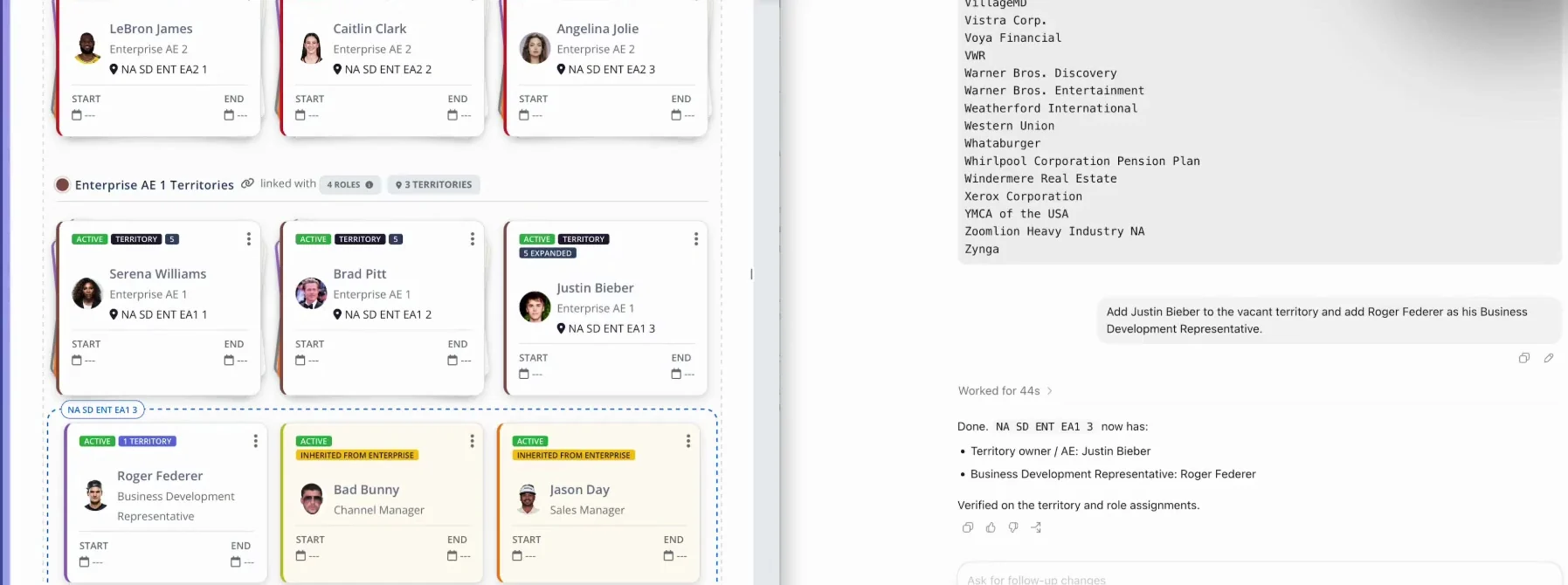
Codex applies a natural-language territory instruction and returns the updated role-assignment model for review.
BoogieBoard's Codex workflow can create a new regional node, such as a Nordics territory, inside the existing hierarchy. Operators can then apply the relevant roles and Balance Goals, test the result in a scenario, and inspect the change before it becomes active.
Why a Cohesive Global Territory Strategy Is Critical
- It prevents market gaps and overlap. Every eligible account has an accountable home, while deliberate exclusions remain distinguishable from routing failures.
- It creates comparable Territory Health. Leadership can compare like roles without pretending every region has identical potential or workload.
- It serves the customer's structure. Parent-child and global-local rules match how the customer buys instead of the seller's internal convenience.
- It broadens hiring flexibility. Time-zone coverage can avoid unnecessarily restricting hiring to tiny geographic patches when physical proximity is irrelevant.
- It makes change governable. New regions, acquired businesses, headcount changes, and segment shifts enter a known hierarchy rather than triggering a complete redesign.
Fullstory demonstrates the operational value. Its GTM organization spanned three continents, four segments per continent, and roughly 12 teams with distinct requirements. The company used tailored parameters by team, maintained regional account-family rules, and delivered territories within two weeks of its fiscal-year start, its fastest rollout to that point.
How to Build a Global Territory Strategy in 5 Steps
Step 1: Define the Coverage Philosophy
Start with what the model must accomplish. Decide whether the primary constraint is market potential, customer continuity, physical proximity, language, regulation, partner coverage, or time-zone accessibility. Do not choose regions before naming the business requirement they solve.
Step 2: Gather Market and Account Evidence
For each theater, document the serviceable market, ICP, customer base, account-family structure, pipeline, role capacity, and local constraints. Separate facts from inherited beliefs. "We have always split Europe by country" is history, not evidence.
Step 3: Design the Territory Hierarchy
Build the durable hierarchy before assigning the current roster. A software company might use:
| Level | Example | Primary logic |
|---|---|---|
| Theater | Americas, EMEA, APAC | Leadership and operating cadence |
| Sub-region | North America East, DACH, ANZ | Time zone, language, or market |
| Segment | Enterprise, Mid-Market | Shared selling motion and capacity |
| Territory | DACH Enterprise 1 | Account-level design against Balance Goals |
The hierarchy should survive a rep departure. Territories are durable; reps are fluid.
Step 4: Standardize Global Rules and Allow Explicit Local Adaptation
Standardize account definitions, hierarchy handling, role meanings, approval authority, exception policy, and the minimum Territory Health evidence every region must publish. Let regions vary Balance Attributes where their markets genuinely differ.
Do Not Overlook Local Constraints
Language, working hours, data rules, contracting entities, customer procurement, and in-person requirements can justify local design. Record each constraint as explicit Territory Logic. Hidden local knowledge is not a scalable operating model.
Step 5: Implement and Communicate Transparently
Compare scenarios with regional leaders, select the approved design, review every account and role movement, and prepare the change narrative before CRM activation. Managers should be able to explain what changed in the business, what work was done, what it means for each seller, and what happens next.
Global territory strategy is an operating system, not a one-time map. Review it when the market, product, customer structure, or coverage model changes, and run a scheduled health check at least annually.
Global Standards vs. Local Adaptation
A global model needs one common operating language without pretending every market is identical. Separate non-negotiable standards from decisions that local leaders can adapt.
| Design area | Global standard | Local adaptation |
|---|---|---|
| Account identity | Provider ID, parent hierarchy, duplicate policy | Local evidence for unresolved entities |
| Segment definitions | Canonical names and reporting rollups | Approved market-specific thresholds |
| Territory Health | Required measure categories and reporting method | Goal targets and acceptable variance by motion |
| Role architecture | Primary-owner and supporting-role definitions | Market-specific role availability and ratios |
| Locks and exceptions | Common criteria, approver, and audit fields | Additional regulated or customer constraints |
| Activation | Scenario approval, effective dating, reconciliation | Market launch sequence and communication channel |
Local adaptation should be explicit data, not a hidden spreadsheet. Record the market, rule, rationale, owner, effective date, and review date. This keeps the global model comparable while recognizing meaningful differences in language, regulation, customer expectations, route to market, and data availability.
Worked Example: A Global Software Coverage Model
Consider a software company with North America, EMEA, and APAC coverage. The company first establishes a global hierarchy with common Strategic, Enterprise, Mid-Market, and Commercial rollups. It uses a durable account-family identifier and one customer-status definition across theaters.
The local constraints differ. North America can support three time-zone bands. EMEA requires language and country-cluster rules. APAC uses broader regional coverage and more partner support because direct capacity is lower. Strategic global parents receive named ownership plus coordinated local roles; subsidiaries do not automatically become independent territories.
The design team selects four common health dimensions: high-fit prospect opportunity, customer revenue exposure, estimated workload, and account-family coherence. Each theater defines target ranges appropriate to its motion. Leadership then publishes global Account Locking Criteria for late-stage opportunities, near-term renewals, strategic relationships, and accounts moved recently. Markets may add a regulatory lock, but they cannot remove a global lock privately.
Three future Scenarios reveal different tradeoffs:
- Scenario A maximizes global account-family coherence but overloads two regional teams.
- Scenario B produces the lowest Balance Goal variance but moves the most customers.
- Scenario C preserves qualifying locks, keeps families coordinated through shared roles, and accepts wider prospect-count variance in APAC until hiring is complete.
Leadership chooses Scenario C, records the temporary capacity exception, and schedules a review after the planned hires ramp. The result is globally governed without forcing every theater into the same shape.
Governance After Go-Live
A global territory strategy fails if the annual design is careful but in-year change is local and invisible. Create one intake for new markets, segment changes, rep departures, parent-hierarchy corrections, strategic exceptions, and role additions. Route each request to the appropriate global and local decision owners.
Monitor:
- accounts that match no territory or multiple territories;
- cross-theater parent families without coordinated coverage;
- vacancies and temporary assignments;
- locks approaching their review date;
- local rules that diverge from the global standard;
- Territory Health by role and theater;
- CRM differences from the approved Scenario.
Use a quarterly global review for structural drift and a faster operating cadence for assignment defects. A local change can be correct for the market and still create a global reporting or customer-coordination problem. The review should show both consequences.
Implementation Checklist
- Publish the global hierarchy, definitions, and decision rights.
- Profile account identity, country, segment, customer status, and parent relationships by theater.
- Approve global Balance Goal categories and local target ranges.
- Define global locks, permitted local additions, and exception authority.
- Build and compare Scenarios with the same current-state snapshot.
- Review global parents, customers, vacancies, and regulated accounts at the account level.
- Prepare market-specific manager and seller communication using one core narrative.
- Activate through controlled CRM updates and reconcile the result.
- Preserve local adaptations and temporary exceptions with review dates.
- Monitor Territory Health and feed market learning into the next design cycle.
The objective is not a uniform map. It is a coherent global operating model whose local differences are intentional, visible, and governable.
Keep a Global Decision Log
For every structural choice, record the question, available options, selected option, evidence, approver, affected markets, effective date, and review trigger. Attach the relevant Scenario comparison and account-level exceptions. The log prevents a local convention from becoming an unexplained global rule and helps new regional leaders understand why the model looks the way it does.
Review the log before each redesign. Some constraints will have expired, some temporary adaptations will have become structural, and some assumptions will have failed. Carrying every historical decision forward without review is not consistency; it is accumulated drift.
Give regional leaders read access to the complete log and edit rights only for their governed decisions. Visibility should be global even when authority is local, because one market's exception can affect account families, reporting, and customer coordination elsewhere.
Frequently Asked Questions
How do you design sales territories across time zones?
Start with the working-hour overlap required for the selling motion, then test market potential, language, hierarchy, and workload inside those bands. Time zones are a constraint within the model, not a substitute for account-level design.
Should global sales teams use geographic territories?
Use geography when location materially affects selling or service. When it does not, named-account, segment, industry, or hybrid models can preserve coverage while avoiding arbitrary map boundaries.
How often should a global territory strategy be reviewed?
Review Territory Health continuously and the full structure at least annually. Trigger an earlier review after a major acquisition, market entry, product shift, segment redesign, or substantial headcount change.
How should global parent accounts and local subsidiaries be covered?
Start with the account-family strategy. Name one accountable global relationship owner when coordination is required, then assign local or specialist roles for execution. Preserve the hierarchy in reporting and document opportunity, communication, and credit rules so local coverage does not create competing customer motions.
About the author: George James is Co-Founder & CPO of BoogieBoard.
In summary: Global territory strategy aligns market structure, account hierarchy, roles, Balance Goals, and governance. Use geography only where it represents a real operating constraint.
Watch territory planning in action
See global hierarchy, scenario, and design workflows on BoogieBoard's YouTube channel.
Customer proof: Fullstory balanced territories across 12 teams on three continents, maintained regional account-family rules, and completed its fastest territory rollout (read the case study).