5 Key Takeaways
- Geography helps when location changes the work: travel, physical service, language, regulation, delivery, partner coverage, or workable selling hours.
- A clean-looking map can conceal unequal market potential, broken account families, constrained hiring, and high maintenance at every boundary.
- Compare Territory Health (the measured condition of the complete book), not the shape. Account potential, workload, continuity, hierarchy, and capacity matter alongside geographic compactness.
- Test hard geography, time-zone bands, geography-plus-segment models, and named-account overlays against the same roster and Balance Goals.
- For many software organizations, time zones are the practical constraint. State, country, or postal boundaries should not become strategy by default.
If you sell inside a geographic territory, the boundary affects your accounts, pipeline, travel or working hours, customer relationships, and hiring flexibility. A map is easy to see and explain, but a clean border does not prove that your territory is workable.
But a map is only a useful territory model when geography represents a real difference in the selling or service motion.
If one side of a border contains twice the qualified market, if a corporate family is split among unrelated reps, or if a hiring manager can recruit only inside a narrow patch for a remote software role, the simplicity is visual rather than operational.
The best geographic split is the one that solves a business constraint without creating a larger coverage problem.
Key Principles for Choosing a Geographic Model
- Start with the operating constraint. Name what location changes: travel, language, regulation, delivery, customer expectations, partners, or working hours.
- Look beyond compactness. Evaluate potential, account quality, workload, customer continuity, hierarchy, and capacity rather than treating adjacent shapes as balanced.
- Test alternatives. Compare a geography-first model with time-zone, segment, industry, named-account, and hybrid scenarios.
- Document exceptions. Strategic accounts, global parents, live opportunities, and service requirements should follow published rules instead of private manager memory.
BoogieBoard's observed territory designs show that geography remains common, but not universal: roughly 25-50% of organizations with 25 or 100+ sellers use a geographic model somewhere in the structure, rising to about 35-60% at 250+ and 50-75% at 1,000+. Larger organizations encounter more regional complexity, but prevalence still does not prove that geography should be the primary account-assignment logic.
Deconstructing Geographic Territory Models
Hard Geographic Boundaries
Each account belongs to a rep according to a state, country, province, postal code, or other exclusive area. The model is straightforward and can work well for field sales, physical delivery, regulated markets, and local relationship networks.
The risk is that administrative borders rarely contain equal market opportunity. Every boundary adjustment can also move large numbers of accounts.
Time-Zone Bands
Accounts are grouped according to workable selling and service hours rather than political boundaries. This is often a better fit for remote software and inside-sales teams. Time zones preserve availability while allowing the design to balance account potential within broader bands.
Geography Plus Segment
The hierarchy begins with a theater or region, then divides accounts by Enterprise, Mid-Market, SMB, industry, customer status, or another selling-motion definition. This keeps regional leadership or language alignment while avoiding one undifferentiated market inside each region.
Named-Account Overlay
Strategic accounts and complex corporate families are assigned explicitly, while the remaining market follows geographic logic. This model protects deliberate customer coverage without requiring every local subsidiary to operate independently.
Location and Regulatory Constraints Change the Answer
Physical-service radius, licensing, data residency, contracting entities, language, and travel requirements can make geography non-negotiable. Record those requirements as Territory Logic. Do not generalize a valid constraint for one motion into a company-wide rule for every role.
Beyond the Map: Hidden Costs You Cannot Ignore
The boundary itself is only one part of the design. Geographic models can create costs that do not appear on the map:
- Restricted hiring pools: a company may insist on local residence even when the role sells remotely and only needs time-zone coverage.
- Unequal market potential: adjacent states or countries can contain radically different numbers of qualified accounts.
- Broken corporate families: parents and subsidiaries fall into different patches without coordination rules.
- Boundary maintenance: every resegmentation, acquisition, or market shift requires new rules and reassignment analysis.
- Customer disruption: account ownership changes because a record crosses a geographic definition, not because the customer or service motion changed.
Example: How the Same Team Changes Under Two Models
Assume a remote Enterprise software team covers the United States and Canada. Customers do not require on-site service, but sellers need workable calling hours. The market is concentrated in a few metros, and several strategic parent companies have subsidiaries across the continent.
| Design factor | Four hard geographic regions | Time-zone and segment hybrid |
|---|---|---|
| Primary boundary | Fixed state/province groups | Working-hour bands, then Enterprise potential |
| Market balance | Depends on where high-fit accounts cluster | Can balance prospect grades within each band |
| Strategic families | May split across regions | Named-account overlay keeps families coordinated |
| Hiring | Often restricted to assigned regio | Broader hiring inside compatible hours |
| Rule maintenance | Many state/province exceptions | Fewer bands plus explicit named accounts |
| Best fit | Local presence materially affects the sale | Remote selling with uneven market density |
The hybrid is not automatically better. It is better only if it improves the chosen Balance Goals without violating a real location requirement.
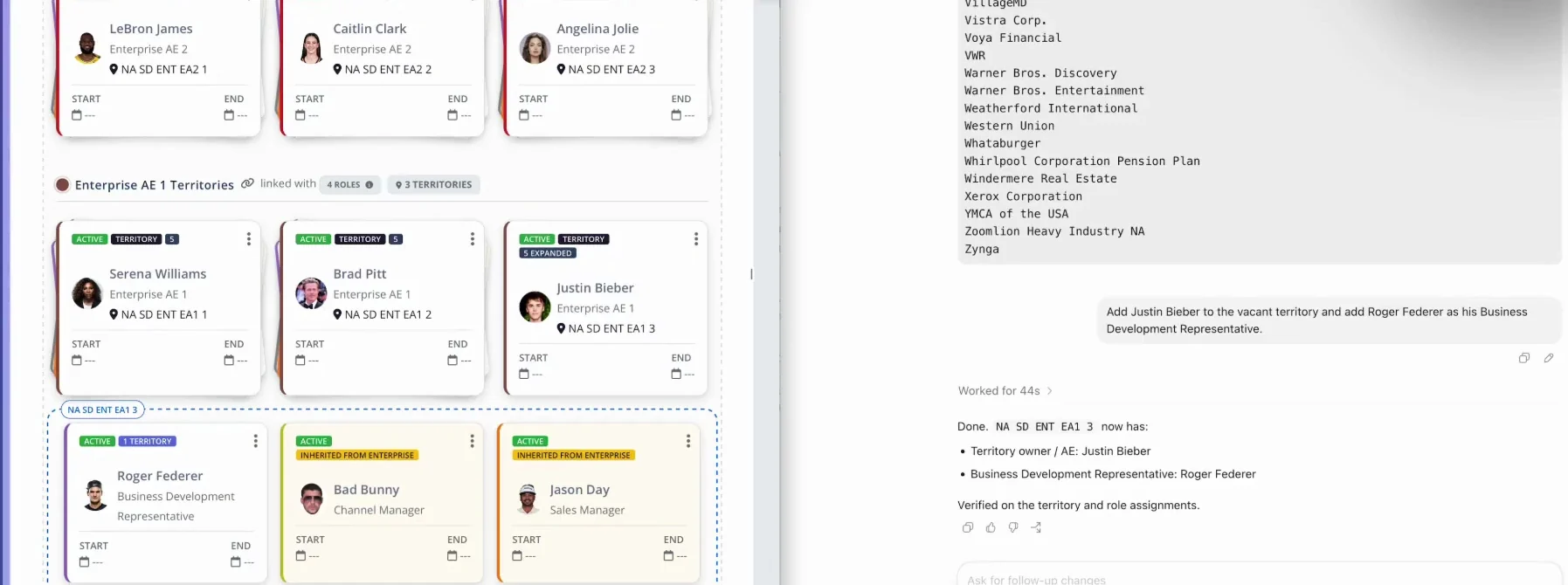
Codex applies a natural-language territory instruction and returns the updated role-assignment model for review.
BoogieBoard's Codex workflow can add a Nordics node under EMEA, define Denmark, Finland, Norway, and Sweden as the relevant country logic, and create the individual territories beneath it. The useful part is not drawing a Nordic shape. It is making the business request explicit in the hierarchy and routing logic so the change can be tested and governed.
Comparing Common Geographic Models
| Model | Useful whe | Primary risk |
|---|---|---|
| Country or state | Legal, language, leadership, or local-market differences are material | Administrative borders substitute for account potential |
| ZIP or postal code | Travel, routes, physical service, or dense field coverage matter | Rule volume and boundary maintenance become excessive |
| Metro or radius | Customer visits and local networks drive productivity | Rural gaps, overlap, and uneven density |
| Time zone | Remote selling needs workable hours more than proximity | Language, regulation, and market differences can be missed |
| Hybrid | Regional constraints coexist with segment, score, or named-account needs | Complexity grows without clear precedence rules |
Salesforce account assignment rules can use account attributes and operators to classify accounts into territories, confirming that geography is one possible input rather than the definition of a territory itself (Salesforce assignment-rule documentation).
Matching the Model to the Selling Motion
Field Sales: Prioritize Reachability
When reps regularly visit customers, build around realistic travel and service patterns. Use route time and account density, not equal land area. A compact urban territory and a broad rural territory may carry comparable workload.
Inside Sales: Prioritize Working Hours and Potential
For remote sellers, time zones often capture the real availability constraint. Balance qualified accounts inside those bands and avoid residency requirements unless local market knowledge is essential.
Global Software: Preserve Regional Rules Without Splitting the Customer
Use theaters for leadership, language, and operating cadence, then add parent-child rules and shared roles. Fullstory's model covered three continents and four segments per continent while assigning regional reps to the same account family. The company rolled the design out within two weeks of its fiscal-year start (Fullstory case study).
Strategic Accounts: Use Named Ownership and Coordinated Roles
When a small number of account families dominate the opportunity, explicit named-account treatment is usually more stable than forcing those families through local boundaries. Regional roles can still support the global owner.
Expert Tip: Agree on the Constraint Before Negotiating the Border
Boundary debates become political when teams have not agreed on what the boundary must accomplish. First publish the constraint and Territory Health measures. Then compare maps as competing solutions to the same problem.
Beyond Geography: Factors That Define the Right Split
Consider manager span, partner coverage, customer buying structure, language, specialist availability, seller capacity, renewal workload, and continuity. The best model may keep a regional hierarchy for management while using non-geographic account logic lower in the structure.
Geography is not outdated. Unexamined geography is. Use it where location changes the work, and let the rest of the territory model reflect how opportunity and customers actually behave.
How This Affects Your Territory
Your job is not to redraw the map. It is to understand what the map is solving and whether the result gives you a credible book.
Start by asking which geographic constraint is real. If the role requires weekly onsite meetings, drive time matters. If the motion is remote software sales, workable hours and language may matter more than state borders. If regulation changes eligibility, the rule should identify the relevant account or seller condition instead of assuming every account in a region behaves the same way.
Then inspect the full book. Territory Health is the measured condition of your territory against standards such as account potential, workload, quality, continuity, and capacity. Ask to see those measures alongside the map. A compact territory can still have too little serviceable opportunity; a wide territory can be workable for remote coverage.
Your comparison should start with the conditions you actually face. Look at when your prospects are reachable, how much of your week travel consumes, whether your account families cross the boundary, and whether your best-fit market is concentrated elsewhere. You are not asking for your preferred shape. You are asking whether the design gives you a territory you can work and a clear explanation when it does not.
Questions to Ask Your Manager
- What business constraint does this boundary represent?
- How do my account quality, workload, and pipeline potential compare with peer territories?
- Are global parents and local subsidiaries coordinated through one account hierarchy or shared coverage rule?
- Which strategic accounts, customers, or opportunities are exceptions, and when will those exceptions be reviewed?
- What evidence would trigger a boundary or capacity review?
An account hierarchy is the parent-child structure connecting related companies. If your territory owns a local subsidiary while another seller owns the global parent, ask who leads the relationship, how information is shared, and how opportunity credit works. Geography should not create competing messages to one customer family.
Challenge the Boundary With Evidence
Avoid arguing that a neighboring patch simply looks better. Show the operational difference. Useful evidence includes reachable high-fit accounts, travel hours, language coverage, customer meetings, active opportunities, renewal exposure, and unworked account volume.
For example, two regions may each contain 300 accounts. Your region has 90 serviceable prospects and a high travel burden; the other has 170 serviceable prospects concentrated in two metros. The account count and area are not the relevant comparison. A Scenario can test a metro adjustment, a time-zone band, or a named-account overlay while measuring the resulting disruption.
Know What Will Stay Stable
Boundary changes can move many accounts at once. Ask which relationships qualify for locks and how open opportunities are handled. The company should define Balance Goals before locks, apply qualifying continuity rules, model the movable book, and evaluate the complete territories afterward. A protected account still contributes to your workload and opportunity even if it did not move.
You should leave the review knowing which accounts are yours, which relationships are shared, what priorities matter, and where to report a data or policy problem. The map is only one part of that answer.
Worked Example: State Borders vs. Time Zones
Suppose six remote AEs cover the continental United States. A state-based model creates one territory with 38% more high-fit accounts than the median and another that spans three working-hour patterns. A time-zone model reduces scheduling friction but splits two strategic parent families.
A hybrid Scenario preserves named global parents, groups the movable book by time zone, and balances high-fit counts and workload within each band. It moves more accounts than the state model but produces clearer working hours and healthier account distribution. Leadership can now choose with the tradeoffs visible instead of assuming the neatest map is best.
Reviewing Geography After Launch
Your geographic model should have review triggers, not just an annual date. Watch for market concentration changing, a new office or hiring location, regulatory requirements, customer families expanding across borders, persistent travel overload, language gaps, or a territory remaining outside its health range.
Separate a boundary problem from an account-data problem. An incorrect country, headquarters location, postal code, or parent link can make the rule appear wrong when the input is wrong. Report the record defect first and rerun the logic before proposing a structural change.
Also distinguish temporary capacity from permanent market structure. If a territory is vacant, use explicit temporary coverage or a future role assignment. Redrawing the boundary around the available people can create another redesign when the planned hire arrives.
At review time, compare the current state with at least one non-geographic alternative. Use the same account population, roster, locks, and health measures so the result tests the model rather than different inputs. Preserve the rejected Scenario and rationale. That history helps you understand whether a later change reflects new evidence or a repeated debate.
What You Should Receive at Go-Live
The seller package should include your account-level territory view, effective date, key gains and losses, shared-account rules, active locks or holdovers, priorities, and the support path. The CRM, routing, dashboards, and manager explanation should agree. If they do not, one source must be named as authoritative while the mismatch is corrected.
Take the unresolved questions to your manager before the go-live date. Which boundary controls your account eligibility? Who coordinates your cross-border customers? How will your quota reflect a material market difference? When can you ask for your territory to be reviewed? What evidence should you collect from your first weeks in the patch? Those answers turn the map from an assignment into an operating agreement you can use.
Frequently Asked Questions
When should a sales team use geographic territories?
Use them when location materially changes selling or service through travel, regulation, language, delivery, local relationships, partner networks, or working-hour requirements.
How do you split geographic territories fairly?
Define comparable Territory Health measures, model account potential and workload inside the candidate boundaries, protect necessary account families or relationships, and compare scenarios before assigning reps.
Are time zones enough for a global sales team?
Sometimes. Time zones solve working-hour coverage, but teams must still evaluate language, regulation, account hierarchy, market potential, customer expectations, and role capacity.
Should a global parent and its subsidiaries stay in one geographic territory?
Not automatically, but the relationship needs coordinated ownership. Keep the account hierarchy visible, name the primary relationship owner, define local and specialist roles, and document communication and credit rules. A named-account overlay can preserve global coordination while local teams execute in their regions.
About the author: Tyler Thompson is Co-Founder & CTO of BoogieBoard.
In summary: Geographic territory splits work when they represent real operating constraints. Evaluate the whole coverage system, test alternatives, and avoid mistaking a tidy map for an equitable market.
Watch territory planning in action
See geographic logic, maps, scenarios, and Balance Goals on BoogieBoard's YouTube channel.
Customer proof: Fullstory coordinated 12 teams across three continents, preserved regional account-family coverage, and completed its fastest territory rollout.