5 Key Takeaways
- Territory structure is the durable system that organizes market coverage; it includes hierarchy, segmentation, assignment logic, role coverage, and governance, not just account ownership.
- Start with the business strategy and customer motion, then choose the structure. Reproducing the sales org chart or drawing equal map regions reverses the decision order.
- Balance Goals are design hypotheses about what makes territories healthy. Use a small set you can defend, and keep weaker signals visible as diagnostics.
- Separate durable territories from the current roster. People move, leave, ramp, and cover vacancies; the coverage model should survive those changes.
- Build, compare, and socialize scenarios before activation. Territory structure is a change-management system as much as an analytical model.
Why do some territory models remain understandable after a hiring change while others collapse into exceptions? The difference is usually structure.
A weak model starts with people and distributes accounts until the totals appear even. A strong model begins with the market, customer motion, and operating rules. It creates durable coverage units, defines what health means, and then assigns people into those units.
That distinction matters because account ownership is only one output. Territory structure also drives forecasting, access, specialist coverage, account-family coordination, quota setting, hiring, and how the organization absorbs change.
What Is a Territory Structure? Core Principles and Objectives
A territory structure is the formal framework used to classify accounts, organize coverage units, assign sales and service roles, and govern changes over time. It connects the serviceable market to the people responsible for working it.
A complete structure includes:
- Hierarchy: the levels through which coverage, management, and reporting roll up.
- Territory Logic: the rules that determine which accounts belong in each node.
- Segmentation Logic: the customer characteristics that create distinct selling or service motions.
- Balance Goals: the measures used to compare opportunity, workload, quality, and continuity.
- Role Assignments: the primary and supporting roles attached to territories.
- Governance: scenarios, Account Locks, exceptions, approvals, Rules of Engagement, and activation.
The structure should accomplish four objectives:
- Complete accountable coverage: eligible accounts have a deliberate home, and uncovered accounts are visible.
- Defensible Territory Health: comparable roles receive comparable opportunity and workload under a published definition.
- Customer alignment: account families and service models reflect how customers buy and how the company serves them.
- Durable change: hiring, attrition, market shifts, and resegmentation can enter the model without rebuilding it from scratch.
Salesforce makes a similar architectural distinction. Its territory hierarchy exists for reporting, forecasting, and record access, while account assignment rules determine which accounts match individual territories. Parent nodes do not automatically inherit child rules, so the hierarchy and logic must be designed deliberately (Salesforce territory-management guidance).
The Building Blocks of Territory Structure
Hierarchy, Segmentation, and Assignment Logic
The hierarchy defines durable levels such as theater, region, segment, team, and individual territory. The right levels depend on actual management and coverage needs. Do not add a layer merely because the org chart contains one.
Segmentation should separate genuinely different motions. Strategic, Enterprise, Mid-Market, and SMB only help if the definitions are explicit and the work differs. Industry, geography, account type, customer status, or channel can also create branches when they change expertise, capacity, or customer experience.
Assignment logic then routes accounts into the structure. It can use country, employee bands, annual revenue, industry, account score, parent relationship, customer status, product, or named-account criteria. Keep the rules mutually intelligible and define precedence when several rules match.
Balance Goals: The Health Measures
Balance Goals define what a viable and equitable territory means for a particular motion. They can measure:
- account and account-family counts;
- prospects by score or grade;
- customers by ARR and renewal quarter;
- pipeline, open opportunities, or whitespace;
- workload, implementation complexity, or service intensity;
- continuity through retained ownership and protected relationships;
- time zones, distance, language, or physical-service constraints.
BoogieBoard's observed designs show that Total Accounts appears in roughly 85-100% of models, while account type, score, ARR, renewals, hierarchy, and continuity measures vary by motion and company. That pattern is useful: account count is usually present, but it is almost never sufficient.
Primary, Supporting, and Shared Coverage
An AE may own the territory while BDRs, CSMs, partner managers, solutions consultants, and managers provide supporting coverage. Some roles attach locally to one territory; others inherit from a team or regional node; still others cover a pool.
The structure should say which role is accountable, which roles need access, how ratios work, and what happens when a seat is vacant. This avoids duplicating territories merely to represent every team member.
A Step-by-Step Guide to Designing Territory Structure
Step 1: Start With the Business Strategy
Name the one to three priorities the coverage model must support. Examples include entering a new market, moving upmarket, increasing expansion, improving retention, specializing by industry, or reducing seller travel.
Then ask:
- Which customer conditions make the priority real?
- Which roles and expertise does the motion require?
- Which account or relationship boundaries must remain intact?
- Which outcomes would prove the structure is working?
The structure is a tool for executing the strategy, not an independent exercise in neatness.
Step 2: Define the Balance Goals
Select the measures that represent healthy coverage for each motion. Use the smallest set that captures material differences, and document the rationale and data source.
| Motion | Potential Balance Goals | Primary design question |
|---|---|---|
| New-logo sales | Prospect grades, serviceable accounts, intent, whitespace | Does each seller receive enough qualified opportunity? |
| Account management | ARR, renewal value by quarter, expansion potential, workload | Are revenue responsibility and service demand comparable? |
| Strategic accounts | Account families, subsidiaries, relationships, complexity | Can the team coordinate the customer as one buying system? |
| Field coverage | Distance, time zones, market potential, travel burden | Does proximity improve the motion enough to justify the boundary? |
| Shared coverage | AE-to-BDR ratio, specialist load, inherited roles | Can supporting roles serve the assigned territories effectively? |
Expert Tip: Do Not Give Every Metric Equal Authority
If a field materially defines health, make it a Balance Goal. If it is useful context but not strong enough to drive assignments, keep it as a report or scenario diagnostic. The point is not to optimize every available column. It is to choose a small, defensible definition of health.
Step 3: Calibrate Targets, Capacity, and Viability
Estimate role capacity, hiring state, expected account load, quota, and service demand. Define minimum viability for a territory before dividing the market. Creating eight equal territories in a market that supports five healthy roles does not create capacity; it distributes scarcity.
Use quota relativity or capacity weights when comparable roles have different targets, start dates, or levels. Fair does not mean every territory contains the same number of accounts.
Step 4: Make the Logic Visible and Explainable
Publish the hierarchy, segment definitions, assignment rules, Balance Goals, locks, and exceptions in language managers can explain. Reps should be able to see why an account belongs in a territory and how the territory compares with peer books.
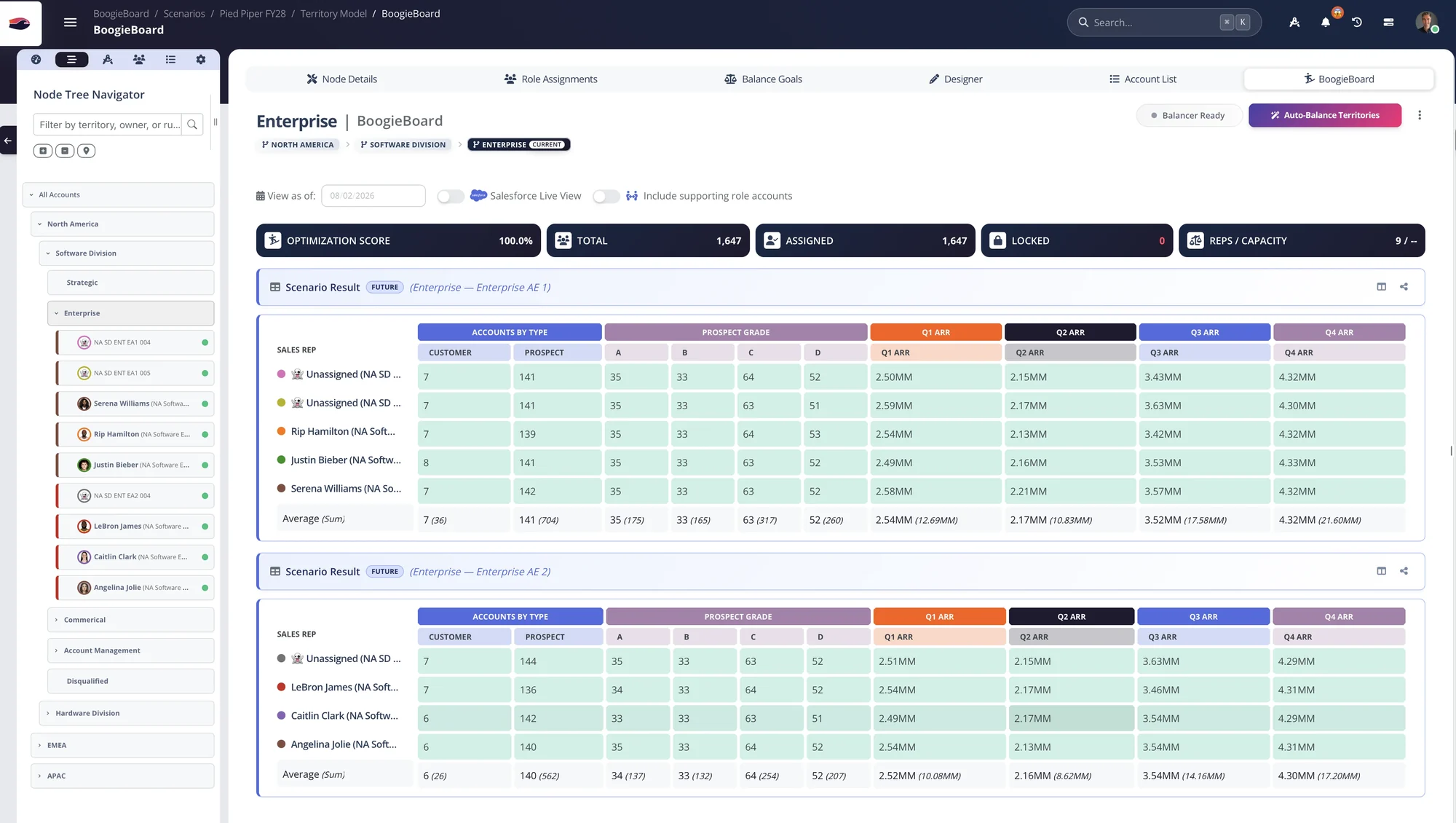
Scenario Results show customer and prospect mix, prospect grade, quarterly ARR, account locks, and rep capacity in one review surface.
BoogieBoard can balance customer books using both quota and workload measures, including renewals and ARR by quarter. The resulting scenario makes the tradeoffs visible before the organization commits to assignments or targets.
Step 5: Implement Through Scenarios, Not One Destructive Draft
Create a current-state baseline, then develop alternatives that emphasize different tradeoffs. One scenario may preserve ownership; another may improve prospect quality; a third may reduce travel or account-family fragmentation.
Compare the scenarios, select one, record the decision, and deploy from an approved state. At BoogieBoard-observed scales, account-to-territory permutations can quickly reach tens or hundreds of thousands, which is why manual rearrangement does not provide meaningful confidence.
Step 6: Monitor, Gather Feedback, and Iterate
Track Territory Health, uncovered accounts, exceptions, rep disputes, hiring changes, and business outcomes. Give managers a structured review path and record the account-level reason for changes.
Run continuous health monitoring and a formal structural review at least annually. Revisit the model sooner after an acquisition, major product shift, segment change, market entry, or substantial roster change.
Common Pitfalls to Avoid
Warning: Every Balance Goal Creates Behavior
If the model rewards account count alone, teams will optimize for equal volume even when opportunity differs. If it protects every existing relationship, the redesign cannot correct historical imbalance. If it prioritizes score without workload, sellers can receive attractive but unserviceable books. Test each measure against the behavior it may create.
- Overly complex hierarchy: layers exist without distinct coverage, management, or reporting jobs.
- Arbitrary targets: territory count follows the headcount request rather than market viability and capacity.
- Opaque assignment logic: managers can see the result but cannot explain why accounts moved.
- Metric gaming: one visible score becomes the goal, while customer fit and workload disappear.
- Forgetting supporting roles: the model assigns owners but leaves BDR, CSM, specialist, partner, and manager coverage to manual cleanup.
A territory structure is effective when it remains clear under change. The market, account logic, health definition, and role model should be understandable before a specific rep name is attached.
A Worked Structure Example
Assume a company sells two software products to Enterprise and Mid-Market accounts across North America and EMEA. The existing structure is geography-first, account ownership is tied directly to employees, and specialists are stored in inconsistent custom fields.
The redesign begins above the account level:
- Hierarchy: global theater, segment, then durable territory.
- Segmentation Logic: one governed employee threshold plus a named strategic-account override.
- Region Logic: time-zone and language constraints inside each theater.
- Role model: one primary AE territory owner, mapped BDR support, product specialists, and customer roles.
- Balance Goals: high-fit prospect counts, product-fit mix, customer ARR exposure, and estimated workload.
Leadership first approves that structure and the goal definitions. It then defines Account Locking Criteria for late-stage opportunities, near-term renewals, strategic relationships, and accounts moved recently. Qualifying accounts leave the movable pool.
Three Scenarios reveal the tradeoffs. One creates the lowest variance but splits global parent families. Another preserves every existing assignment and leaves severe opportunity concentration. The selected Scenario coordinates families through primary and supporting roles, protects qualifying locks, and accepts a temporary workload difference in EMEA while a future hire is vacant.
The team evaluates the complete territories after locked accounts return. It records the residual imbalance, temporary support, quota implication, and review date. The structure now explains not only where an account belongs, but who covers it, which health measures matter, and how change will be governed.
Locks, Balance Goals, and the Movable Book
The order of operations prevents a recurring doctrine conflict:
- Set the high-level hierarchy and segment structure.
- Define Balance Goals as the measurable health hypothesis.
- Define Account Locking Criteria as continuity constraints.
- Apply qualifying locks and create the movable book.
- Optimize the movable book against the Balance Goals.
- Recombine all accounts and evaluate complete Territory Health.
Locks are not another Balance Goal. They can make a goal harder or impossible to reach. If that happens, keep the qualifying lock, disclose the remaining variance, and ask leaders whether to accept it, adjust quota or capacity, revise future lock criteria, or choose another Scenario.
Do not publish a numeric claim about how much locking reduces disruption. BoogieBoard does not yet have a validated disruption benchmark split by locked and unlocked accounts. The expected direction is reasonable; the number is not available.
Operating Controls After Launch
A durable structure needs controls for ordinary change:
- one source of truth for territory, role, and account associations;
- effective dates for assignments and structure versions;
- separate paths for data corrections, policy questions, and exceptions;
- explicit temporary coverage for vacancies and ramping hires;
- account-level review before CRM activation;
- reconciliation after deployment;
- scheduled Territory Health monitoring;
- review dates for locks and exceptions.
Track structural drift, not only attainment. Useful indicators include unassigned and multiply assigned accounts, parent families split against policy, supporting roles missing from eligible accounts, territories outside accepted health ranges, expired locks, and live CRM values that differ from the approved Scenario.
Design Review Questions
Before approval, ask:
- Can every territory be explained through the hierarchy and logic?
- Can every assigned role be traced to a role rule or approved exception?
- Do the primary goals reflect strategy and reliable data?
- Are weak signals still diagnostics rather than hidden weights?
- Are locks applied consistently and measured in the final book?
- Can the structure represent vacancies, future hires, and temporary coverage?
- Can the team compare current and proposed states at the account level?
The model is ready when the answers form one coherent operating system, not when the org chart simply looks complete.
Run the same questions against at least one ordinary account, one strategic family, one locked customer, one vacant territory, and one shared-role account. Edge cases reveal whether the structure is genuinely operable or only plausible in summary.
Record every result.
Frequently Asked Questions
How do you structure sales territories?
Start with business strategy and customer motion, define a durable hierarchy and segment rules, select a small set of Balance Goals, calibrate capacity, model role coverage, compare scenarios, and document governance before activation.
How many Balance Goals should a territory model use?
Use the fewest measures needed to capture material differences in opportunity, workload, quality, and continuity. Many teams need several goals, but adding every available metric weakens the decision model.
How often should territory structure be reviewed?
Monitor health continuously and run a formal structural review at least annually. Trigger an earlier review after major changes to market, product, customer motion, hierarchy, or headcount.
Should geography be the foundation of territory structure?
Only when location represents a real operating constraint such as travel, language, regulation, delivery, or working hours. Otherwise segment, account potential, named accounts, industry, or hybrid logic may fit better.
About the author: Kevin Davis is Co-Founder & CEO of BoogieBoard.
In summary: Effective territory structure connects strategy, hierarchy, assignment logic, Balance Goals, role coverage, scenarios, and governance. Design the durable system first; assign the current roster second.
Watch territory planning in action
See hierarchy, Balance Goals, role assignments, and scenario workflows on BoogieBoard's YouTube channel.
Related framework: The Balance Goal Guide provides a working method for choosing and documenting the measures that define Territory Health.