
5 Key Takeaways
- Territory design determines the opportunity and workload a seller receives; incentive design determines what the company expects that seller to produce from it.
- Fair does not mean equal. Comparable roles need comparable opportunity relative to quota and capacity, not identical account counts or identical books.
- Territory and compensation teams should agree on the business objective, potential measures, capacity assumptions, and scenario before quotas become commitments.
- Quota relativity allows territory size and quality to reflect seller level, ramp, start date, and target instead of forcing every rep into the same allocation.
- When territory and quota design happen separately, the quota often becomes a late mathematical repair for an opportunity imbalance the territory created.
Most companies know territories and quotas are related. Fewer design them together.
Revenue Operations may build the account books while Finance or Sales Compensation develops quotas in a different calendar, using different assumptions and a different data set. Each process can look internally sound. The mismatch appears only when a rep receives a territory that cannot reasonably support the target attached to it.
That is not merely a quota problem or a territory problem. It is a system-design problem.
What Does Territory and Incentive Alignment Mean?
Territory and incentive alignment is the practice of designing seller opportunity, workload, capacity, quota, and performance measures as connected decisions. It links what a rep can work to what the company asks that rep to achieve.
A territory is the durable container for market coverage. The seller is assigned into that structure. The quota establishes the expected outcome for the period. Quota relativity then lets the territory design account for meaningful differences among roles, sellers, and ramp states.
Related Planning Terms
| Term | Question it answers | Primary output |
|---|---|---|
| Territory design | Which accounts and opportunities should this coverage unit contain? | Territory hierarchy, logic, assignments, and Territory Health |
| Quota design | What outcome should the assigned seller be expected to produce? | Revenue, pipeline, renewal, or activity target |
| Capacity planning | How many people and how much work can the model support? | Roles, headcount, coverage ratios, and hiring plan |
| Quota relativity | How should different targets or ramp states change the assigned book? | Relative territory size, potential, and workload |
These outputs should remain distinguishable, but they should not be produced in isolation.
The Different Dimensions of Alignment
Alignment by Business Target
The territory model must reflect what the company is trying to grow. A new-logo motion needs enough qualified prospect potential. An account-management motion needs renewal and expansion opportunity distributed by period. A strategic-account motion may emphasize account-family complexity and relationship continuity over raw account count.
Alignment by Seller Capacity
Two sellers with the same title may not have the same capacity during the period. A new hire, a future start, a leave, a senior role, and a specialist role all change the work that can reasonably be covered. Capacity assumptions should be visible inputs, not explanations added after assignment.
Alignment by Planning Horizon
Annual redesign, quarterly quota updates, and in-year territory maintenance operate on different clocks. Define which inputs can change, who approves the change, and whether the quota, territory, or both will move. Otherwise every staffing change becomes an improvised compensation decision.
How to Align Territory and Incentive Design
Step 1: Agree on the Business Objective
Bring Sales Leadership, Revenue Operations, Finance, and Compensation together before either team finalizes its model. Name the outcome: new ARR, gross margin, renewals, expansion, logo acquisition, or market entry. Then define the seller behaviors and account conditions that support it.
Step 2: Select Measures of Potential and Workload
Choose a small set of Balance Goals that represent what each seller can win and what each seller must service. Examples include prospect grades, historical or expected ARR, renewal value by quarter, open pipeline, number of account families, implementation complexity, and customer count.
Expert Tip: Pair Opportunity With Workload
Do not let a single potential measure stand in for the entire job. Two customer books can contain the same ARR while carrying very different renewal calendars and service loads. Pair an outcome measure with at least one workload measure and one continuity or quality measure where the motion requires it.
Step 3: Calibrate Quotas, Capacity, and Territory Relativity
Estimate what a healthy territory can support, then test the proposed quota against that opportunity. If roles have materially different targets, ramp, or start dates, model those differences directly.
Consider three enterprise AEs:
| Seller state | Illustrative quota | Territory implication |
|---|---|---|
| Senior AE | $1.2M | Larger book with proportionally more qualified potential |
| Established AE | $1.0M | Baseline healthy territory for the role |
| Future-start AE | $500K | Smaller ramping book with temporary coverage rules |
The goal is not to guarantee attainment. It is to make the relationship between opportunity and expectation explicit enough to defend.
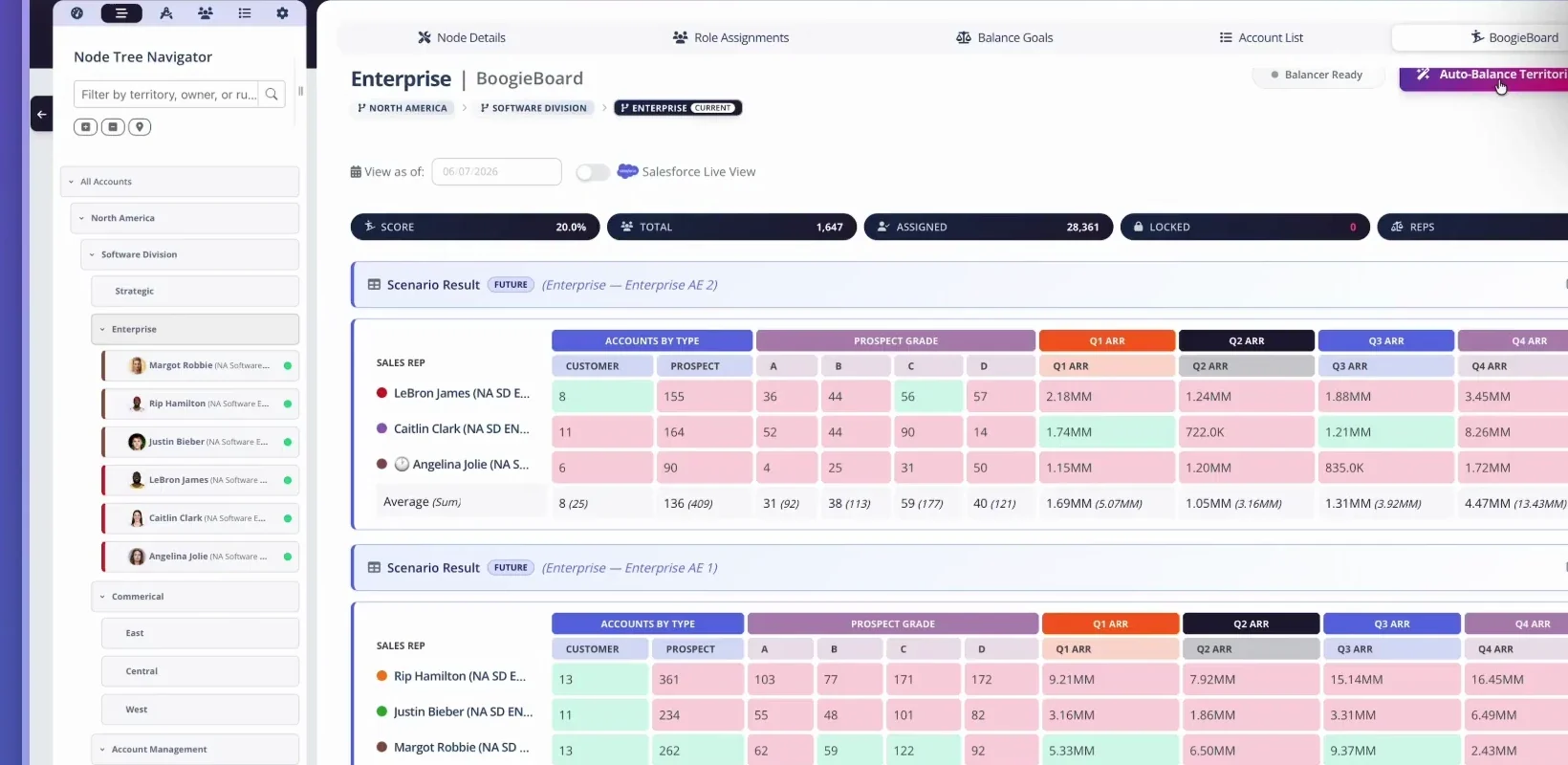
A scenario result compares quota-relative territory measures across reps before the proposed design goes live.
BoogieBoard can use quota relativity as an input while balancing customers, prospects, and ARR. In the resulting scenario, a higher-quota senior seller receives a proportionally larger book, while a later-starting rep receives a smaller ramping territory. The design remains inspectable before anyone publishes assignments.
Step 4: Make Fairness and the Decision Process Transparent
Publish the Balance Goals, capacity assumptions, quota-relativity rules, exception criteria, and selected scenario. Show reps comparable roles rather than presenting a single summary score without context.
Piercy, Cravens, and Morgan’s field investigation of territory design found that effectiveness depends on the broader sales-management system, including managerial judgment and behavior, not simply a mechanical division of accounts. That supports treating territory and quota design as an integrated management decision rather than two disconnected calculations (British Journal of Management study).
Risks of Designing the Two Systems Separately
- Different calendars: quotas are committed before the final account set or roster exists.
- The equal-book fallacy: every seller receives the same number of accounts despite different potential, workload, role, or ramp.
- Quota as a repair mechanism: leaders lower or raise targets to compensate for territory quality after the territory design is already fixed.
- Opaque mid-cycle changes: an account move changes opportunity, but no one evaluates whether it also changes quota, credit, or compensation treatment.
Warning: Do Not Let One Model Hide the Other
A sophisticated quota model cannot rescue poor account coverage, and a balanced territory does not prove the quota is achievable. Keep both models visible. Document which assumptions are shared and which judgment belongs to each owner.
Communicating and Implementing the Aligned Plan
Use a single approval and launch path:
- Confirm the approved account universe, roster, roles, and start dates.
- Freeze the planning version of potential, workload, and historical-performance data.
- Compare territory scenarios using the agreed Balance Goals and quota-relativity rules.
- Validate quota outcomes against the selected scenario before compensation approval.
- Review exceptions with Sales Leadership, Finance, and HR or Legal where required.
- Publish territory assignments, quotas, crediting rules, and dispute paths together.
- Reconcile the deployed CRM state to the approved planning state.
Governance and Compensation Controls
Quota and compensation decisions can affect employment terms, commissions, and local compliance obligations. Maintain dated approvals, versioned assumptions, effective dates, and written change rules. When legal or tax treatment varies by jurisdiction, route the final plan through the appropriate specialists rather than treating the territory model as legal authority.
A Worked Alignment Example
Consider a company with ten Enterprise AEs and a $20 million new-ARR target. Finance initially proposes equal $2 million quotas. Territory analysis shows that the current books differ materially in high-fit account potential, customer obligations, and reachable buying centers.
The team does not use quota to repair the territory after the fact. It works through one joint model:
- Business objective: acquire new enterprise logos while protecting strategic customer expansions.
- Role capacity: each AE owns named prospects and a small set of expansion customers, with shared BDR and specialist support.
- Territory measures: high-fit potential, buying-department presence, active pipeline, expansion workload, and account-family coherence.
- Continuity constraints: late-stage opportunities, near-term customer events, and accounts moved recently qualify for locks.
- Scenario review: three future allocations are compared for opportunity, workload, disruption, and quota relativity.
After locks are applied, one book remains 18% above the potential range and another remains below it. Leadership can now see the real choice. It may accept a temporary difference and use quota relativity, move movable prospects, change supporting capacity, or choose another Scenario. It should not silently claim that equal quotas make unequal opportunity fair.
The approved package records the territory, quota, effective date, locked accounts, temporary support, and review trigger together. Managers receive the same rationale before sellers see either number.
The Handoff Between Territory, Capacity, and Quota Planning
The three systems answer different questions:
| Planning system | Primary question | Output required by the next system |
|---|---|---|
| Capacity planning | How much productive coverage is available and when? | Role counts, ramp, vacancies, productivity assumptions |
| Territory planning | How should market and customer responsibility be organized? | Viable books, potential, workload, locks, role assignments |
| Quota planning | What performance target should apply to each role or territory? | Quotas, periods, crediting, relief, and change policy |
The handoffs should be versioned. If hiring assumptions change after territories are designed, the territory model must show the vacant or overloaded capacity. If the market definition changes after quotas are set, Finance must be able to identify which targets relied on the old potential model.
Do not allow the calendars to finish independently and reconcile through manager negotiation. Establish shared milestones: data and market lock, capacity assumption approval, territory Scenario approval, quota calibration, manager review, seller communication, and CRM activation.
Fairness, Transparency, and Decision Rights
Comparable opportunity does not mean identical accounts, and an aligned system can still contain deliberate differences. A strategic role may carry fewer accounts and a higher quota. A new market may have a lower initial target but more uncertainty. A customer-heavy book may need different workload support.
For every difference, document:
- the role or market reason;
- the measures used;
- the accountable approver;
- whether the condition is permanent or temporary;
- the review date or trigger;
- the quota, capacity, or support consequence.
Publish the principles before individual numbers. Sellers should know how Territory Health, quota relativity, locks, ramp, vacancies, and in-year changes interact. Managers need account-level context and a clear route for data corrections, policy questions, and exceptions.
In-Year Change Policy
Alignment is tested when the organization changes. The policy should cover rep departures, new hires, promotions, parental or medical leave, acquisitions, segment changes, major account events, and territory redesign.
For each event, define whether the territory changes, whether quota changes, how opportunity credit is handled, who provides temporary coverage, and when the decision takes effect. Preserve the prior and new state. A rep should never discover a material quota or book change through a CRM update alone.
Measure alignment after launch through territory potential, workload, capacity utilization, quota attainment distributions, seller questions, exception volume, and customer continuity. Use the evidence to revise the next planning hypothesis without treating one outcome as proof that a territory or quota caused it.
Alignment Review Scorecard
A joint review should combine leading operating evidence with lagging results.
| Dimension | Evidence to inspect | Question for approvers |
|---|---|---|
| Market opportunity | High-fit potential, active market signals, serviceable accounts | Does each target have a credible opportunity base? |
| Workload | Customers, renewals, account complexity, required activity | Can the role execute the assigned book? |
| Capacity | Productive heads, ramp, vacancies, supporting roles | Is the coverage assumption available when the target begins? |
| Continuity | Locks, holdovers, customer handoffs, recent moves | Did the model protect costly relationships deliberately? |
| Quota relativity | Potential and workload differences by territory | Are target differences supported and explainable? |
| Operation | CRM assignments, crediting, reporting, effective dates | Do systems reflect the approved package? |
Set tolerance ranges before reviewing named sellers. Otherwise, the team may move the standard to defend a preferred assignment or quota. Where a measure falls outside tolerance, require one of four explicit treatments: redesign, support or capacity adjustment, quota treatment, or accepted exception with a review date.
The scorecard should never collapse into one synthetic fairness score. Keep the components visible so leaders understand whether a difference comes from opportunity, work, continuity, capacity, or policy. That detail is also what managers need to explain the final result credibly.
At the end of the cycle, compare the approved assumptions with the operated model. A territory may have been viable when approved and then lost a seller, gained customers, or changed segment. Record that distinction so the next design does not mistake in-year drift for a bad planning hypothesis.
Include managers in that comparison. They can identify whether a workload assumption failed, a support role never materialized, a customer event changed the book, or sellers misunderstood the model. Route factual corrections immediately; carry strategic findings clearly into the next joint design cycle with a named owner and firm decision date.
Frequently Asked Questions
Should territory and compensation planning happen at the same time?
They should share assumptions and decision gates, even if separate teams perform the analysis. Territory scenarios must be stable enough to test quotas before either output becomes final.
Who owns the handoff between territory and quota design?
Revenue Operations is often best positioned to manage the shared planning model, while Sales Leadership owns coverage decisions and Finance or Compensation owns target and payout governance. Name one accountable leader for the handoff.
Do fair territories need to be equal?
No. Fair territories provide comparable opportunity relative to role, quota, capacity, and workload. Equal account counts can create unfair books when accounts differ materially.
What happens when a territory changes mid-year?
Apply the published Rules of Engagement for account movement, crediting, holdovers, and quota treatment. Evaluate the materiality of the opportunity change and document whether the quota remains, transfers, or is prorated.
About the author: George James is Co-Founder & CPO of BoogieBoard.
In summary: Territory and incentive design are two halves of the same operating system. Align objectives, evidence, capacity, quotas, and launch governance before sellers inherit the mismatch.
Watch territory planning in action
See quota relativity, workload balancing, and scenario comparison on BoogieBoard's YouTube channel.
Related framework: The Balance Goal Guide helps planning teams define the potential and workload measures used to compare territories.