5 Key Takeaways
- A coverage plan is the formal framework that defines which markets and accounts receive attention, which roles are responsible, and how responsibility changes over time.
- The operational layer classifies accounts and territories in systems such as Salesforce; the strategic layer decides what the classifications and assignments should mean.
- Common models include owner-centric, geographic, named-account, segment, and hybrid coverage. Each is appropriate under different selling constraints.
- Design from business objectives, the serviceable market (accounts the company can realistically pursue), capacity, role responsibilities, Territory Health (the measured condition of the complete book), and governance, then test the model before activation.
- Start with coverage, not fairness. First determine what the business and customers require; then distribute that responsibility against an explicit equity standard.
If you carry a quota or customer responsibility, a coverage plan determines which accounts you can work, which teammates share them, what happens to your pipeline when roles change, and how the company evaluates your territory. It should answer "who is responsible for what?" before you are asked to operate the model.
Without a plan, coverage becomes a collection of owner fields, manager assumptions, side agreements, and exceptions. One team believes Strategic means a named list. Another applies a revenue threshold. A customer has an AE, CSM, partner manager, and specialist, but reporting treats one account owner as the whole model.
A coverage plan turns those implicit decisions into an operating framework. It should be clear enough to explain, structured enough to measure, and durable enough to survive a rep departure.
What Is a Coverage Plan? A Comprehensive Definition
A sales coverage plan is the formal framework an organization uses to decide which markets, accounts, and customer relationships receive sales attention and which roles are accountable for that attention.
It includes:
- serviceable market and ICP definitionsn- segment, industry, region, and hierarchy logicn- territory and book-of-business structuren- role responsibilities and overlaysn- account eligibility and exclusionsn- Territory Health and capacity assumptionsn- assignment, exception, and change rulesn- operational representation in Salesforce or another CRM
The term can describe two related layers:
- Operational classification: how accounts, territories, users, and rules are represented in a system.
- Strategic coverage design: why the company chose those territories and assignments and how they support the business model.
Both layers matter. A beautifully designed model that cannot be operated will decay. A perfectly configured CRM model built on weak strategy will scale the wrong decision.
The Operational Role of Coverage Plans: The Salesforce Example
Enterprise Territory Management is Salesforce's native framework for territory models, hierarchies, assignment rules, users, and account associations. Salesforce also publishes the underlying Territory Management 2.0 object model, making the distinction between models, territories, account associations, and user associations explicit.
That structure creates administrative order. It can distinguish an active model from a planning model, represent parent and child territories, and connect accounts and users to them.
The CRM still needs decisions from the coverage plan:
- Which characteristics define an Enterprise account?
- Does a parent account pull its subsidiaries into one territory?
- Is geography a hard rule, soft preference, or irrelevant?
- Can one account belong to several role-specific territories?
- What happens when a role is vacant?
- Which changes require approval?
Salesforce can store and enforce parts of the model. It does not decide the company's coverage strategy.
Examples of Operational Coverage Objects
| Operational object | Coverage meaning |
|---|---|
| Territory model | The active or proposed coverage system |
| Territory hierarchy | The durable organization of regions, segments, and territories |
| Assignment rule | Account characteristics that qualify for a territory |
| Account-territory associatio | The operational relationship between an account and territory |
| User-territory associatio | The role or person covering the territory |
| Forecast manager | The person accountable for forecast rollup |
These objects are important, but they are implementation vocabulary. The coverage plan supplies the business definitions behind them.
Coverage Plans as a Strategic Growth System
Strategically, a coverage plan communicates where the company will spend scarce selling capacity. It connects market strategy, customer needs, headcount, and role design.
A good plan answers four questions:
- What deserves coverage? The serviceable account universe and customer base.
- What type of coverage? New business, expansion, retention, partner, specialist, or pooled service.
- How much capacity is required? Headcount, ramp, productivity, and workload assumptions.
- Who is accountable? Durable territories and roles, followed by the current roster.
Do not start with fairness. Start with coverage. Determine what customers and the business require, then use Balance Goals to distribute that responsibility equitably.
Common Types of Coverage Plans
Owner-Centric Coverage
The account owner is treated as the primary unit of coverage. This model is simple and can work for small teams with one role per account.
- Best for: early-stage or simple selling motions.
- Advantage: easy to understand and operate.
- Risk: rep departures create an orphan window, and multiple roles become invisible.
Geographic Coverage
Accounts are assigned by country, state, postal code, radius, or another physical boundary.
- Best for: field sales, physical delivery, regulation, or frequent in-person service.
- Advantage: clear local accountability and travel logic.
- Risk: natural boundaries rarely contain equal potential or workload.
Named-Account Coverage
Specific accounts or corporate families are curated into territories.
- Best for: Strategic and major-account selling.
- Advantage: high precision around must-win targets.
- Risk: hidden executive discretion and untracked exceptions can replace consistent policy.
Segment-Based Coverage
Accounts are grouped by a shared motion such as SMB, Mid-Market, Enterprise, or Strategic.
- Best for: organizations with meaningfully different sales cycles, roles, and service levels.
- Advantage: aligns capacity and enablement with the job.
- Risk: inconsistent or stale segment definitions move accounts arbitrarily.
Hybrid Coverage
The model combines segment, geography, industry, status, product, hierarchy, or named accounts.
- Best for: businesses with several real operating constraints.
- Advantage: reflects the actual GTM strategy.
- Risk: complexity becomes difficult to explain, test, and maintain.
Expert Tip: Align the Model With the Constraint
Choose each dimension because it solves a named business or customer requirement. Geography should not appear simply because the prior model used a map. Industry should not appear because a CRM field happens to be populated. Every layer needs a reason.
How to Design an Effective Coverage Plan: 7 Steps
1. Define Business Objectives
State the growth, retention, market-entry, product, or customer outcome the coverage model must support. Include the go-live date and the decisions that are already fixed.
2. Define the Serviceable Market and Customer Universe
Start with SAM, then narrow with ICP, account status, hierarchy, and explicit exclusions. Separate customers from prospects because the obligations and movement costs differ.
3. Establish Capacity and Role Responsibilities
Document headcount by role, hiring timing, ramp, productivity, and workload. Define what the AE, BDR, AM, CSM, partner manager, specialist, and manager own.
4. Choose the Coverage Model and Hierarchy
Select owner-centric, geographic, named-account, segment, or hybrid logic. Build durable territory nodes before assigning current employees. The territory is durable; the rep is fluid.
5. Define Territory Health and Viability
Choose Balance Goals that express the model's hypothesis: account potential, customer ARR, prospect quality, renewal timing, account hierarchy (the parent-child structure connecting related companies), workload, geography, or another measurable attribute.
Do not optimize everything equally. Publish the few measures that define a viable patch and the acceptable variance around them.
6. Document Assignment and Change Rules
Define Account Locks, vacancies, temporary coverage, account transfers, split responsibilities, customer transitions, data disputes, approval authority, and escalation paths. These Rules of Engagement keep the model intact after go-live.
7. Model, Communicate, and Operate the Plan
Build several scenarios, compare balance and disruption, approve the preferred design, train managers, review the pre-flight change set, and activate it in the CRM.
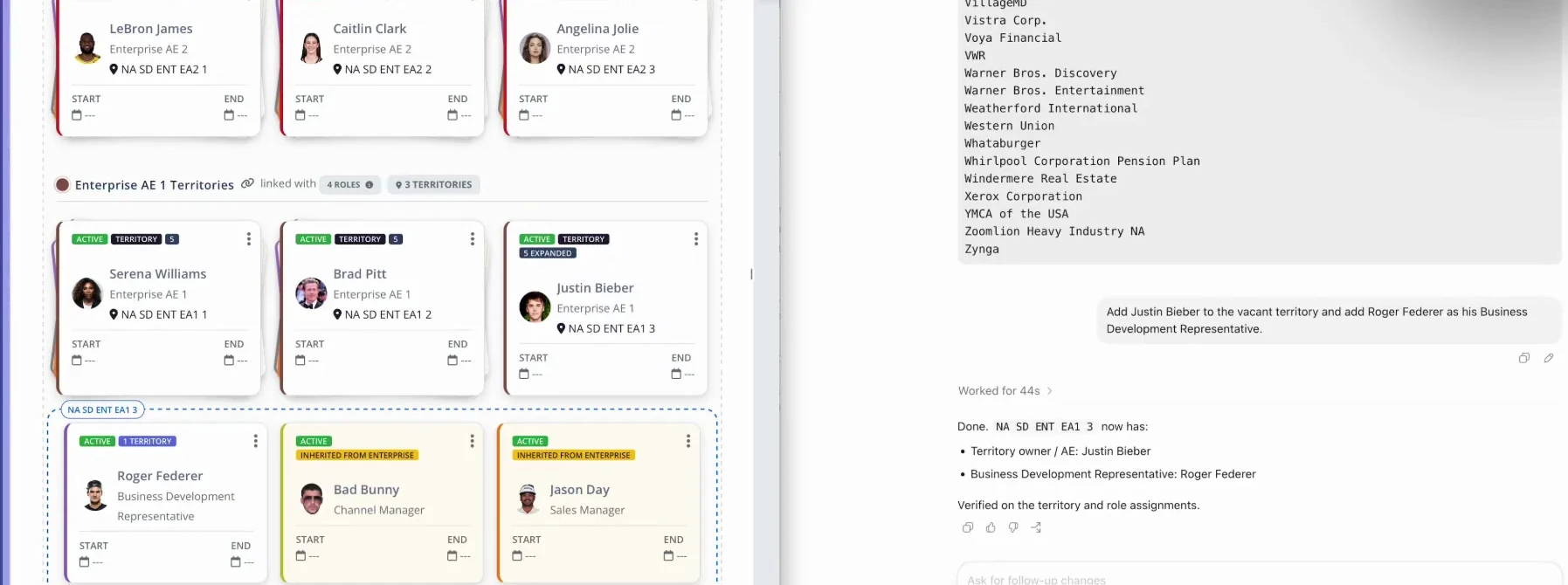
Codex applies a natural-language territory instruction and returns the updated role-assignment model for review.
BoogieBoard's Codex workflow can fill vacant AE and BDR seats inside an existing territory hierarchy. That is the benefit of separating durable coverage from the current roster: an ordinary personnel change does not require the company to redesign its market.
Coverage Plan vs. Related Planning Systems
| System | Primary questio | Example output |
|---|---|---|
| Coverage pla | Who is responsible for what? | Markets, accounts, roles, and accountability |
| Capacity pla | How much productive coverage will we have? | Headcount, ramp, productivity, vacancies |
| Territory pla | How should the account universe be organized? | Territory hierarchy and assignments |
| Quota pla | What performance expectation fits each role and patch? | Quota by role or territory |
| Rules of Engagement | How will the model operate as conditions change? | Transfer, exception, split, and escalation policy |
The systems overlap but should not be collapsed. Capacity supplies inputs. Territory planning designs the structure. The coverage plan defines responsibility across that structure. Quota follows territory potential. Rules of Engagement preserve the model.
A coverage plan is therefore more than a roster or map. It is the company's explicit promise about accountable market and customer coverage.
How This Affects Your Territory
A coverage plan is useful to you only when it becomes concrete. You should be able to see your primary territory, supporting roles, account eligibility, priorities, customer obligations, and the rules for changes.
Several specialist terms matter because they change your daily work:
- Serviceable market means the accounts the company can realistically pursue or serve after product, segment, geography, regulatory, and capacity limits are applied.
- Account hierarchy means the parent-child structure connecting related companies. It determines whether you coordinate one corporate relationship or treat local entities independently.
- Balance Goal means a measurable design objective, such as comparable high-fit account counts or customer workload.
- Territory Health means the measured condition of your complete book against those goals.
- Enterprise Territory Management is Salesforce's native framework for territory models, hierarchies, account associations, rules, and user assignments.
Those definitions let you ask whether the operating system reflects the strategy instead of treating CRM fields as the whole plan.
Questions to Ask Your Manager
- Which accounts and customer motions am I accountable for?
- Which supporting roles can access the same accounts, and who makes the final decision?
- What makes an account eligible for my territory or excluded from it?
- Which Balance Goals define a workable book for my role?
- How are live opportunities, near-term renewals, and strategic relationships protected during change?
- Where do I report a data defect, ask a policy question, or request an exception?
If the answers depend on private manager memory, the coverage plan is not fully operational.
A Worked Coverage Example
Consider a software company with Enterprise AEs, BDR support, CSMs, and industry specialists. The strategic plan defines Enterprise by a governed employee threshold, keeps global parent families coordinated, and assigns named high-potential accounts. BDRs support AE territories at a documented ratio. CSMs own customer adoption, while AEs retain new-business responsibility and specialists join only for qualified industries.
The operational plan represents durable territories in Salesforce, maps each role to the appropriate account fields or territory objects, and publishes how leads, opportunities, customers, and future hires are handled. Account locks protect late-stage opportunities and near-term renewals. The company compares future Scenarios before changing live ownership.
For you, the important output is not the architecture diagram. It is a territory view that explains which accounts are yours, why they are priorities, which roles share them, what stayed protected, and when the new assignments take effect.
What Sellers Should Watch During Coverage Changes
Coverage plans are most visible when someone joins, leaves, changes roles, or when the company enters a new market. During those events, confirm:
- whether your quota or performance period changes with the account assignment;n- whether open opportunities follow a holdover policy;n- who maintains customer contact during temporary coverage;n- when CRM access, routing, and reporting will match the announced plan;n- whether transferred account context and activity history are complete;n- when temporary assignments will be reviewed.
Do not accept "the system will update" as the whole change plan. A controlled transition needs an effective date, named owners, account-level review, and a reconciliation after deployment. If the CRM and the announced plan disagree, sellers need one authoritative place to report the mismatch.
Your responsibility is to work the approved coverage model and surface evidence when it fails. The company's responsibility is to make the model viable, explainable, and governed. That shared standard protects seller focus and customer continuity through ordinary change.
How to Evaluate the Plan You Receive
Use three tests. First, clarity: can you identify your accounts, priorities, supporting roles, and change rules without reconstructing them from several systems? Second, viability: does the book contain enough credible opportunity and an executable workload for your role? Third, continuity: are customers, live opportunities, and recent transitions protected through explicit policy?
Raise a concern with the evidence category attached. A wrong parent or segment is a data correction. An unclear holdover is a policy question. A request to keep an account outside the rule is an exception. That distinction helps the company respond quickly without turning every issue into a political renegotiation.
The plan should also state when it will be reviewed. Market evidence, capacity, and customer status change. A durable coverage model does not mean a frozen one; it means change follows a visible process and preserves the history.
Ask your manager to distinguish temporary coverage from the permanent model. A vacant seat may require you to support additional accounts for a defined period, but the plan should name the future owner, effective date, and workload or quota treatment. Without those details, temporary assignments can quietly become your new baseline.
Finally, confirm that the announced model and CRM agree. If your account view, routing, opportunity access, and reporting show different owners, use the published correction path. You should not have to choose which system to believe.
Bring any remaining gaps to your manager as direct questions. Which source defines your accounts? Who can work alongside you, and who decides when your priorities conflict? What happens to your pipeline if your territory changes? How will your workload and quota be reviewed together? When will your temporary coverage end? You should leave with answers you can use in your daily work, not a diagram of the system that created them.
Frequently Asked Questions
How does a sales coverage plan work?
It defines the serviceable account universe, coverage model, territory hierarchy, role responsibilities, health measures, assignment rules, and change governance, then operationalizes them in the CRM.
Who owns the coverage plan?
RevOps commonly operates it, while Sales leadership owns market and role decisions, Finance contributes capacity and quota constraints, and Business Systems governs CRM implementation.
What makes a good coverage plan?
It is aligned with strategy, explicit about responsibility, measurable through Territory Health, viable against capacity, understandable to sellers, and governable as people and accounts change.
How often should a coverage plan be reviewed?
Monitor coverage continuously, review health during the year, and reassess the full model during annual planning or after a material strategy, product, market, or headcount change.
About the author: Kevin Davis is Co-Founder & CEO of BoogieBoard.
In summary: A coverage plan defines accountable responsibility across markets, accounts, and roles. Start with coverage requirements, then design equity and governance around them.
Watch territory planning in action
See territory hierarchy, role, vacancy, and scenario workflows on BoogieBoard's YouTube channel.
Customer proof: Fundraise Up would not commit to a hiring plan until it had clear account coverage. BoogieBoard helped the team visualize alternatives and move from coverage uncertainty to an executable plan (read the Fundraise Up case study).