5 Key Takeaways
- An account split is a rule for dividing coverage, responsibility, or credit across multiple sellers; those are three different decisions.
- Resolve global-versus-local and parent-versus-child ownership before calculating percentages. Most split disputes begin as hierarchy disputes.
- Even, percentage-based, and tiered models can all work when the triggering event, eligible roles, duration, and approval authority are written down.
- Salesforce can represent territories and multiple assigned users, but the organization still has to define the Rules of Engagement that govern shared work.
- The best model serves the customer hierarchy first, then makes internal crediting consistent with that coverage design.
Account splits are often introduced as commission math: two people contributed, so divide the credit. In territory planning, the harder question comes first: which account, buying center, geography, or legal entity was each person responsible for?
A global parent may negotiate centrally while local subsidiaries buy separately. An AE may own the opportunity while an account manager owns the customer relationship. A partner seller may create the path to the deal without owning either record.
If the account hierarchy and role model are ambiguous, a precise percentage only makes the disagreement look settled.
What Is an Account Split?
An account split is a documented rule for sharing one or more of the following:
- Coverage: who is expected to work the account or part of the account family
- Responsibility: who owns specific activities, relationships, regions, products, or stages
- Credit: how bookings, revenue, quota attainment, or compensation credit is allocated
These layers should connect, but they should not be collapsed. Territory assignment answers where a role is responsible. Opportunity and revenue credit answer what contribution is recognized. Compensation answers how the recognized contribution is paid.
Start by naming the unit being split: ultimate parent, legal entity, location, buying center, opportunity, product line, or revenue stream.
The participants may include a global account owner, local account owner, account executive, account manager, BDR, solutions consultant, partner manager, or channel partner. Each role should receive a split only for a defined responsibility or contribution. A title by itself is not a split rule.
Salesforce represents real-world company structures through the Parent Account field and account hierarchies (Salesforce Account Hierarchy documentation). D&B's Corporate Linkage product separately distinguishes the direct line to a global ultimate from a full family tree of related entities (D&B Corporate Linkage documentation). Those are useful reminders that "the account" may be a multi-level data structure before it becomes a coverage decision.
How to Calculate an Account Split: The Core Formula
For a percentage-based model:
Individual credited amount = eligible amount x approved split percentage
The formula is simple. Defining the eligible amount and approved percentage is the real operating work.
Step 1: Establish the total eligible amount
Decide whether the split applies to total contract value, annual contract value, booked revenue, recognized revenue, expansion value, or another measure. Also define exclusions such as services, pass-through costs, renewals, or partner-sourced revenue.
Step 2: Apply each participant's approved share
The shares should total 100% unless the plan explicitly permits overlay credit above 100%. Document whether the split is permanent for the account, limited to one opportunity, or expires after a transition period.
Worked example
A U.S. enterprise AE owns the global parent and commercial negotiation. A German AE owns the subsidiary relationship and local buying process. A $300,000 eligible opportunity is approved at 60% global and 40% local.
| Participant | Basis | Split | Credited amount |
|---|---|---|---|
| Global AE | Parent relationship and commercial lead | 60% | $180,000 |
| Local AE | Subsidiary access and local execution | 40% | $120,000 |
The table is not the policy. The policy must also say who approves the split, when it becomes final, which CRM records hold it, and what happens if the opportunity expands into another country.
Common Account-Split Models
Even split
An even split gives each eligible participant the same share. It is useful when contributions are genuinely equivalent or when measuring contribution would cost more than the precision is worth.
The risk is false equality. A 50/50 default can become a substitute for defining ownership, especially in global account families.
When it is used: Two sellers share the same account family or transition responsibility and their expected work is genuinely equivalent.
Example: Two regional AEs jointly cover a $200,000 opportunity spanning their territories. With an approved 50/50 credit split, each receives $100,000 of credited amount. The agreement should still name one commercial lead and one customer-facing escalation owner.
Percentage-based split
A percentage model allocates credit according to documented contribution or responsibility. It supports nuanced coverage but creates negotiation overhead when the evidence and approval process are weak.
Use a small set of permitted bands, such as 75/25, 60/40, and 50/50, rather than inventing a bespoke percentage for every deal.
When it is used: Contributions or durable responsibilities are unequal but both are necessary. A global owner may lead pricing and executive alignment while a local owner manages procurement, implementation contacts, and the legal entity.
Example: On a $400,000 eligible opportunity, a 70/30 global-local split produces $280,000 and $120,000 of credited amount. If the underlying buying process later moves fully to the local entity, the policy should say whether the split changes or remains fixed for that opportunity.
Tiered or graduated split
A tiered model changes the split based on stage, source, time, or value. For example, a transition owner may receive 50% on opportunities already qualified, 25% on early-stage pipeline, and no credit on opportunities created after the transition date.
This is particularly useful after territory changes. It protects legitimate in-flight work without turning every moved account into permanent dual ownership.
A graduated model can also improve the retained share as responsibility deepens. For example, a supporting seller might receive 20% for sourced pipeline, 35% after completing discovery and stakeholder mapping, and 50% after becoming the approved co-owner. Define the measurement event in CRM fields rather than relying on retrospective judgment.
Note: Credit Can Be Based on Revenue, Profit, or Another Measure
The split percentage and the eligible base are separate. A 60/40 split applied to annual contract value produces a different result from the same split applied to gross profit, first-year revenue, or recognized revenue. Publish both parts of the formula.
Account Splits by Coverage Model: Practical Cases
Global parent and local subsidiary
The parent owner governs the enterprise relationship, while local owners cover buying centers or legal entities. Before creating a split, decide whether the customer buys centrally, locally, or both.
BoogieBoard benchmarks show why this becomes an enterprise issue: 60-85% of large-company account populations participate in a corporate-family relationship, compared with 5-15% in small-company populations. At the same time, parent relationships are missing on 25-55% of accounts that should have one. The split process must include hierarchy validation.
Example: A global parent signs a $600,000 master agreement, while three regional subsidiaries each control deployment. The global AE receives 50% of eligible credit for the commercial agreement. The remaining 50% is divided among the three local owners according to deployed value: 25%, 15%, and 10%. The percentages are calculated on the same eligible amount, total 100%, and are attached to the opportunity rather than forced into account ownership.
New business and customer expansion
An AE may open the account, while an AM owns expansion after handoff. Define the handoff event and whether open opportunities remain with the original owner. A date alone is weaker than a status rule tied to opportunity stage, renewal window, and customer continuity.
Example: An AE closes a $150,000 new-logo contract and receives full new-business credit. A $60,000 expansion is already qualified when the account transitions to the AM. The holdover policy gives the AE 40% and the AM 60% on that expansion, producing $24,000 and $36,000 of credited amount. Expansions created after the transition window belong fully to the AM.
Partner and direct seller
The partner role may source, influence, or transact the deal. Each contribution should have a specific definition. "Partner involved" is not enough to support repeatable crediting.
Define whether partner participation changes account coverage, opportunity credit, compensation, or all three. A sourcing partner may justify a one-opportunity split without becoming a permanent role owner. A reseller that holds the customer contract may require a different account and revenue model.
Expert tip: Document the trigger, eligible roles, approved percentages, duration, record location, approver, and exception path. If one field is missing, the split will be renegotiated in the next edge case.
The Problem with Manual Account Splits and the Case for Automation
The governing principle is simple: serve the customer hierarchy first. Manual split administration often reverses that order. A percentage is negotiated in email, entered in a spreadsheet, and later used to justify account ownership. The team can no longer tell whether the number came from the customer structure, a durable policy, or a one-time compromise.
Manual processes create four risks:
- Accuracy: Eligible amount, percentage, and effective date can live in different files or fields.
- Efficiency: RevOps repeatedly reconstructs agreements when opportunities change stage, value, owner, or region.
- Transparency: Sellers see the final credit but not the policy or approval that produced it.
- Scalability: Parent-child relationships, overlays, transitions, and multi-party splits multiply faster than spreadsheet controls.
Automation should not invent the policy. It should enforce a policy the organization can explain:
- Identify the ultimate parent and relevant children.
- Determine where buying authority and relationships sit.
- Define the durable territories and role assignments.
- Decide which opportunities or revenue streams cross those boundaries.
- Apply the written split model only to the crossing point.
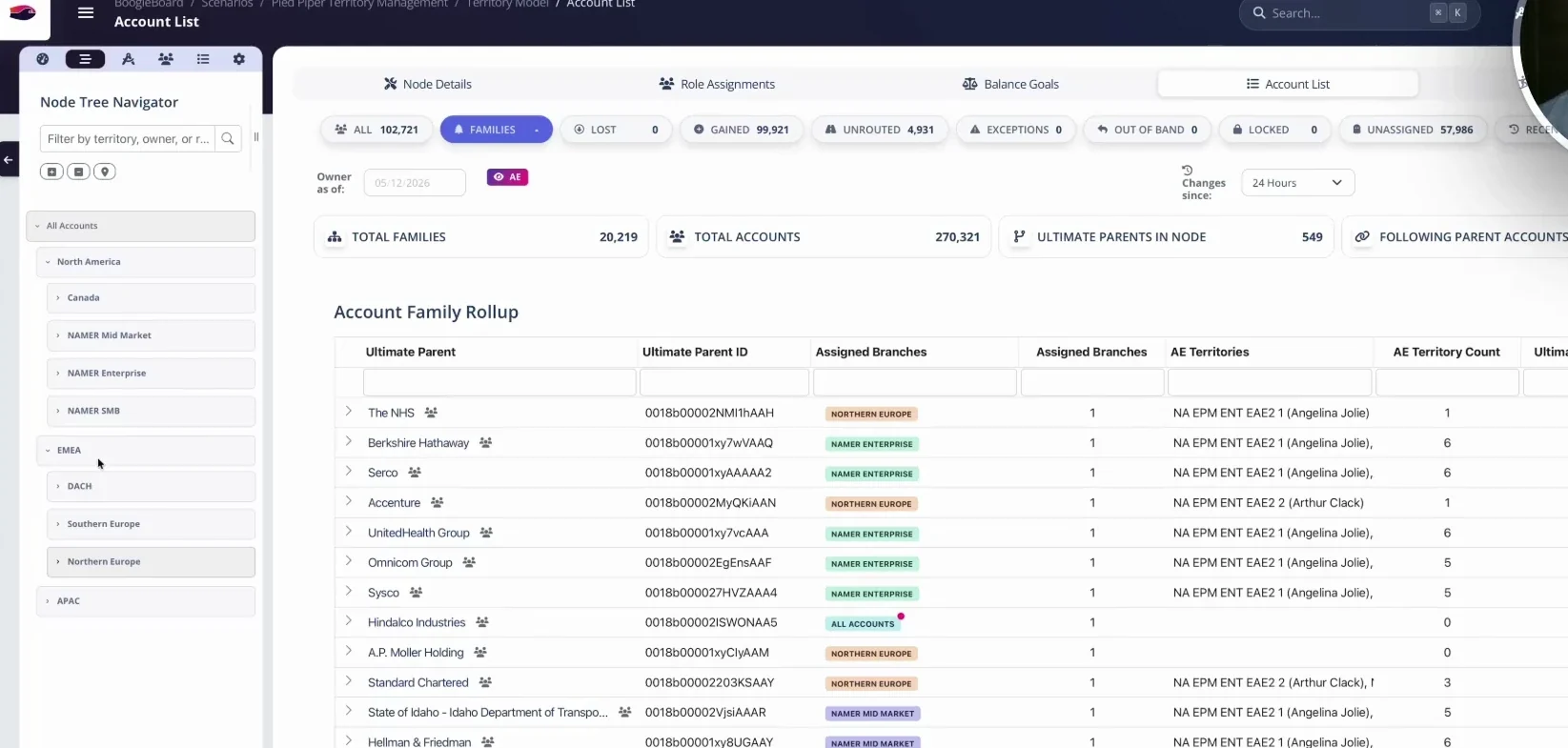
An account-family rollup keeps parent, child, and branch relationships visible during territory design.
BoogieBoard lets RevOps model parent-child relationships and assign several roles across the same account family. That keeps hierarchy, territory, and role logic visible before the team sends downstream crediting rules to Salesforce or compensation systems.
Salesforce's territory model supports a parent-child territory hierarchy and account/user assignments, and only one model is active at a time (Salesforce Territory Model documentation). The platform can store the model; your Rules of Engagement must still explain how shared accounts are worked.
A governed workflow keeps the active account hierarchy, proposed role assignments, account locks, split rationale, approver, and future state together. Operators can test the change before touching production and preserve the rejected scenario. That is the territory equivalent of Qobra's automated split calculation: the system makes the decision traceable and repeatable.
How to Negotiate and Govern an Account Split
- Know the customer and coverage facts. Bring the account hierarchy, buying centers, opportunity history, current roles, and documented contribution. The discussion should begin with the work and customer structure, not a preferred percentage.
- Research the internal standard. Compare the request with the approved models for global-local coverage, partner involvement, transitions, and expansion. Consistent bands are easier to govern than bespoke percentages.
- Understand what each party provides. A global owner may provide executive access and contracting leverage; a local owner may provide procurement access and implementation continuity. Name the value instead of relying on seniority or title.
- Negotiate beyond the percentage. The effective date, duration, eligible amount, account role, opportunity role, approval authority, and review point can matter more than moving from 60/40 to 65/35.
The later a split is discussed, the more it feels like a judgment about individual value. Set default rules during territory design and require exceptions before a defined opportunity stage. Keep assignment and credit fields separate: do not overwrite account ownership to force compensation credit.
Warning: Watch for Hidden Scope
Ask whether the split applies to one opportunity, every child account, all future expansion, renewals, services, or the entire account family. An apparently modest percentage becomes expensive and confusing when its scope or duration is undefined.
Track who approved the exception, why the default rule did not fit, and when the arrangement ends. Repeated exceptions reveal a territory or policy problem that should be fixed at the model level.
The Rules of Engagement template is the natural home for these definitions.
Account splits should make collaboration predictable, not make ownership negotiable. Begin with the customer structure, establish durable coverage, and use the simplest credit model that accurately reflects the crossing work.
The Minimum Account-Split Record
Every approved split should produce a durable record, not only a percentage in an opportunity. Capture:
- the account family and covered entities;
- the primary owner and participating roles;
- the eligible revenue, profit, opportunity, or responsibility being divided;
- each participant's percentage or tier and the effective dates;
- the business rationale and policy reference;
- the approver and approval date;
- renewal, expansion, and customer-communication ownership;
- review triggers, expiration, and superseded terms.
Reconcile that record with the CRM after activation. A split can be approved correctly and still fail operationally if an account association, role field, opportunity split, or reporting rule is missing. Review the account, opportunity, and corporate-family levels together.
For temporary arrangements, require an end condition. Examples include the receiving seller's ramp date, the close of a holdover opportunity, a renewal date, or completion of a customer handoff. Permanent ambiguity often begins as a temporary split with no review date.
Frequently Asked Questions
What is the difference between an account split and an opportunity split?
An account split describes shared coverage or responsibility across an account or family. An opportunity split allocates credit for a specific deal. One account can have stable shared coverage and different splits on individual opportunities.
Should account splits always total 100%?
Usually, yes. Some organizations permit overlay credit above 100%, but that should be an explicit compensation-policy choice with clear quota and cost implications.
Who should approve an account split?
Use the lowest authority that can apply the policy consistently, typically the relevant sales leaders with RevOps validation. Cross-region or exception splits may require a higher approver.
Can Salesforce manage account splits?
Salesforce can represent account, opportunity, team, and territory relationships, but configuration varies. Define the business policy first, then map each assignment and credit decision to the appropriate object or field.
About the author: George James is Co-Founder & CPO of BoogieBoard.
In summary: Account splits are hierarchy and coverage decisions before they are percentages. Define the unit, role, trigger, duration, and approval path, then calculate the credit.
Watch territory planning in action
See product walkthroughs and practical territory workflows on BoogieBoard's YouTube channel.