
5 Key Takeaways
- Sales Rules of Engagement define who can act, which evidence governs, and how ownership, collaboration, credit, and exceptions work across the revenue team.
- Define accounts and account families before writing assignment rules. Account ownership, opportunity responsibility, customer coverage, and compensation credit need separate decisions.
- Make every rule usable: name its scope, trigger, authoritative record, decision owner, effective date, exception path, and review condition.
- Test the policy against real conflicts before rollout. Include territory transfers, departing reps, partner claims, duplicate accounts, and automated routing failures.
- Give AI-assisted workflows explicit limits. Record the rule and evidence behind consequential changes, and route ambiguous cases to a named human decision-maker.
An inbound request arrives from a subsidiary. The parent belongs to an enterprise rep. A regional AE already has an open opportunity. A partner claims the introduction.
Who should contact the buyer?
If the answer depends on which manager responds first, your organization has an unwritten policy. Sales Rules of Engagement make that decision visible before the next conflict reaches the customer.
The goal is straightforward: two informed people should be able to apply the same rule to the same evidence and explain the result. Start with account definitions, work through ownership and handoffs, then document exceptions. Write the introduction last.
What are sales Rules of Engagement?
Sales Rules of Engagement, or ROE, are the internal policies that define how accounts, territories, leads, opportunities, customer relationships, and sales credit are handled. They establish decision rights, authoritative data, handoff conditions, and a process for resolving disagreements.
A sales process explains how work progresses. An ROE explains who may do that work, under which conditions, and who decides when rules collide.
Keep four questions separate: Who owns the account? Who runs this opportunity? Who supports the customer? Who receives credit? One person may fill several roles, but changing one role should not silently change the others. Link credit decisions to the governing compensation plan rather than inventing payout terms in a territory policy.
For a shorter reference, see the Rules of Engagement definition.
When should you write or refresh your ROE?
Build the first version when teams need a shared answer to recurring ownership questions. Refresh it before changing segments, territory assignments, roles, partner motions, lead routing, or the systems that execute those decisions.
New automation deserves the same review. If an enrichment service changes a company's employee count, should its segment change immediately? If an AI agent identifies a parent company, can it move the account? Decide those permissions before enabling the workflow.
Also review repeated exceptions. Ten requests for the same departure from policy may reveal a bad rule, stale data, or unclear training. Log the pattern and investigate it; approving requests individually hides the underlying problem.
Start with the free sales ROE template
Open the free BoogieBoard Rules of Engagement template. Make a copy and use it to assemble your organization's policy.
The original template provides the section checklist. Use this updated rule card inside each section to turn questions into operating decisions:
| Field | What to write |
|---|---|
| Scope and trigger | Covered accounts, roles, regions, and the event that activates this rule |
| Authoritative evidence | Exact system, record, field, timestamp, and precedence if sources disagree |
| Default decision | Who does what when the stated conditions are met |
| Effective period | Start date, time zone, expiry, and treatment of work already underway |
| Owner and approver | Who maintains the rule and who decides exceptions |
| Dispute path | Intake channel, required evidence, response target, and final arbiter |
| Implementation and review | System control, test case, change log, and next review trigger |
A rule such as “existing opportunities stay with the original rep” is incomplete. Define which stages qualify, the evidence cutoff, who handles new opportunities, and when the holdover expires.
The 14 sections to include in your sales ROE
Build the following sections in dependency order. Keep them in one searchable policy, with links to authoritative systems and a shorter field guide for sellers. Mark a section not applicable when the motion genuinely does not exist.
1. Account definition
Specify what counts as one account: a legal entity, purchasing unit, location, or another defined commercial unit. Identify the stable record ID and the process for creating, merging, or deactivating records.
Name the sources for employee count, revenue, industry, headquarters, billing location, customer status, account score, and owner. Include an annotated CRM record or field dictionary. Distinguish observed company attributes from internal classifications; an account score is a decision input, not an independently verified fact.
2. Account hierarchies
Explain how ultimate parents, subsidiaries, divisions, franchises, and locations relate to selling rights. A corporate relationship does not automatically establish one buying center.
Choose when ownership follows the whole family and when entities receive separate coverage. Document exceptions for holding companies, private-equity portfolios, franchises, and regional purchasing. Name the hierarchy source and who resolves conflicts. Define what happens after acquisitions, divestitures, and relocations, including whether changes take effect immediately or at the next planning boundary.
3. Territories and target account lists
Define how accounts enter territories and target account lists, who can add or remove them, and how vacancies or role changes affect coverage. Explain responsibilities for BDRs, AEs, AMs, CSMs, overlays, and solution engineers. Separate access to a record from authority to pursue it.
For territory design, establish the high-level hierarchy and segments first. Then define Balance Goals: the measures of opportunity, workload, quality, or continuity used to judge the design. Next define Account Locking Criteria, apply qualifying locks, and model the remaining movable book. Evaluate complete resulting territories, including locked accounts. If continuity creates residual imbalance, disclose that tradeoff.
4. Segments, regions, and industries
Publish thresholds, source fields, boundary cases, and refresh timing. For each cutoff, show which segment owns the exact boundary value. Identify whether geography follows headquarters, operating location, billing address, or buying center.
Specify when a changed attribute becomes a changed assignment. A data refresh during an active sales cycle should follow a published transition rule rather than accidentally transferring coverage overnight.
5. Opportunity management
Define when an opportunity can be created, required qualification evidence, stage entry and exit criteria, and the treatment of duplicates, stalled deals, reopened opportunities, and expansion.
Record the opportunity owner, supporting roles, and credit policy separately. State who can change each and how the decision is logged. An activity timestamp may establish work performed; it does not, by itself, establish permanent account ownership or commission entitlement.
6. Holdovers, transfers, and splits
Define the event that transfers customer coverage from acquisition to account management. Specify the effective date, required handoff information, customer introduction, and receiving owner's acknowledgement.
Define new-logo, existing-customer, and churned-customer treatment explicitly so reactivation and expansion do not depend on a rep’s interpretation.
For open opportunities, publish holdover eligibility, evidence cutoff, expiry, approver, and extension conditions. Explain what happens when a rep leaves or a deal slips beyond its protection period. Reference approved split-credit rules without assuming account transfer and credit transfer are identical.
Salesforce's territory-maintenance guidance advises caution around moving accounts with late-stage opportunities and emphasizes advance communication. Use that principle to design continuity rules; it does not prescribe a universal holdover duration.
7. Leads and lead routing
Publish the order in which routing rules apply. Address existing customers, matched named accounts, active opportunities, partner referrals, and unmatched leads. Define when a BDR qualifies a request and when it goes directly to an AE or account team.
For round-robin routing, identify eligibility, capacity, working hours, absence coverage, acceptance deadlines, and reassignment conditions. Send ambiguous matches to an owned queue. A record with two plausible account matches needs a resolution path, not a random assignment.
8. Partners and reseller motions
Distinguish referral, co-sell, reseller, and other supported motions. Define registration evidence, protection periods, expiration, partner-manager responsibilities, and the treatment of an existing direct opportunity.
Publish how competing claims are evaluated. Decide who communicates with the customer while the dispute is open. Link compensation treatment to the approved partner agreement and credit policy so internal coverage rules do not create contradictory promises.
9. Data disputes and exceptions
Create one intake path with required record IDs, the disputed rule, supporting evidence, and requested outcome. Name the resolver, response target, escalation owner, and temporary coverage arrangement.
Classify requests before deciding them. A correction fixes inaccurate evidence. An exception permits different treatment for a specific case. A policy change changes the standard for a population. Give exceptions expiry or review conditions, and retain the decision rationale. See the territory-dispute guide for the broader operating process.
10. RFP response
Name the owner of a request for proposal, qualification criteria, go/no-go decision-maker, contributors, and review deadlines. Include partner-led requests and opportunities spanning regions or account families.
State whether responding establishes ownership or merely assigns responsibility for that response. An urgent deadline should not settle an unresolved account claim by accident.
11. President's Club and recognition
Link to approved eligibility rules, measurement periods, credit definitions, and treatment of transfers, promotions, and leave. Name the owner for interpretation questions.
Avoid creating a second performance calculation inside the ROE. Finance, People, and the relevant policy owners should resolve inconsistencies between recognition criteria and the governing compensation or employment documents before launch.
12. Annual and quarterly planning calendar
Work backward from the effective date. Show data validation, account tiering, holdover requests, territory decisions, capacity and quota planning, compensation communication, manager preparation, system activation, and sales kickoff.
For each milestone, name an owner and dependency. A seller announcement needs an approved policy and a reliable account view. A system change needs a tested configuration and an operating support path.
13. Resources and references
Link the territory roster, account field dictionary, compensation policy, routing specification, stage definitions, partner policy, request forms, account-planning guidance, and change log.
Use authoritative links instead of copying values that will drift. Give sellers a short “where do I go?” index for ownership questions, data corrections, holdovers, and exceptions. Assign someone to maintain that index and replace broken destinations.
14. Introduction and document controls
Write this section last and place it first. State purpose, scope, policy owner, contributors, approvers, version, effective date, review cadence, and escalation authority.
Preserve prior versions. Record which rule governed an event at the time it occurred. A changed webpage should not erase the basis for an earlier decision. Summarize material changes so managers can explain what their teams need to do differently.
Worked example: a territory transfer with an open opportunity
Consider an illustrative policy for a subsidiary moving from Enterprise to Commercial on October 1. The current AE has an active opportunity; the new territory owner will handle future business.
The sample rule protects opportunities that reached proposal stage by September 30 at 5 p.m. Central Time and have a documented customer next step. Protection expires October 31 unless the designated approver grants a recorded extension. These dates and criteria illustrate a policy choice, not a recommended industry standard.
| Decision | Application of the sample rule |
|---|---|
| Account coverage | Commercial becomes primary on October 1 |
| Existing qualifying opportunity | Current AE continues through the approved holdover period |
| New opportunity | Commercial owns it, subject to the published collaboration rules |
| Incoming buyer inquiry | Check whether it belongs to the protected opportunity before routing |
| Sales credit | Apply the governing compensation policy; do not infer credit from the new account owner |
| Expiry or slippage | Review before October 31; record extension or execute the defined handoff |
RevOps retains the opportunity ID, stage evidence, next step, approver, and policy version. The customer receives one coordinated contact plan.
Now test a variation: the rep moved the opportunity to proposal stage on October 2. It fails the published cutoff. The rep can request an exception, but cannot silently backdate eligibility. That distinction makes the rule usable under pressure.
How to test and launch your ROE
- Collect existing decisions. Inventory written policies, system rules, and recurring manager judgments. Identify conflicts before drafting new language.
- Complete the foundation. Resolve account definitions, hierarchy treatment, segments, and role responsibilities before writing routing or transfer logic.
- Test difficult cases. Include a disputed parent, duplicate account, rep departure, late-stage transfer, partner claim, and unmatched inbound request. Ask two operators to apply the rules independently.
- Reconcile policy and configuration. Compare expected outcomes with the planned CRM, routing, and territory settings. Salesforce's design guidance includes reviewing assignments before activation; use that review to catch differences between your written policy and system behavior.
- Prepare managers and activate. Approve the version, explain changes, confirm the effective time, and provide account-level handoff information. Use the territory-plan communication guide to organize the rollout.
- Review operating evidence. Inspect unresolved disputes, expired exceptions, failed routes, and repeated manual overrides. A quarterly review is a useful starting cadence, with earlier review after material changes.
Define success operationally: can sellers find the rule, can managers explain it, and does the live assignment match it? Track exception age and repeat dispute categories to identify where maintenance is needed.
Add rules for AI-assisted sales workflows
If AI proposes account matches, enrichment, routing, or reassignment, document its authority alongside the human roles.
Separate suggesting, approving, and executing a change. A suggested account family should not automatically override a verified hierarchy, active holdover, or account lock.
For consequential automated changes, require an inspectable record of the inputs, rule version, proposed action, and result. Define when missing or conflicting evidence sends work to human review. Name the person who owns the exception queue and the method for reversing an incorrect change.
Test automation against the same edge cases as human operators. A faster decision is only useful when it follows the policy your organization actually approved.
Put territory rules into practice with BoogieBoard
The ROE defines the policy. The planning and operating systems need to make its effects visible.
BoogieBoard's territory management platform supports reviewing account additions and removals, historical assignments, segmentation changes, role overlays, and CRM sync rules. Those capabilities give operators a practical place to inspect territory changes and compare them with the policy's intended outcome.
Use that visibility to check whether a transfer changed the intended role, whether the right account population moved, and whether a discrepancy needs investigation. Keep the policy version and exception rationale in your governed records. Territory software does not replace the organization’s decisions about compensation, partner rights, or who can approve a departure from the rule.
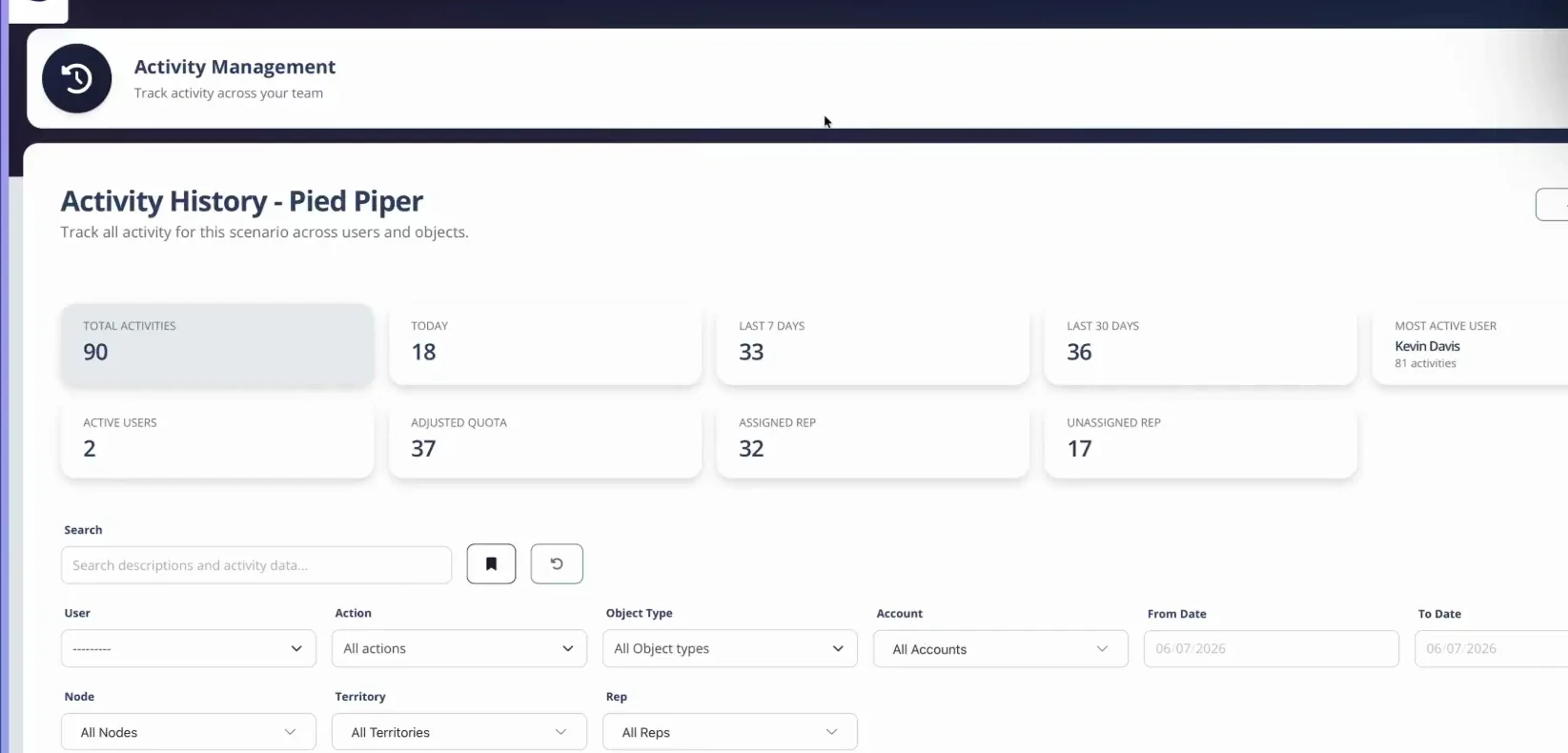
BoogieBoard Activity History showing territory changes by user and time
Activity History provides a record of territory actions by user and time.
Frequently Asked Questions
Who should own sales Rules of Engagement?
Assign Sales Ops or Revenue Ops as the document owner, with named owners for routing, customer handoffs, partnerships, and credit policy. Sales leadership should approve decision rights and resolve policy tradeoffs. One coordinator keeps the document coherent; section owners keep individual rules accurate.
How often should the ROE change?
Review quarterly and after significant changes to coverage, roles, systems, or the selling motion. A review does not require a rewrite. Change rules when evidence warrants it, preserve the previous version, and communicate effective dates before teams operate under new terms.
Does account ownership determine opportunity ownership?
Your policy must specify the relationship. An account can transfer while an eligible opportunity remains temporarily with the prior AE. Document the opportunity ID, protection conditions, expiry, customer contact plan, and treatment of new opportunities so the exception stays bounded.
Can AI decide which rep gets an account?
Only within the authority your organization explicitly grants the workflow. Define eligible inputs, rule precedence, review triggers, and reversal procedures. Treat unresolved identity, hierarchy, or protection conflicts as review cases rather than assuming a confident recommendation is sufficient evidence.
Is an ROE the same as a compensation plan?
No. The ROE explains operating responsibilities and points to the policy governing credit. The compensation plan governs payment terms. Keep the documents consistent, and have the responsible owners resolve contradictions instead of deriving a payout from a CRM owner field.
Should the policy live in a document or the CRM?
Keep a readable, versioned policy where the team can find it, and link it to the systems executing individual rules. Include a quick-reference guide and an escalation path. The practical test is whether a seller can find the answer and an operator can verify the implementation.
See territory planning in practice
Explore workflows on the BoogieBoard YouTube channel, or schedule a live demo to discuss your territory operating model.