5 Key Takeaways
- The category exploded from a handful of tools to a crowded matrix in ten years. Most of it is mapping software wearing a planning label.
- A territory stack combines source data, CRM execution, planning and scenario modeling, analytics, and activation; a mapping product covers only the visualization portion of that architecture.
- Inventory each tool by operating job, assign one authoritative owner to every field and decision, preserve Salesforce as the execution system of record, and require the planning layer to compare scenarios, roles, rules, exceptions, approvals, and account-level changes.
- Best-of-breed tooling creates integration and stewardship work, while a single-suite approach reduces connections; neither is acceptable if ownership, identifiers, effective dates, and correction paths remain undefined.
- The architecture fails when mapping software wears a planning label but cannot represent roles, vacancies, locks, scenario assumptions, approvals, deployment, or an audit trail.
The category exploded from a handful of tools to a crowded matrix in ten years. Most of it is mapping software wearing a planning label. That position is useful only when the planning team can translate it into inputs, decisions, controls, and a result the field can understand.
BoogieBoard treats the RevOps territory tooling architecture as part of a governed change process. The model must connect market strategy with account-level evidence, productive capacity, explicit decision rights, and controlled activation. The objective is not to remove judgment. It is to make judgment visible and repeatable.
The central position is: Most territory design still happens like it's 1995. The sections below turn that position into definitions, alternatives, procedures, examples, controls, and an operating decision.
Working Definitions
- Scenario: one complete current-state or proposed territory design.
- Balance Goal: a measurable objective for healthy opportunity, quality, workload, or continuity.
- mapping tool: software that visualizes locations or boundaries without necessarily modeling territory rules, roles, scenarios, and activation.
- territory-based model: a coverage model in which the territory persists while people rotate through assigned roles.
- Salesforce Sync: the controlled exchange of approved territory structure and assignments with Salesforce.
BoogieBoard has observed organizations budgeting roughly $120,000 to $180,000 annually for a territory-planning specialist. That is an observed operating range, not a universal salary benchmark or an invented software ROI claim. For the revops territory tooling architecture, use that observation only for the claim and population it directly supports.
Independent evidence provides a separate check for the revops territory tooling architecture: Salesforce's Sales Territories implementation guide documents territory models, hierarchies, assignment rules, user assignments, account assignments, and activation as distinct parts of the operating architecture.
What Is The RevOps Territory Tooling Architecture?
A territory stack combines source data, CRM execution, planning and scenario modeling, analytics, and activation; a mapping product covers only the visualization portion of that architecture. Separate market data, planning logic, and execution records. Source systems describe accounts, the planning layer evaluates complete scenarios, and Salesforce operates the approved model. When those responsibilities blur, the revops territory tooling architecture creates conflicting truths, duplicate fields, and assignments that cannot be explained later. In the RevOps territory tooling architecture, test the choice against Balance Goal, then record any accepted exception in the decision log.
The RevOps territory tooling architecture is an operating decision across data, territory structure, roles, assignments, and activation. Scenario, Balance Goal, and mapping tool must refer to durable records and published rules rather than a temporary person field. The result should tell the team which system owns each fact, how proposed changes are tested, and when an approved state becomes live. The the RevOps territory tooling architecture review is complete only when mapping tool and the affected account roster tell the same story.
Core Components: The RevOps Territory Tooling Architecture
Inventory each tool by operating job, assign one authoritative owner to every field and decision, preserve Salesforce as the execution system of record, and require the planning layer to compare scenarios, roles, rules, exceptions, approvals, and account-level changes. A complete architecture needs stable account identifiers, a current-state baseline, durable territories, explicit roles, repeatable assignment rules, exceptions, effective dates, and an activation record. Scenario, Balance Goal, and mapping tool should connect those elements without turning the current owner into the model itself. The the RevOps territory tooling architecture review is complete only when mapping tool and the affected account roster tell the same story.
Document system responsibilities before configuring features. Name where account facts originate, where scenarios are modeled, where approvals are recorded, and where the live assignment is served to sellers. That division keeps Salesforce authoritative in execution without asking it to perform every planning calculation. Use one current-state baseline to keep every the RevOps territory tooling architecture scenario comparable.
Scenario: The Decision Test
The architecture fails when mapping software wears a planning label but cannot represent roles, vacancies, locks, scenario assumptions, approvals, deployment, or an audit trail. A practical test is to pick one surprising account and trace it end to end. Explain why it is in the segment, why it belongs in the territory, whether it is locked, which goals it affects, and what happens when the seller changes. If the answer requires several private spreadsheets, the model is not yet governed. Use one current-state baseline to keep every the RevOps territory tooling architecture scenario comparable.
Worked Example 1: A Decision You Can Reproduce
A governed stack may use Snowflake for account attributes, an enrichment provider for firmographics, BoogieBoard for current and future territory scenarios, Salesforce for live assignments and forecasting, and BI for downstream performance analysis. Assume Salesforce shows one owner, the warehouse contains updated employee count and hierarchy, and a planning scenario proposes a new territory and overlay role. Match the account with a stable identifier, preserve the live state, test the proposed assignments, and activate only the approved changes. The output includes the prior state, new state, reason, approver, and effective date. For the RevOps territory tooling architecture, name the approver, the permitted evidence, and the condition that would justify a departure from the rule.
Compare three states: the live Salesforce model, a low-disruption proposal, and a proposal that fixes the largest coverage gap. Review every account that changes territory or role. The chosen scenario becomes an approved deployment package; rejected alternatives remain available for audit and later review. Keep account-level results beside the the RevOps territory tooling architecture summary so Balance Goal remains inspectable after approval.
Scenario: The Decision Test: Review 5
Best-of-breed tooling creates integration and stewardship work, while a single-suite approach reduces connections; neither is acceptable if ownership, identifiers, effective dates, and correction paths remain undefined. The business consequence is clearest when a company cannot separate execution from starting conditions. If opportunity and workload are invisible, attainment becomes an ambiguous signal. A measured territory does not explain every result, but it gives leadership a defensible denominator for capacity, quota, and performance conversations. Keep account-level results beside the the RevOps territory tooling architecture summary so Balance Goal remains inspectable after approval.
Worked Example 2: A Decision You Can Reproduce
For Worked Example 2: A Decision You Can Reproduce, show the prior state, proposed state, reason, and effective date. Use Balance Goal to test whether the live state, future scenario, and approved Salesforce result remain consistent; record exceptions instead of hiding them in a person field.
Compare three states: the live Salesforce model, a low-disruption proposal, and a proposal that fixes the largest coverage gap. Review every account that changes territory or role. The chosen scenario becomes an approved deployment package; rejected alternatives remain available for audit and later review. Before activating the RevOps territory tooling architecture, show managers the effect on mapping tool and every downstream rule that depends on it.
Decision Note: Balance Goal
For Decision Note: Balance Goal, make the implicit policy inspectable at account level. Use mapping tool to test whether the live state, future scenario, and approved Salesforce result remain consistent; record exceptions instead of hiding them in a person field.
See Scenario Planning in the Planning Workflow
The relevant product workflow is Manage Territory Scenarios in BoogieBoard. BoogieBoard Scenario Planning keeps the account-level assumptions, tradeoffs, and proposed assignments visible while the team completes that work.
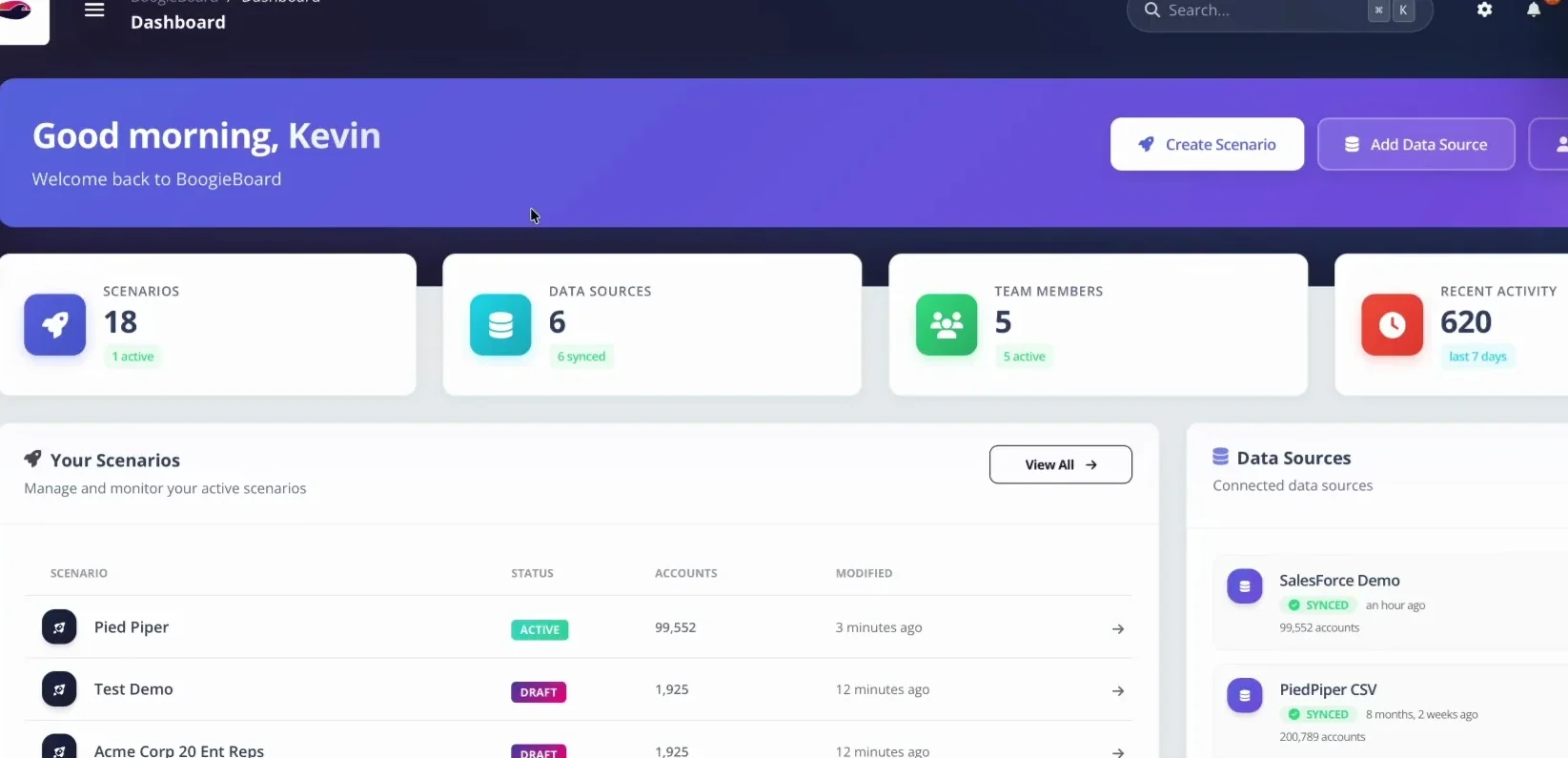
BoogieBoard keeps current and future territory scenarios separate so teams can model changes before activation.
Business and Field Consequences: The RevOps Territory Tooling Architecture
This decision affects more than visual symmetry. It changes market coverage, seller focus, quota credibility, customer continuity, performance interpretation, and the amount of manual administration required during the year. Poor design transfers work to managers and sellers, who then create informal rules to keep operating. For the RevOps territory tooling architecture, document the effect on Scenario before the model advances.
The business consequence is clearest when a company cannot separate execution from starting conditions. If opportunity and workload are invisible, attainment becomes an ambiguous signal. A measured territory does not explain every result, but it gives leadership a defensible denominator for capacity, quota, and performance conversations. In the RevOps territory tooling architecture, test the choice against Balance Goal, then record any accepted exception in the decision log.
Scenario: The Decision Test: Review 9
For Scenario: The Decision Test: Review 9, report both the summary result and affected account roster. Use Salesforce Sync to test whether the live state, future scenario, and approved Salesforce result remain consistent; record exceptions instead of hiding them in a person field.
Measure data reconciliation, assignment completeness, exception volume, change volume, vacancy coverage, and activation accuracy separately. For Scenario, Balance Goal, and mapping tool, report both the summary and the affected account roster so a clean dashboard cannot hide incorrect records. The the RevOps territory tooling architecture review is complete only when mapping tool and the affected account roster tell the same story.
mapping tool: The Decision Test
For mapping tool: The Decision Test, make the implicit policy inspectable at account level. Use Scenario to test whether the live state, future scenario, and approved Salesforce result remain consistent; record exceptions instead of hiding them in a person field.
territory-based model: The Decision Test
For territory-based model: The Decision Test, make the implicit policy inspectable at account level. Use Balance Goal to test whether the live state, future scenario, and approved Salesforce result remain consistent; record exceptions instead of hiding them in a person field.
How to Put RevOps Territory Tooling Architecture Into Practice
How to Put RevOps Territory Tooling Architecture Into Practice should produce one inspectable Salesforce decision before the process advances. Preserve the live state, validate identifiers and roles, model the proposed state, review account-level changes, record approval, and activate on a defined date. A late exception should not silently rewrite the rule or the baseline. For the RevOps territory tooling architecture, name the approver, the permitted evidence, and the condition that would justify a departure from the rule.
Use current and future states side by side. Classify feedback as a data correction, policy exception, or preference, and preserve who made the decision. For the planning team, the practical test is whether another informed person can trace an active assignment back to the approved rule and scenario. Keep account-level results beside the the RevOps territory tooling architecture summary so Balance Goal remains inspectable after approval.
Decision Note: mapping tool
For Decision Note: mapping tool, connect the choice to seller, customer, and operating consequences. Use territory-based model to test whether the live state, future scenario, and approved Salesforce result remain consistent; record exceptions instead of hiding them in a person field.
Decision Worksheet
| Decision | Evidence to inspect | Control |
|---|---|---|
| Define the population | Scenario and comparable roles | Named data owner |
| Measure the current state | Balance Goal and mapping tool | Source date and baseline |
| Choose the tradeoff | Scenario comparison and complete Territory Health | Recorded approver |
| Activate the result | Account roster, changes, quota, and transition rules | Effective date and correction path |
Source of Truth and Identity Controls
Create a field-level source map for the revops territory tooling architecture. Name the authoritative system for account identity, hierarchy, segment, owner, territory, role, opportunity, and customer obligation. Reconcile records with a stable external ID, flag unmatched accounts, and prevent a local spreadsheet or custom person field from quietly becoming another golden record. Use Scenario as the account-level test for this control.
Current-to-Future Scenario Test
Preserve the live Salesforce configuration as a dated Current State Scenario before evaluating the revops territory tooling architecture. Build the proposed model separately, compare every changed account and role, and keep rejected alternatives available. Reviewers should see both the summary tradeoff and the exact records behind it. For Balance Goal, record the assumption that would cause the future state to change.
Approval and Exception Review
Classify feedback on the revops territory tooling architecture as a data correction, policy exception, or preference. Corrections update governed evidence; exceptions require a reason, owner, and expiry or review condition; preferences remain visible without silently changing the model. Name one Approver and use mapping tool to show which evidence that person considered.
Frequently Asked Questions
What tools do RevOps teams use for territory planning?
A territory stack combines source data, CRM execution, planning and scenario modeling, analytics, and activation; a mapping product covers only the visualization portion of that architecture. Best-of-breed tooling creates integration and stewardship work, while a single-suite approach reduces connections; neither is acceptable if ownership, identifiers, effective dates, and correction paths remain undefined. Use the published definitions and complete-territory result instead of relying on one universal benchmark.
Is mapping software the same as territory planning software?
Inventory each tool by operating job, assign one authoritative owner to every field and decision, preserve Salesforce as the execution system of record, and require the planning layer to compare scenarios, roles, rules, exceptions, approvals, and account-level changes. A governed stack may use Snowflake for account attributes, an enrichment provider for firmographics, BoogieBoard for current and future territory scenarios, Salesforce for live assignments and forecasting, and BI for downstream performance analysis. Publish the assumptions so another reviewer can reproduce the answer.
What data is required for the revops territory tooling architecture?
For the RevOps territory tooling architecture, assemble governed account data, current assignments, role capacity, and decision evidence for Scenario, Balance Goal, and mapping tool. Date the sources and publish the definitions so another reviewer can reproduce the result and separate a factual correction from a policy exception.
How often should the revops territory tooling architecture be reviewed?
Review the RevOps territory tooling architecture on the formal planning cadence and whenever the inputs behind Scenario, Balance Goal, and mapping tool change materially. Keep customer and pipeline ownership stable between reviews; reopen the model when strategy or new evidence changes the decision, not merely because a manager prefers a different assignment.
How should Salesforce and the planning layer divide responsibility?
For the RevOps territory tooling architecture, keep the governed source data behind Scenario, Balance Goal, and mapping tool in its approved system, compare current and future states in the planning layer, and operate only approved assignments in Salesforce. Stable identifiers, field ownership, and a dated sync prevent competing records of truth.
How should territory changes be tested before activation?
Changes to the RevOps territory tooling architecture should be tested by freezing the live Salesforce state, validating the inputs behind Scenario, Balance Goal, and mapping tool, modeling the proposed future scenario, inspecting account-level differences and exceptions, and recording approval. Activate on a defined date and reconcile the deployed result to the approved scenario.
About the author: Kevin Davis is Co-Founder & CEO of BoogieBoard.
In Summary
The category exploded from a handful of tools to a crowded matrix in ten years. Most of it is mapping software wearing a planning label. Use the sequence above to keep the decision governed, evidence-based, and inspectable at both the account and territory levels.
See Territory Planning in Practice
Watch practical territory-design workflows on the BoogieBoard YouTube channel.