5 Key Takeaways
- Start by separating three problems: multiple names for one account, related entities that share buying decisions, and subsidiaries that buy independently. Each needs a different output.
- Use existing account IDs, parent fields, and licensed corporate-linkage data first. Preserve the distinction between a direct parent and an ultimate parent.
- Domain and name similarity generate candidates. A shared website, high fuzzy score, or larger employee count cannot establish a parent-child relationship on its own.
- Use AI to classify candidate pairs and research subsidiaries with unrelated names. Require evidence, structured outputs, and an unresolved option instead of forced answers.
- Reconcile proposals before changing CRM records or territories. Keep legal relationships, buying-center decisions, and coverage policies separate so a hierarchy correction does not silently reassign accounts.
I've tackled parent-child account hierarchies several times. The right approach depends on the size, quality, and complexity of the account list. A process that works for a few thousand well-maintained records can struggle with a multinational database full of aliases, missing identifiers, and acquisitions.
The most useful starting point is to separate the problems hiding inside the phrase “fix our hierarchy.” You may need to reconcile names, establish corporate relationships, or decide which entities should share sales coverage. Those are different decisions.
Here is one method for doing the work: five passes that combine fixed matching rules with AI-assisted classification and research. It requires someone who understands the data and can build and maintain the processing workflow.
Why account hierarchy cleanup becomes a sales problem
An alias counted as another prospect inflates the addressable account list. A subsidiary automatically rolled into its parent can disappear from a rep's book even when it buys independently. Two unrelated businesses with similar names can become one “family” that nobody can explain.
The operational cost comes later: duplicate outreach, disputed coverage, misleading account counts, and manual exceptions during territory planning. Faster matching helps only if the output represents the relationships the business actually needs.
Separate three issues before choosing a matching technique
1. Different names for the same account. A renewal, expansion, import, or naming change can produce several labels for one entity. Identify a primary account and retain secondary names as aliases. Use the canonical record for planning counts while preserving the original IDs and transaction links. Similar names alone do not justify a merge.
2. Related entities that share a buying center. A buying center is the group that evaluates, funds, and approves a purchase. Regional subsidiaries or shared-services entities may purchase through the same operating company. Capture the legal parent relationship and the shared-services function separately. Then confirm whether the relevant product is purchased centrally before keeping the accounts under common coverage.
3. Subsidiaries that operate and buy independently. A holding company may own businesses with distinct brands, budgets, and decision-makers. Preserve the corporate link and record operating independence. These companies may belong in different territories even though they share an ultimate parent.
These are practical sales-data categories, not a complete corporate taxonomy. Buying independence can vary by product, region, or purchase size. Leave it unknown when the evidence does not answer the question.
What this method produces
An account hierarchy records relationships between entities. A coverage policy determines how your team serves them. Keep both visible without forcing them into one parent field.
D&B's ownership documentation distinguishes parent, subsidiary, headquarters, and global-ultimate roles. Its Global Family Tree documentation describes tracing an entity to its ultimate parent. Those corporate relationships provide useful evidence; they do not establish where a customer makes purchasing decisions.
Build six stages around the matching passes: preserve a source snapshot, normalize identifiers, generate candidates, evaluate evidence, reconcile and approve, then export and monitor. RevOps owns the definitions; a data owner maintains the pipeline; sales stakeholders resolve buying-center questions.
Store the accepted output in fields that downstream planning can use:
| Field group | Minimum useful output |
|---|---|
| Identity | Source-system ID, canonical account ID, primary name, retained aliases |
| Corporate relationship | Direct parent, ultimate parent, relationship type, external identifiers |
| Commercial interpretation | Independent operating company: yes/no/unknown; buying-center ID; product scope; shared-services function |
| Evidence and control | Source, checked date, method, status, reviewer, version, effective date |
Relationship evidence belongs in a separate record when multiple sources disagree. Keep proposed and accepted values distinct. Territory tools such as BoogieBoard can apply coverage rules downstream; resolving entity identity remains an explicit upstream responsibility.
A five-step method for building parent-child account hierarchies
Before running the passes, profile missing fields and choose a representative review sample. Include aliases, international names, known independent subsidiaries, and unrelated lookalikes. Agree on what counts as a correct relationship before tuning thresholds.
Choose tools for inspectable outputs, repeatable runs, and manageable review queues. A script, matching library, licensed data source, and model API can work together. Test each component against your hardest records rather than selecting a model on reputation alone.
Step 1: Match account IDs, D-U-N-S numbers, and existing parent fields
Start with evidence already attached to the records. Compare repeated account IDs within the same source system and investigate different names associated with them. An ID identifies a source record; it does not prove that every imported row describes the same legal entity.
Extract populated direct-parent and ultimate-parent fields without collapsing their meanings. The direct parent is one level up; the ultimate parent sits at the top of the corporate family. Record where each value came from and when it was checked. Existing CRM relationships may be useful, stale, or incorrect.
Where available and licensed, use D-U-N-S identifiers to retrieve corporate-linkage data. Map external entities back to your internal IDs. If a parent is absent from the CRM, retain an external reference and an unmatched status; do not attach the child to a vaguely similar account just to fill the field.
Partial identifier coverage still creates a useful starting set. Measure coverage in your own list instead of assuming most records have these fields. Review contradictions before treating an existing value as authoritative.
Output: identifier-backed relationship proposals, reconciled alias candidates, and a list of missing or conflicting references.
Step 2: Group website domains to find additional candidates
Normalize website URLs into hostnames and registrable domains. Remove paths and protocol differences, but preserve the original URL for inspection. A suffix-aware parser matters: the Public Suffix List explains why suffixes such as co.uk require more than splitting a hostname at the last dot.
Group accounts sharing a registrable domain. Use similar brand labels across country domains as a weaker, separate signal. Neither proves common ownership: websites can represent brands, franchises, shared services, or unrelated entities using a hosting platform.
Revenue and employee counts can help prioritize a group for review. They cannot reliably identify its legal parent. A holding company can be smaller than an operating subsidiary, and enrichment values may describe different scopes.
I've had mixed results with domain matching. Keep its contribution measurable: inspect the useful relationships it adds beyond Step 1 and the false positives it introduces. Where URL coverage is poor, lower its weight or skip the pass.
Output: domain-based candidate groups with a reason for inclusion, never automatic parent assignments.
Step 3: Use fuzzy name matching, then classify the candidates with AI
Normalize names consistently while retaining the originals. Compare punctuation, suffix, abbreviation, and transliteration variants without stripping away distinguishing words. “Northstar Medical” and “Northstar Media” should remain distinguishable.
RapidFuzz's documentation describes similarity scorers including partial-ratio matching. Use a score to retrieve possibilities, not to measure the probability of common ownership. A cutoff such as 70 is an experiment to validate against your sample, not an industry acceptance standard.
An all-against-all comparison grows quadratically: doubling the number of accounts roughly quadruples the comparisons. For larger lists, generate candidates through multiple overlapping groups, such as distinctive name tokens and normalized domains, and deduplicate pairs. Check that these shortcuts do not exclude international or differently branded subsidiaries.
Send each candidate group to an LLM with the IDs, original names, available context, and retrieved evidence. Ask it to distinguish same entity, parent-child, another relationship, unrelated, and insufficient evidence. Require the specific evidence behind each proposed link.
For example, an illustrative “Harbor Manufacturing” candidate list might contain “Harbor Manufacturing Europe” and “Harbor Marine Services.” A shared word puts both into review; it should not put both into the family.
Return IDs from the supplied list. Validate the response structure and reject invented IDs. Structured JSON makes results easier to process; it does not make the relationship correct. Unsupported classifications stay unresolved.
Output: classified candidate pairs, evidence references, and a review queue. This pass is particularly useful for aliases and similar-name entities; it misses subsidiaries with unrelated names.
Step 4: Research subsidiaries whose names do not reveal the parent
For unresolved accounts, ask an AI-assisted research workflow to propose a likely parent using current corporate sources or licensed linkage evidence. A model's remembered association is a lead to investigate, especially after acquisitions, divestitures, and rebrands.
You can request a subsidiary-likelihood score from 1 to 10 to prioritize research. Keep that score separate from acceptance. Without calibration against reviewed examples, an 8 does not mean an 80% chance of being correct.
Require the proposed official parent name, direct-versus-ultimate relationship, supporting source, checked date, and unresolved reason. Only populate an accepted parent after the evidence passes your review policy. Match the proposed name to your account list using identifiers first, then carefully reviewed name matching.
Process small batches if results remain attributable to individual account IDs. Batch size should follow evidence length and output reliability; there is no mandatory one-call-per-account design. Retry failed records without rerunning successful ones.
Give the response a stable contract: account_id, candidate_parent_id, candidate_parent_name, relationship_type, evidence_reference, checked_date, and review_status. Allow null parent values and an explicit insufficient-evidence status. Keep the original response alongside the validated fields so reviewers can diagnose a bad match.
Record buying-center independence separately. Corporate ownership evidence may establish the family link while leaving procurement autonomy unknown. Resolve that question with account-team or customer evidence relevant to what you sell.
Output: evidence-supported differently named subsidiary proposals, unmatched external parents, and unresolved research cases.
Step 5: Reconcile the passes and approve one version
Define precedence around evidence quality, source recency, relationship type, and the business consequence of being wrong. A current verified corporate record should generally outweigh a name-only suggestion. Conflicting credible sources need review rather than an automatic winner. For example, if a current corporate filing identifies Parent B while an older CRM record names Parent A, verify the acquisition date and affected entity before accepting B. Keep the territory owner unchanged until the separate coverage review.
Do not average fuzzy similarity and model likelihood into a universal confidence score. They measure different things. Likewise, two methods repeating the same upstream source do not provide independent confirmation.
Validate the accepted structure: no self-parent links, no cycles, no missing referenced IDs, and no contradictory direct parents within the chosen tree model. Preserve multiple ownership relationships separately when a simple tree cannot represent them.
Keep an override log with the reviewer, evidence, reason, and effective date. Retain rejected candidates so a future run does not repeatedly resubmit the same error without new evidence.
Worked example: one family, three different treatments
The following companies and decisions are fictional. Harbor Holdings owns Harbor Manufacturing and Beacon Packaging; Harbor Manufacturing owns its European subsidiary. Assume a reviewer has verified both the corporate links and the buying-center evidence.
| Input record | Accepted interpretation | Planning treatment |
|---|---|---|
| Harbor Manufacturing / Harbor Mfg. | Two names for the same entity | One canonical planning account; retain both source references |
| Harbor Manufacturing Europe | Subsidiary using a shared buying center for this product | Retain child identity; propose shared coverage |
| Beacon Packaging | Independently buying subsidiary of Harbor Holdings | Preserve family link; allow separate coverage |
| Harbor Marine Services | Similar name; no verified relationship | Keep separate; reject unsupported family link |
Here, an ultimate-parent rollup would erase a meaningful difference between Harbor Manufacturing Europe and Beacon Packaging. Name matching alone would miss Beacon Packaging and might incorrectly include Harbor Marine Services.
Approve the relationship data before authorizing coverage changes. Train operators to distinguish an alias correction from a subsidiary link, show sellers how to challenge a record, and explain when the new version takes effect. Export a preview, compare expected changes, and retain the prior version for reversal.
Output: versioned accepted relationships, unresolved exceptions, and an approved downstream change set.
What a better hierarchy changes for territory planning
Preserve customer coverage without hiding independent opportunity
The point of this method is a usable account structure. Shared buying centers can receive coordinated coverage; independent subsidiaries can remain visible as distinct opportunities. Sales leadership should approve that treatment for the selling motion.
Put those decisions in your sales Rules of Engagement. A corrected parent field should not independently decide opportunity ownership, customer responsibility, or sales credit.
Make territory consequences reviewable
After defining hierarchy and segments, establish Balance Goals: measurable objectives for opportunity, workload, quality, and continuity. Next define Account Locking Criteria, apply qualifying locks, and design scenarios for the movable accounts. Evaluate the complete resulting territories, including locked accounts, and disclose residual imbalance.
The distinction matters when a newly discovered family crosses several territories. A cleaner corporate tree is not permission to break an account lock or move an active customer relationship without review.
BoogieBoard Account Family Management supports conditional treatment: children can follow parents, remain independent, or follow rules based on account attributes. Its documented workflow also provides visibility into split siblings, unassigned parents, and proposed assignment changes.
Use that workflow to inspect how accepted family relationships affect coverage. Complete matching and research in your data-preparation workflow, then use the approved relationships to plan coverage in BoogieBoard.
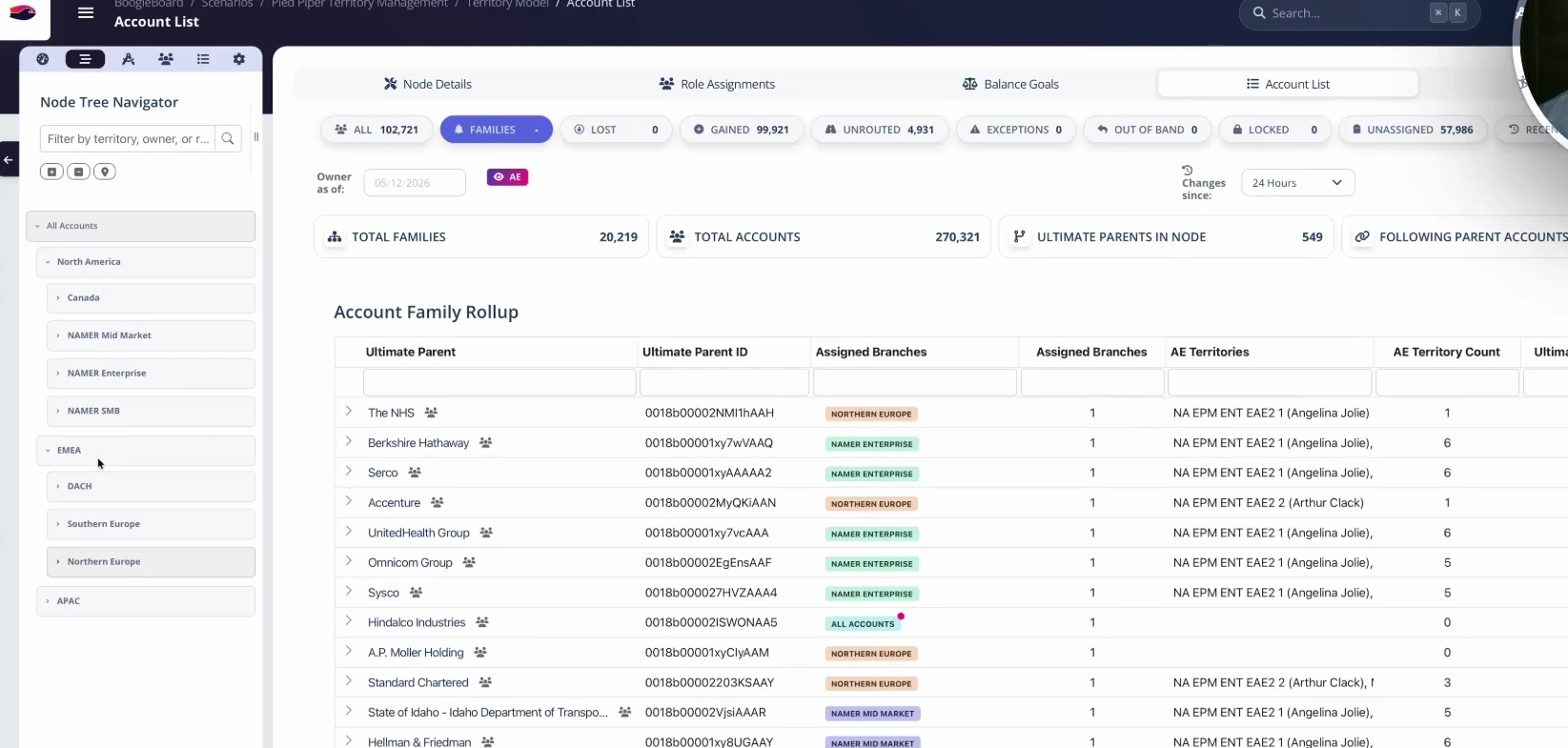
BoogieBoard account-family rollup showing parent IDs and assigned branches
BoogieBoard account-family rollup: inspect parent relationships alongside assigned branches.
Check readiness before scaling the method
Run a reviewed pilot and record three measures: the share of accepted links that reviewers confirm, the share of known links the process finds, and the unresolved share. For an illustrative pilot, 96 correct links among 100 accepted links means 96% precision. In a separate known-link test, finding 72 of 80 links means 90% recall. These figures illustrate measurement, not recommended release thresholds. Inspect results by relationship class and region; an overall average can hide weak performance on independent subsidiaries.
Agree on release criteria before reviewing the results. Test reversibility, ID mapping, and the downstream assignment preview. Assign someone to resolve exceptions and refresh relationships when new evidence arrives.
Estimate cost from the pilot's candidate volume, tokens, retrieval charges, retries, and human review time. Model inference is only one component. There is no defensible fixed budget for an account list without knowing its size, ambiguity, and evidence requirements.
You are ready to expand when operators can explain accepted links, unresolved cases remain visible, and repeated runs produce traceable changes. If accuracy is weak, fix candidate generation or evidence quality before increasing throughput.
Frequently Asked Questions
How long does it take to build a reliable account hierarchy?
Profile the data and complete a reviewed pilot before estimating the full project. Missing identifiers, differently named subsidiaries, conflicting evidence, and review capacity drive the timeline. Separate machine processing time from the time required to resolve business judgments.
Do we still need spreadsheets?
A spreadsheet can support sampling and review if IDs, versions, and decisions stay intact. For recurring runs, store accepted relationships and evidence in a controlled system with repeatable exports. Avoid letting an untracked working copy become the hierarchy of record.
Does finding a parent mean every child should share its sales owner?
No. Ownership is one input to coverage design. Confirm the buying center for your product and apply approved family-treatment rules. An independently buying subsidiary can retain its own territory while remaining linked to the corporate family.
What account data should we send to an LLM?
Use only the fields necessary for the classification: account IDs, business names, relevant domains, and approved evidence. Avoid unrelated contact or deal details. Apply your organization's provider, access, retention, and data-handling requirements before processing CRM exports.
Can we skip D-U-N-S matching if coverage is limited?
Yes. This is a modular method. Use the identifiers and relationship evidence you have, record coverage gaps, and assess what each additional pass contributes. Sparse coverage can still provide useful reviewed examples, but it does not validate the rest of the list.
What should happen when two passes disagree?
Preserve both proposals and their evidence. Apply your documented precedence only when it resolves the conflict credibly; otherwise route the case to review. Keep the last accepted relationship until a replacement is approved, and make unresolved status visible to downstream users.
See account-family planning in practice
Explore practical workflows on the BoogieBoard YouTube channel. To discuss how your verified hierarchy should influence territory coverage, Schedule a Live Demo.