5 Key Takeaways
- Financial-services territory planning is a hierarchy and governance problem before it is a mapping problem.
- Evaluate software on parent-child data, AUM and branch metrics, role overlays, account-level exceptions, approvals, audit history, and CRM deployment.
- Geographic tools are strongest for contiguous field territories; connected planning platforms are strongest when territory, quota, capacity, and compensation must move together.
- Run every vendor through one real account family and one real mid-year change. Feature lists hide the operational handoffs that create risk.
- Treat vendor fit as an operating-model decision: the strongest platform is the one that can represent your eligibility, hierarchy, metrics, governance, and deployment requirements without hiding them in manual work.
Financial-services coverage models rarely fit a clean map. A wealth-management organization may segment by assets under management, branch, advisor type, and geography. A commercial bank may cover a parent company centrally while assigning subsidiaries or locations to local teams. Insurance and payments companies often combine product overlays, regulated eligibility, partners, and account families.
The software must do more than draw boundaries. It must preserve the logic behind who can cover which account, how related entities roll up, what remains locked, who approves an exception, and what is ultimately written to Salesforce.
Why Financial Services Needs Specialized Territory Planning Software
The account hierarchy is part of the territory
In large-company datasets BoogieBoard works with, 60-85% of accounts participate in a corporate-family relationship. Yet parent relationships are missing on 25-55% of accounts that should have one, and complex families duplicate at roughly three times the rate of standalone companies.
That combination is dangerous in financial services. A planner may unintentionally assign a parent and subsidiary to competing teams, count the same opportunity twice, or separate a centrally managed relationship from the local entities that transact.
Franchise, cooperative, branch, broker-dealer, and fund structures can be harder than a conventional enterprise hierarchy because legal control, economic relationship, and selling responsibility are not always the same tree.
The system therefore needs more than a Parent Account field. It must distinguish the legal family, the economic relationship, the territory used for planning, and the roles allowed to serve each entity. It should also let the team preserve a named-account override without hiding it inside a geographic rule.
Industry-specific scale metrics matter
Generic employee and revenue bands are often insufficient. Financial-services teams may need:
- assets under management or assets under administratio
- deposits, premiums, payment volume, or loan bookn- branches, advisors, covered entities, or locationsn- customer status, product eligibility, or regulatory classificatio
- ultimate-parent and subsidiary rollups
Across BoogieBoard designs, annual revenue is the most unreliable common firmographic field: 15-50% may be missing and 30-55% of populated values may be stale or wrong. The chosen platform should let you use the data that actually defines the financial-services motion and expose missing values before rules run.
For wealth and RIA motions, observed AUM bands often begin around $250 million, $1 billion, and $10 billion. Institutional motions may move those boundaries up by an order of magnitude. That difference cannot be resolved by picking a universal template. The platform must support your definition, retain its version, and show which accounts change when the threshold changes.
Compliance and Audit Requirements
Eligibility, segmentation, and access rules
The platform should support explicit account eligibility and segment rules rather than relying on a manager's memory. It should separate the account universe that belongs in a territory from accounts deliberately excluded from coverage.
This is operational governance, not a substitute for legal compliance review. Your compliance, legal, HR, and security teams still own the rules that apply to your business.
At minimum, ask whether eligibility can be expressed by product, advisor certification, jurisdiction, customer type, account status, and corporate-family role. Then test a record with missing or conflicting data. A system that silently drops the account from every rule creates a coverage gap; a governed system identifies it for resolution.
Full assignment history
For each territory change, teams should be able to reconstruct:
- the source data and effective daten- the rule or manual exception usedn- the prior and future territoryn- the roles affectedn- the approver and rationalen- the CRM fields or objects updated
Salesforce supports planning and active territory-model states and requires teams to review assignments before activation (Salesforce Managing Territories). A planning platform should strengthen that control with scenario comparison and account-level change visibility.
The history must go beyond "account moved." It should show the source model, scenario, applicable rule, manual override, old and new values, person making the change, approver, timestamp, and deployment result. Finance and compliance teams may care about different fields, but both need a traceable chain from policy to live assignment.
Locks, exceptions, and corporate actions
M&A, branch changes, advisor moves, hierarchy refreshes, and protected relationships create exceptions. The software should let operators lock specific accounts, time-bound a holdover, route an approval, and preserve the reason without editing the base rule beyond recognition.
Treat hierarchy refreshes like controlled corporate actions. Identify affected parents and children, compare current and proposed ownership, preserve qualified opportunities and near-term renewals, and set an effective date. A bulk data update should never become an unreviewed territory change.
The 8 Best Territory Planning Platforms for Financial Services in 2026
The products below are not ranked from universally best to worst. They are grouped by the planning problem each is best positioned to solve. Capabilities are based on current official product materials; validate security, compliance, implementation, and integration requirements directly with each vendor.
For a neutral category definition and a broader comparison set, G2's Sales Planning Software category requires territory planning, quota planning, capacity management, CRM integration, and what-if scenario modeling. The evaluations below apply a financial-services operating lens on top of those baseline capabilities.
1. BoogieBoard: Best for account-centric territory design and governed change
BoogieBoard is built around account-level territory planning: hierarchies, segmentation logic, Balance Goals, Account Locks, multi-role assignments, scenarios, collaboration, audit history, and Salesforce synchronization.
It is strongest when the central problem is deciding which related accounts and roles belong together, comparing fairness with disruption, and showing the exact future-state assignments before activation.
Balance Goals can evaluate account count, ultimate parents, customer and prospect mix, AUM or another scale measure, pipeline, renewals, and workload in the same scenario. Account Locks protect exceptions before optimization, while role assignments keep global, local, specialist, manager, and customer roles visible without pretending one owner field represents the full coverage team.
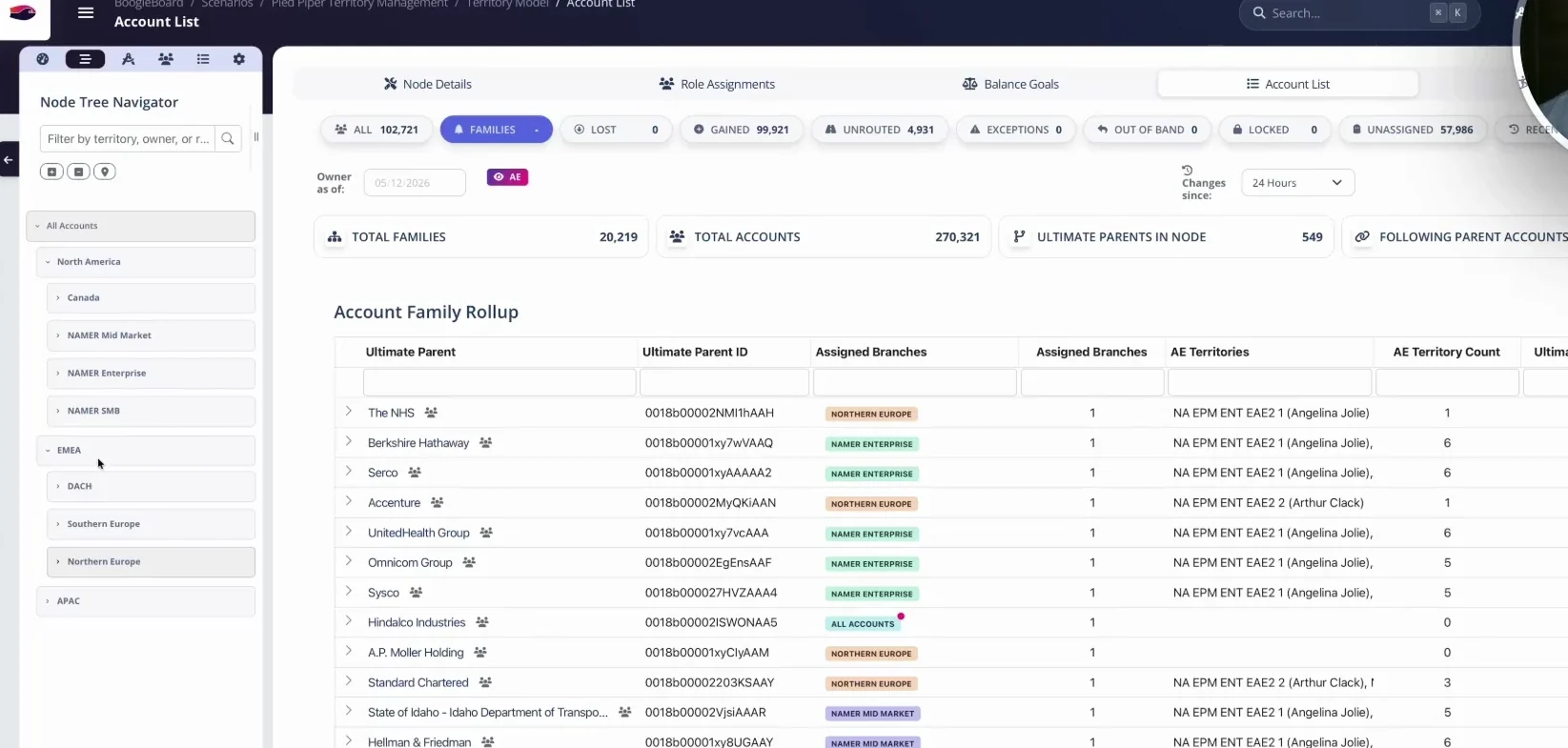
An account-family rollup keeps parent, child, and branch relationships visible during territory design.
Best fit: RevOps teams that need to combine corporate-family logic, industry metrics, role overlays, protected accounts, and controlled Salesforce changes in one operating workflow.
Evaluate carefully: Confirm the specific Salesforce objects and fields used by your organization, the authority for financial-services eligibility rules, and the controls required by your security and compliance teams.
2. Salesforce Maps Territory Planning: Best for Salesforce-native geographic planning
Salesforce Maps Territory Planning creates alignments, imports or builds territory hierarchies, assigns units and owners, and can work with Enterprise Territory Management models.
Its alignment model is well suited to boundary-based planning and Salesforce-native deployment. Official documentation describes importing active or planning ETM models, configuring hierarchies up to ten levels, assigning owners, and publishing aligned units.
Best fit: Salesforce-centered field organizations where geographic units, map-based alignment, and publishing into Salesforce are primary requirements.
Evaluate carefully: Bring non-geographic account families, named exceptions, financial scale metrics, and multi-role coverage to the demonstration rather than assuming a geographic alignment solves them.
3. Xactly AlignStar: Best for established territory mapping within SPM
Xactly's territory-mapping product emphasizes visual territory design, balancing, and connections with CRM, ERP, and HR data inside a broader sales-performance portfolio.
The attraction is ecosystem breadth: organizations can evaluate territory alignment alongside other sales-performance processes. For financial services, the key question is how account-family data and governed exceptions are represented inside that broader model.
Best fit: Organizations already evaluating Xactly for quota, incentive, or sales-performance processes and needing territory alignment in the same ecosystem.
Evaluate carefully: Ask the vendor to demonstrate your AUM or branch model, approval history, account-level protection, and Salesforce deployment rather than relying on suite-level claims.
4. Varicent: Best for connected territory, quota, and capacity planning
Varicent Sales Planning connects territories, quotas, capacity, and scenario modeling. Its value is the ability to evaluate planning levers together rather than treating territory design as an isolated map.
That connected model is useful when a territory change should immediately inform capacity and quota decisions. It can reduce the reconciliation work created when each planning lever lives in a different system.
Best fit: Larger enterprises that need territory and quota planning to share data, assumptions, and governance.
Evaluate carefully: Test the implementation effort required for your corporate hierarchies, manager workflows, financial-services metrics, and day-to-day account exceptions.
5. Fullcast: Best for territory planning plus ongoing GTM operations
Fullcast Territory Management combines territory carving with operational management. Its SmartPlan materials emphasize constraints, headcount, portfolio alignment, and scenarios.
Fullcast's operating orientation matters for teams that continue changing territories after annual planning. Criteria can incorporate firmographics, account status, needs, headcount, and portfolio constraints, with scenarios used to compare plans.
Best fit: Teams seeking one broader RevOps platform for planning and running coverage after the annual design cycle.
Evaluate carefully: Show the vendor a complex ultimate-parent family, regulated eligibility exception, protected opportunity, and role overlay to confirm depth beyond general GTM operations.
6. Forma AI: Best for territory, quota, and incentive connectivity
Forma AI Territory and Quota Planning supports multiple territory structures, account-level exceptions, scenarios, workload scoring, manager refinement, approvals, and audit trails while connecting planning with incentive compensation.
Its official materials describe geography, named accounts, products, overlays, management structures, workload indexes, and connected quota and incentive processes. That makes it a serious option when territory changes must cascade into adjacent SPM decisions.
Best fit: Enterprises that want territory and quota changes to flow into a connected compensation operating model.
Evaluate carefully: Determine whether the platform's broader SPM model provides the account-level hierarchy, lock, and Salesforce operating detail your RevOps team needs without specialist configuration.
7. EasyTerritory: Best for Microsoft-centric mapping and field coverage
EasyTerritory integrates with Dynamics 365 and Power BI and emphasizes geographic analysis, nested territories, routing, and balance by revenue, account count, or workload.
It is strongest when the planning team already works in Microsoft's data and reporting ecosystem. Nested territories, map layers, routes, and CRM writes can support branch and field-service models where physical coverage is central.
Best fit: Microsoft-centric field teams where visual geography, routing, and CRM writeback are central.
Evaluate carefully: Confirm how non-geographic named accounts, ultimate-parent relationships, multi-role assignments, and Salesforce-specific deployment would be handled.
8. Maptitude: Best for GIS-heavy desktop territory analysis
Maptitude provides GIS, demographic data, geographic territory balancing, hierarchical geographic territories, and spreadsheet/database integration.
Maptitude gives analysts substantial control over geographic units, demographics, travel considerations, and hierarchical map territories. Desktop and offline workflows may also matter for teams with restricted data or specialized GIS requirements.
Best fit: Analysts who need deep geographic control, demographic layers, or offline desktop mapping more than a collaborative account-governance workflow.
Evaluate carefully: It is an analyst-led mapping environment, so test approvals, account-family logic, role assignment, audit history, and CRM operationalization separately.
Financial-Services Territory Software Comparison
| Platform | Primary strength | Account hierarchy | Scenario/governance | Ecosystem |
|---|---|---|---|---|
| BoogieBoard | Account-centric territory operations |
Core focus | Scenarios, locks, approvals, audit |
Salesforce |
| Salesforce Maps | Geographic alignment | Territory hierarchy | Alignment planning and publish |
Salesforce |
| Xactly AlignStar | Visual territory mapping | Validate in demo | Planning within SPM suite | Xactly/CRM |
| Varicent | Connected sales planning | Validate in demo | What-if territory/quota planning |
Varicent |
| Fullcast | Plan-to-run RevOps | Account criteria | Ongoing territory operations |
CRM/RevOps |
| Forma AI | Connected TQM and incentives |
Complex structures | Approvals, scenarios, audit | Forma SPM |
| EasyTerritory | Microsoft field mapping | Nested territories | Mapping and balancing | Dynamics/Power BI |
| Maptitude | GIS and demographic analysis |
Geographic hierarchy | Analyst-led scenarios | Desktop/data files |
"Validate in demo" is intentional. A vendor's use of the word hierarchy does not prove that its data model can represent your legal entities, ultimate parents, branches, advisors, and local coverage rules without workarounds.
Best Practices for Financial-Services Territory Planning
- Map every coverage rule to its governing requirement before configuring software. Document the customer population, product, advisor or seller eligibility, jurisdiction, corporate-family treatment, and approval authority. Use that policy map as the configuration checklist.
- Define hierarchy and segmentation rules at the right level. AUM, branches, deposits, products, and regulatory status may live on different entities. State whether a rule applies to the ultimate parent, legal entity, location, opportunity, or role.
- Require account-level traceability from day one. Every assignment should trace to source data, the rule or exception, the scenario, the approver, and the effective date. Retrofitting this history after a dispute is considerably harder.
- Protect active customer work before optimization. Lock qualified opportunities, near-term renewals, regulated relationships, and explicitly approved named accounts before balancing the movable book.
- Run parallel scenarios during major transitions. Keep the current model and proposed model visible at the same time. Compare Territory Health, account movement, role changes, coverage gaps, and downstream CRM effects before activation.
- Give the right functions direct review access. RevOps, Sales leadership, Finance, customer teams, security, and compliance should review the fields and decisions they own without routing every question through the model builder.
- Review assignment history during the year, not only during annual planning. Repeated exceptions, unassigned eligible accounts, stale hierarchies, and drift between the plan and CRM indicate that the operating model needs correction.
The right platform is the one that can model your real account structure and change process without hiding critical policy in spreadsheets or custom fields.
Frequently Asked Questions
What makes financial-services territory planning different?
Financial-services models often combine complex account families, industry-specific scale measures such as AUM or branches, regulatory eligibility, local and global coverage, and stricter approval and audit expectations.
Is geographic territory mapping enough for a financial-services team?
Sometimes, especially for branch or field coverage. It is not enough when parent-child ownership, named accounts, product overlays, advisor relationships, or non-geographic segmentation drive assignments.
Should territory and quota planning use the same platform?
They should at least share data and assumptions. A connected platform can reduce reconciliation work, but an account-centric territory tool may be a better fit when hierarchy and assignment governance are the dominant problem.
How should we evaluate vendor claims about account hierarchy?
Bring a real family structure and ask the vendor to model ultimate-parent rollups, child-level ownership, global and local roles, exceptions, and downstream CRM records live.
How long does implementation usually take?
Implementation depends on hierarchy quality, number of coverage roles, policy clarity, integrations, security review, and the amount of historical logic being migrated. A simple geographic model can move quickly; a global account-family model with governed exceptions should be evaluated on accuracy and operating control before speed.
About the author: Kevin Davis is Co-Founder & CEO of BoogieBoard.
In summary: Financial-services territory software should be evaluated on hierarchy, industry metrics, governed exceptions, role coverage, scenario control, and auditability, not on map quality alone.
Watch territory planning in action
See product walkthroughs and practical territory workflows on BoogieBoard's YouTube channel.