

Not as a hypothetical. Not as a thought exercise. We actually ran it.
We treated the 2026 Masters like what it is: a strategic account design problem. 91 golfers need to be sorted into 31 threesomes, assigned to 31 tee times, and optimized for the best possible viewing outcome. That's the same problem RevOps teams solve every planning season — just with golfers instead of accounts and TV ratings instead of quota attainment.
Here's exactly how we did it.
The Framework
Before touching any data, we mapped the Masters pairing problem onto territory design language:
| Masters Component | BoogieBoard Component |
|---|---|
| Golfer | Account to place |
| Threesome | Book of business to build |
| Tee time | Quota band with different value |
| Pairing rule | Lock the model has to respect |
| TV viewership | The total outcome to optimize |
If you've ever built territories, this should feel familiar. You've got a set of entities (golfers), a set of containers (threesomes), a set of constraints (traditions, rivalries, broadcast windows), and an objective function (maximize entertainment value across the full day).
The only difference is the inputs. Instead of ARR, employee count, and industry vertical, we're working with Instagram followers, strokes gained, and Amen Corner timing.
Step 1: Load the Field
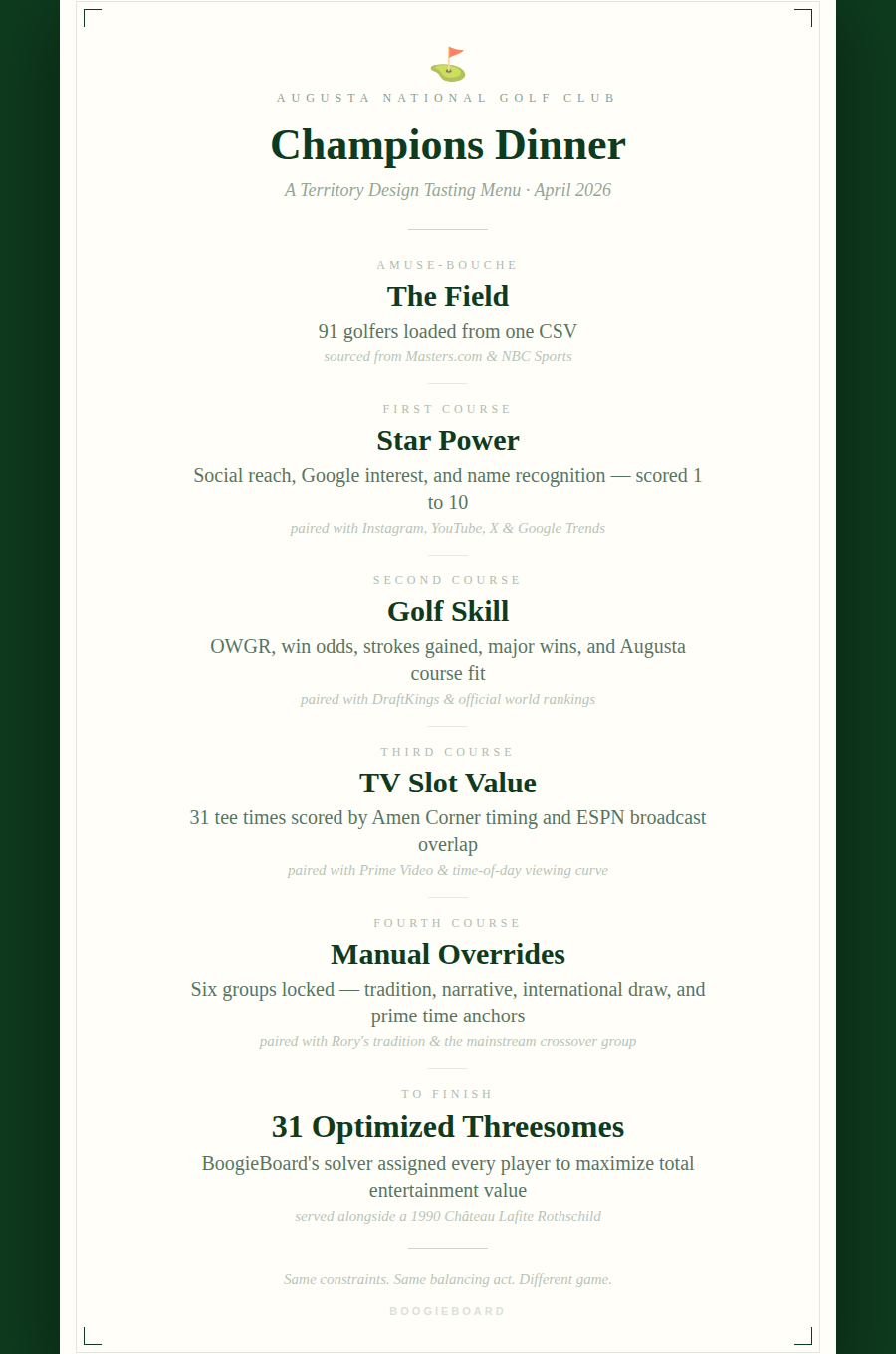
We started with a CSV of all 91 players entered in the 2026 Masters, sourced from Masters.com and cross-checked against NBC Sports. Each player record included name, status (professional or amateur), and qualifying source.
This is the equivalent of your CRM export. Raw account list. No enrichment yet.
Step 2: Build the Star Power Dataset
The first variable layer is star power — a measure of who actually moves the needle for TV viewership independent of how well they play golf. Max Homa might not win the tournament, but he drives more casual viewer interest than most of the field.
We built this from three signal categories:
Social reach
For each golfer, we pulled follower counts across Instagram, YouTube, and X. We didn't pre-weight these into a composite score. BoogieBoard's algorithm ingests each platform as its own variable so it can learn the relative importance across the field rather than having us guess at a 40/35/25 split. Bryson DeChambeau's 2.6M YouTube subscribers hit differently than Rory McIlroy's 4.5M Twitter followers. The model handles that.
Google search interest
We used Google Trends data to measure 12-month search popularity for each player, normalized against the field. This captures who people are actively looking up — which picks up players like Ludvig Åberg who might not have massive followings yet but are generating huge search buzz.
Name recognition
This is the qualitative layer: major championship wins, media visibility, controversy factor, and mainstream crossover appeal. A player with five major wins carries more cultural weight than their follower count alone suggests. We scored this as a discrete input and let the algorithm factor it alongside the quantitative signals.
All three categories go into BoogieBoard as separate variables — not as a pre-packaged composite. The algorithm determines how much each variable matters in the context of the full optimization.
Step 3: Build the Golf Skill Dataset
The second variable layer captures actual playing ability. If we only optimized for star power, we'd end up with dead groups full of talented but unknown players. The skill data ensures competitive balance.
We pulled four signal categories:
OWGR ranking
The Official World Golf Ranking covers every tour — PGA, LIV, DP World, Korn Ferry — under one system. This is the universal skill baseline. Scottie Scheffler at #1 and Jon Rahm at #67 (depressed by LIV's ranking point structure) both have OWGR numbers, which matters when half your marquee players are on a different tour.
Current form and win odds
Here's the move that saved us $30/month on a Data Golf subscription: we used DraftKings Masters betting odds as a proxy for current form and Augusta course fit. Oddsmakers employ teams of analysts who blend strokes-gained categories, recent results, course history, weather projections, and proprietary models into a single implied probability. Scheffler at 16.4% and Rahm at 10.0% reflect a massive amount of analytical work we get to inherit for free. We fed these probabilities directly into BoogieBoard as a variable.
Strokes gained decomposition
SG: Off-the-Tee, Approach, Around the Green, Putting, and Total. These are the granular skill categories that tell you whether a player is a bomber, a precision iron player, or a scrambling wizard. Augusta rewards specific skill profiles — distance off the tee, approach play from 175+ yards, and touch around severely sloped greens. Each SG category enters the model as its own input.
Augusta course fit and Masters experience
Number of previous Masters starts and major championship wins. A first-time player at Augusta faces a massive experience disadvantage — the course rewards familiarity with its slopes, angles, and green complexes. We included this as a separate variable from overall skill because a guy like Patrick Reed (8 Masters starts, one green jacket) has Augusta-specific equity that his current world ranking doesn't capture.
Again — all of these go into the algorithm as independent variables. No pre-packaged "golf skill score." BoogieBoard handles the multivariable optimization natively.
Step 4: Build the TV Slot Value Dataset
This is where the project gets interesting. Most people think about tee times as early vs. late. That's wrong.
The real question is: when does your group hit the iconic holes during the broadcast window?
Thursday's coverage looks like this:
| Broadcast Window | Time (ET) |
|---|---|
| Featured Groups streaming | 9:15am onward |
| Amen Corner coverage | 10:45am – 6:00pm |
| Holes 15 and 16 coverage | 11:45am – 7:00pm |
| Prime Video | 1:00pm – 3:00pm |
| ESPN main broadcast | 3:00pm – 7:30pm |
A round takes roughly 4.5 hours. The front nine takes about 2.5 hours. That means Amen Corner (holes 11-13) comes roughly 3 to 3.5 hours after your tee time, and the finishing stretch hits about 4 to 4.5 hours in.
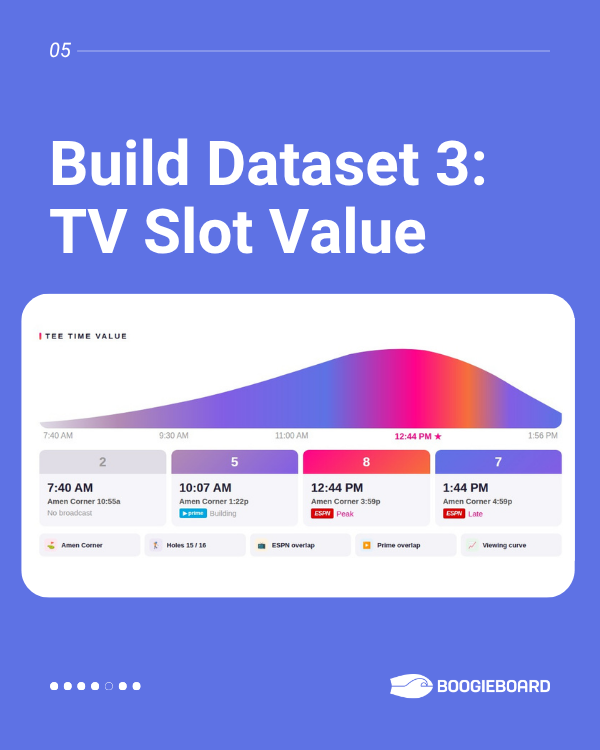
So a group teeing off at 7:40am hits Amen Corner at 10:55am — before most of America is watching. A group teeing off at 12:44pm hits Amen Corner at 3:59pm — right as ESPN goes live to millions.
We scored every tee time slot using five inputs:
- ESPN back-nine overlap — how many minutes of a group's back nine fall within the 3-7:30pm ESPN window
- Amen Corner timing — whether the group reaches holes 11-13 during the featured coverage window
- Holes 15-16 timing — same analysis for the iconic par-5 15th and par-3 16th
- Prime Video overlap — minutes of back nine during the 1-3pm Prime window
- Time-of-day viewership curve — general Thursday TV viewing peaks in early afternoon
The result is a value curve that peaks around the 12:27pm to 1:08pm tee times and drops off on both ends — early morning slots are the least valuable, the very last slots drop back because groups finish after peak viewing hours.
Step 5: Lock the Overrides
Before running the solver, we locked six groups. This mirrors how RevOps teams lock strategic accounts before the algorithm runs — certain assignments are non-negotiable.
Lock 1: Rory McIlroy + Mason Howell → 10:31 AM
Masters tradition dictates the defending champion plays with the US Amateur champion. Non-negotiable. We paired them in a mid-morning slot to catch the building broadcast audience.
Lock 2: Scottie Scheffler → 1:44 PM
The world #1 and two-time Masters champion goes in the penultimate group. His back nine hits Amen Corner during peak ESPN at 4:59pm and he finishes around 6:14pm. Maximum eyeballs on the favorite.
Lock 3: Bryson DeChambeau + Xander Schauffele → 10:07 AM
The LIV vs. PGA narrative collision. YouTube mega-star against the reigning PGA and Open champion. We slotted them two groups before Rory to build broadcast momentum.
Lock 4: Jordan Spieth + Brooks Koepka + Max Homa → 1:20 PM
This is the mainstream crossover group. Koepka's got the swagger, Homa's got the internet, Spieth's got the heartstrings. None of them are favorites to win but all three are guys that casual fans and non-golf people actually know. Prime afternoon slot.
Lock 5: Jon Rahm + Ludvig Åberg → 1:08 PM
International firepower. Rahm is the hottest player coming in with two recent LIV wins. Åberg is the buzzy young Swede. A 1:08pm tee time means their back nine plays out in prime time for US viewers and late evening for Europeans — keeping that audience engaged.
Lock 6: Fred Couples + Vijay Singh + José María Olazábal → 7:40 AM
Five combined green jackets in the honorary early slot. Low TV value but high sentiment. Masters tradition puts the legends early.
Step 6: Run the Algorithm
With three full datasets loaded and six groups locked, we let BoogieBoard's solver handle the remaining 78 players across 25 open tee time slots.
The algorithm's objective: maximize total entertainment value across all groups and time slots, subject to constraints. Each group needs a balanced mix — you can't stack all your stars in one threesome and leave another group with three amateurs. Higher-value players should generally land in higher-value TV slots. And every player must be assigned exactly once.
BoogieBoard doesn't need us to pre-package a single "player value" score. It ingests all the raw variables — Instagram followers, YouTube subscribers, OWGR rank, win odds, SG categories, Masters starts, major wins, TV slot value — and runs the optimization across all dimensions simultaneously. That's the whole point. A human can't mentally balance 15 variables across 91 players and 31 time slots. The algorithm can.
The Output
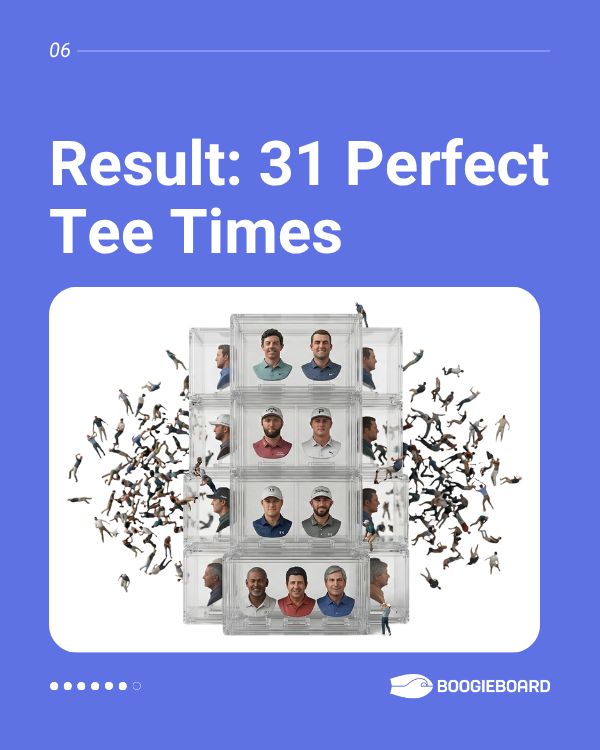
Here are the five marquee threesomes the solver produced for prime time:
10:07 AM — Bryson DeChambeau / Xander Schauffele / Matt Fitzpatrick
Three players with realistic green jacket aspirations. DeChambeau's been in the final group two years running. Fitzpatrick just won the Valspar. Schauffele has five top-10 Masters finishes in seven years. This group's Amen Corner moment hits at 1:22pm as Prime Video comes online.
10:31 AM — Rory McIlroy / Cameron Young / Mason Howell
The defending champion, the Players Championship winner, and the US Amateur champion. Tradition meets rising talent. Their back nine catches the transition from Prime Video to ESPN.
1:08 PM — Jon Rahm / Ludvig Åberg / Chris Gotterup
The hottest player in the field, the breakout Swedish star, and a two-time winner in 2026 making his Masters debut. Amen Corner at 4:23pm. Peak ESPN.
1:20 PM — Jordan Spieth / Brooks Koepka / Max Homa
Eight combined major wins and one of the biggest social media followings in golf. This group doesn't need to contend to keep people watching. Amen Corner at 4:35pm.
1:44 PM — Scottie Scheffler / Tommy Fleetwood / Robert MacIntyre
The world #1, the world #4, and the world #8. The penultimate group carries the heaviest combined ranking in the field. Scheffler's finishing stretch hits ESPN around 6:00pm — the final hour of the broadcast.
What This Demonstrates
This was a fun Masters Week exercise. But the underlying problem — sort entities into balanced groups, assign them to slots with different values, respect constraints, optimize for an outcome — is a territory design problem.
Replace golfers with accounts. Replace threesomes with books of business. Replace tee times with quota bands. Replace TV viewership with revenue potential.