

The Three Approaches to Structure Your Sales Team for Complex Hierarchies: A Coordination Spectrum
Structure your sales team to serve the customer's hierarchy, not your own convenience. Understand where decisions get made and align your sales approach accordingly.
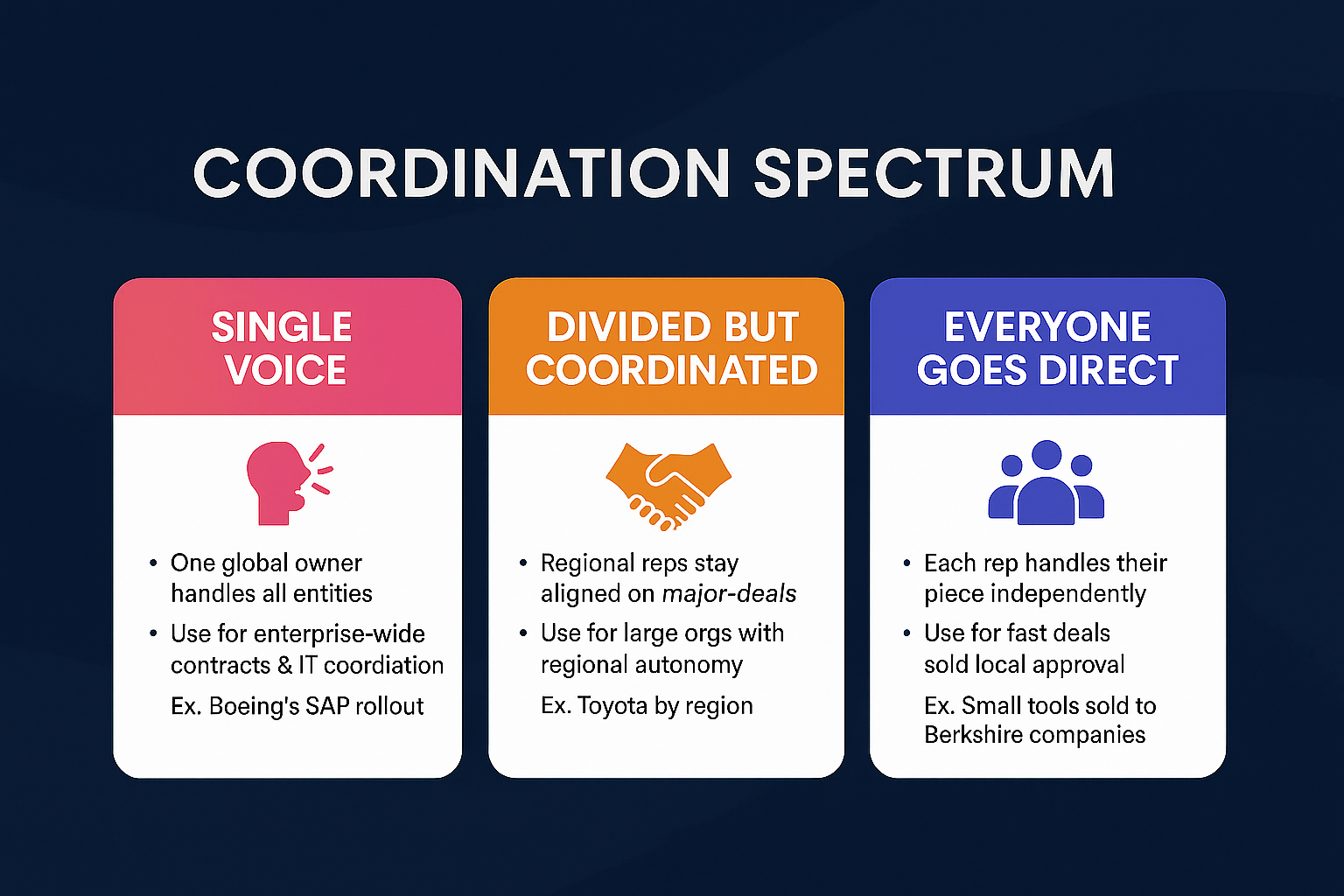
Use the below framework to figure out the right structure with which to serve your customers.
How to Sell to 6 Different Corporate Structures:
1. Integrated Corporate Structure (Classic Hierarchy)
Parent company controls subsidiaries and divisions. Shared operations, strategy, branding, and central directives from Corporate HQ.
Commonality: Very common - default for large multinationals and single-industry companies.
Examples: ExxonMobil, Apple, Procter & Gamble, Boeing.
🏦 How They Buy
| Purchase Type | Annual Value | Decision Maker | Examples | What Matters |
|---|---|---|---|---|
| Core Platforms | $250k+ | Corporate HQ | ERP, CRM, HRIS, IaaS | Full corporate control - enterprise standards drive everything |
| Significant Departmental Software | $100k-$250k | Divisional leadership | Advanced analytics, specialized finance systems | Corporate approval required despite divisional budget |
| Smaller Departmental Tools | $50k-$100k | Department Head/Director | Workflow automation, team utilities | Corporate IT review - lighter involvement |
| Low-Value Tools | <$10k | Manager level (P-card) | Small SaaS subscriptions, basic tools | Corporate IT check - minimal but increasing |
Key Influencers: Corp IT, Corporate Procurement, Corporate Finance, Divisional Leaders, Functional VPs at HQ.
Decision Drivers: Standardization, efficiency, security, integration, enterprise value, corporate standards compliance.
Process: Formal RFPs, rigorous Corp IT security reviews, multi-level approvals, Corporate Procurement management.
Contracting: Enterprise License Agreements (ELAs) or Master Service Agreements (MSAs) signed by Parent Company/Corporate HQ.
🤔 Sales Strategy
Account Planning: Map corporate standards and HQ influence. Use top-down/bottom-up approach.
Messaging: Enterprise value, scalability, security, compliance, standardization.
Opportunity Potential: High potential for large, complex enterprise deals.
⚠️ CRM Challenges
CRM Impact: Standard parent-child fields capture basic hierarchy. Global divisional mapping during reorganizations requires ongoing data governance.
Private: Difficult. Requires deep research or premium data tools.
Publicly Traded: Moderate difficulty. SEC filings list major subsidiaries, but internal divisions and influence lines harder to map.
2. Holding Company Structure (Conglomerate)
Holding company owns controlling stakes in diverse, independent operating subsidiaries. No powerful central Corp IT function. Subsidiaries operate with high autonomy like independent companies.
Commonality: Less common than integrated structures, but includes major players and many smaller private holding companies.
Examples: Berkshire Hathaway, Alphabet Inc (Google parent)., ITW (Illinois Tool Works).
🏦 How They Buy
| Purchase Type | Annual Value | Decision Maker | Examples | What Matters |
|---|---|---|---|---|
| Operational Software | Any value | Subsidiary leadership | ERP, CRM, Martech, Operations tools | Subsidiary acts like independent company with own thresholds |
| Holding Company Tools | Varies | Holding Co HQ | Consolidated financial reporting, massive capital tools | Rare - only for holding company's own needs |
| Cross-Subsidiary Buys | Large | Holding Co + Subsidiaries | Leveraged purchases across similar subsidiaries | Uncommon in diverse conglomerates |
Key Influencers: Subsidiary CEO/President, Subsidiary CFO, Subsidiary IT/Operations heads, Subsidiary department heads. Holding Company influence minimal.
Decision Drivers: Subsidiary-specific needs, budget, ROI for individual subsidiary.
Process: Varies by subsidiary size and maturity, contained within subsidiary.
Contracting: Contracts signed by individual subsidiary legal entity.
🤔 Sales Strategy
Account Planning: Treat each major subsidiary as separate account. Research subsidiary specifics.
Messaging: Tailor value proposition directly to subsidiary needs.
Opportunity Potential: Multiple medium-to-large deals across portfolio, requires separate efforts.
⚠️ CRM Challenges
Publicly Traded: Moderate for identifying first-level operating subsidiaries. Deeper ownership chains or private subsidiaries harder to trace.
Private: Very difficult. Often opaque.
CRM Impact: Represent each operating subsidiary as distinct account. Linking to holding company parent is secondary since buying is decentralized.
3. Franchise Model
Franchisor licenses brand, business model, and operating system to independent business owners (franchisees). Franchisor sets standards, franchisees manage local operations.
Commonality: Extremely common in specific sectors - fast food, hospitality, retail services. Represents vast number of SMB units.
Examples: McDonald's, Marriott International, 7-Eleven, Subway.
🏦 How They Buy
| Purchase Type | Annual Value | Decision Maker | Examples | What Matters |
|---|---|---|---|---|
| Mandated Core Systems | Varies | Franchisor HQ | POS, Reservations, Core Accounting, Brand Website Integration | Franchisor IT drives selection for consistency |
| Franchisee Discretionary | <$20k | Franchisee Owner/GM | Local Marketing, Scheduling, Analytics, HR tools | Acts like SMB with typical thresholds |
| Multi-Unit Operator | $10k-$50k | Multi-unit operator | Tools across their portfolio of locations | Consolidated buying for their locations |
Key Influencers:
Mandated: Franchisor HQ Ops, IT, Procurement
Discretionary: Franchisee Owner/GM, Multi-unit operators, Franchisee Advisory Councils
Decision Drivers:
Franchisor: Brand consistency, system-wide efficiency, negotiated volume discounts
Franchisee: Local ROI, ease of use, operational problems, affordability
Process: Mandated = Corporate sales cycle at Franchisor HQ. Discretionary = SMB sales cycle direct to franchisees.
Contracting: Mandated systems often require franchisee adoption of franchisor agreement. Discretionary uses standard vendor contracts with franchisee entity.
🤔 Sales Strategy
Account Planning: Identify if solution is mandated or discretionary. Map Franchisor HQ and franchisee landscape.
Messaging:
To Franchisor: Consistency, efficiency, data
To Franchisee: Local ROI, ease of use
Opportunity Potential: Large roll-out via Franchisor; high volume of smaller deals via franchisees.
⚠️ CRM Challenges
Franchisor Data: Easy to identify.
Franchisee Data: Extremely difficult at scale. Franchisee ownership is highly dynamic and not comprehensively available in public records. Multi-unit operators are key targets but hard to map.
CRM Impact: One of the most challenging structures to map and maintain. Linking locations to franchisee entities, then to multi-unit owners, then to franchisor brand requires robust CRM setup and intense data stewardship.
4. Private Equity (PE) Ownership Model
PE firm acquires controlling stake in operating company (portfolio company) to increase value for resale within 3-7 years. PE firm exerts significant strategic, financial, and operational influence. Focus on maximizing ROI and achieving investment thesis.
Commonality: Very significant and cyclical. Huge portion of M&A activity involves PE firms.
Examples: KKR owning RJR Nabisco (historical), Blackstone owning Hilton (historical). Key players: KKR, Blackstone, Carlyle, TPG.
🏦 How They Buy
| Purchase Type | Annual Value | Decision Maker | Examples | What Matters |
| Strategic Investments | $100k+ | PE Firm approval required | Core operations, value creation plan tools | Speed prioritized if aligned with PE plan |
| Operational Expenditures | <$100k | Portfolio Co management | Standard business tools | Must align with PE-approved budgets and strategy |
Key Influencers: PE Operating Partners, Portfolio Company CEO & CFO (often PE-approved), PE firm's internal procurement specialists.
Decision Drivers: ROI (clear, measurable, fast), cost reduction, EBITDA impact, enabling growth strategy, supporting quick exit.
Process: Can be faster than traditional corporate cycles if aligned with PE strategic priorities. Rigorous focus on business case and financial justification.
Contracting: Contract signed by portfolio company legal entity. PE firm approval might be implicit or explicit. Terms scrutinized for cost, flexibility, and alignment with expected ownership duration.
🤔 Sales Strategy
Account Planning: Research specific PE owner and their stated goals/thesis for this investment. Understand expected holding period. Identify key PE contacts and portfolio company executives.
Messaging: Quantifiable ROI, speed-to-value, alignment with PE objectives (cost reduction, revenue growth, efficiency).
Opportunity Potential: Significant deals that close quickly if strategically aligned, but highly sensitive to value justification.
⚠️ CRM Challenges
PE Owner Identification: Moderate. Usually feasible via news, PE firm websites, data providers.
Portfolio Tracking: Tracking PE firm's entire portfolio and rapid changes (acquisitions/exits) is continuous intelligence effort.
CRM Impact: Link portfolio company accounts to PE firm parent. Documenting PE operating partner influence requires detailed activity logging and contact roles rather than simple structural links.
5. Joint Venture (JV) Model
Two or more independent parent companies create new, separate legal entity (JV) to pursue specific business objective. JV operates as distinct entity, governed by JV agreement. Parent companies provide oversight via board seats and resources.
Commonality: Common for specific purposes, less common as permanent structure. Used for large projects, market entry strategies, specific product collaborations.
Examples: MillerCoors (historical JV), Hulu (original JV structure), numerous JVs in energy, construction, automotive industries.
🏦 How They Buy
| Purchase Type | Annual Value | Decision Maker | Examples | What Matters |
| JV Operations | <$100k | JV General Manager/CEO | Project-specific software, operational tools | JV agreement sets delegated authorities |
| Major Expenditures | $100k+ | JV Board approval | Significant systems, capital expenditures | Parent company approval often required |
| Parent Integration | Varies | Parent Co + JV | Systems compatible with parent standards | Potential compatibility needs with multiple parents |
Key Influencers: JV General Manager/CEO, JV functional heads, Parent company representatives on JV board or steering committees.
Decision Drivers: Needs specific to JV's project/mission, budget allocated by parents, potential need for compatibility/integration with parent company systems.
Process: Complex, potentially requiring approvals from multiple stakeholders. May adopt procurement processes from one parent or create its own.
Contracting: Contract with JV legal entity. May require review/approval from parent company legal/procurement teams.
🤔 Sales Strategy
Account Planning: Treat JV as unique entity but map parent influence/approval paths. Understand JV mandate and governance.
Messaging: Tailor to JV objectives, address parent compatibility needs.
Opportunity Potential: Varies by JV scope/funding. Complex sales cycles possible.
⚠️ CRM Challenges
JV Identification: Moderate. Major JVs are typically announced.
Parent Mapping: Identifying all parent companies and accurately mapping specific stakes, roles, and lines of influence can be complex and require research.
CRM Impact: JV should be its own account. Linking it to multiple parent accounts and detailing relationships (ownership percentage, operational lead, technology provider) often requires custom fields or flexible account hierarchy model.
6. Cooperative (Co-op) Model
Business owned and democratically controlled by members, who are often customers (credit unions, REI), employees (worker co-ops), or producers (agricultural co-ops). Focus on providing benefits and value to members, not maximizing shareholder profit.
Commonality: Common but concentrated in specific sectors - agriculture, utilities (electric co-ops), financial services (credit unions), certain retail areas.
Examples: REI (consumer), ACE Hardware (retailer), Ocean Spray (producer), Navy Federal Credit Union (consumer).
🏦 How They Buy
| Purchase Type | Annual Value | Decision Maker | Examples | What Matters |
|---|---|---|---|---|
| Operational Purchases | <$100k | Management | Standard business software, operational tools | Handled within approved budgets |
| Significant Expenditures | $100k+ | Board of Directors | Strategic systems, major capital expenditures | Formal board approval, committee review, detailed justification |
| Member-Sensitive | Varies | Board + Members | Systems affecting member data/experience | Member votes required for very large expenditures |
Key Influencers: General Manager/CEO, Department Heads, Board of Directors, Member Committees.
Decision Drivers: Member benefit, long-term value, reliability, alignment with co-op mission, ethical considerations, affordability within member-approved budgets.
Process: Slower, more formal, consensus-driven for large purchases. Clear justification of member value required. Board meeting schedules impact timelines.
Contracting: Contract with co-op entity. Board approval often documented. Terms may emphasize long-term partnership, member data protection.
🤔 Sales Strategy
Account Planning: Understand co-op mission, governance (board, committees), budget approval processes.
Messaging: Member value, reliability, long-term partnership, security, mission alignment.
Opportunity Potential: Stable, long-term customers, potentially longer cycles.
⚠️ CRM Challenges
Co-op Entity: Easy to moderate for identifying the co-op itself.
Retailer/Purchasing Co-ops: For co-ops like ACE Hardware, mapping hundreds or thousands of independent member businesses is very difficult, similar to franchise data challenge.
CRM Impact: Co-op is one account. For retailer/purchasing co-ops, linking all member businesses systematically is major undertaking.
Selling into complex hierarchies demands a tailored approach. Understanding the customer's organizational structure, whether integrated, a holding company, franchise, private equity-owned, joint venture, or cooperative, dictates the effective sales strategy. Align your sales team structure with the customer's buying process, focusing on where decisions are made.